


X-C Skiing: What To Wear
[Editor Note: SeniorsSkiing.com is asking our readers to contribute to support our online magazine. Yes, we have grown in the number of subscribers and advertisers. But our expenses have also grown. You can help us defray some of these expenses by helping us out with a donation.]
Support SeniorsSkiing.com by clicking here.
______________________________________________________
Don’t Wear Your Ski Parka. Choose Specialized Gear For XC.
Contemporary nordic ski togs are lightweight, warm, and more athletic looking than Alpine gear. Credit: Roger Lohr
Often on cross country (XC) ski trails, you see many of the uninitiated in clothes that just don’t work. That is, they are dressed for downhill skiing with insulated ski jackets and pants, alpine ski gloves or mittens, and ski goggles. Over-dressed on an XC trail can lead to heavy sweating, dehydration, cold, and fatigue. There is a better way.
XC skiing is a form of recreation that involves moving and thus lighter clothing is appropriate and recreational XC ski garb is versatile, functional, and fashionable, which is different than either outfits for downhill skiing or the suction suits worn by the XC ski racers seen at the Olympics.
Currently, the most popular cross country ski apparel is from companies like Craft, Daehlie, Sporthill, Swix, and others. What is important is that the products fill a function that includes comfortably allowing movement, protection from the outdoor elements, and transporting perspiration out to keep skiers dry. Of course, skiers need to heed the weather by wearing layers (base layer underwear, pants and tops, and outerwear) and when it’s colder, more layers or thicker layers are necessary.
XC Ski Jacket and Pants
A jacket for XC skiing provides a layer to keep warm and also a way to cool off and transport perspiration away. These jackets have a mesh liner and material that is comfortable when you have to zip up the collar on a very cold day. The hood on the jacket is useful if it suddenly gets cold out on the trail. The high-hip fit keeps you warm and the zippered side pockets can be closed to avoid losing pocketed items. In some jackets the pockets have a mesh liner that allows for the skier’s heat to escape when working hard. The jacket arms might have extended cuffs, which are a nice touch to keep snow out of your gloves. The inside chest pocket has a zipper and a hole for a phone and earbuds for the times that you may want musical accompaniment on solo trail outings.
The pants for XC skiing may be light overpants with zippers along the entire length of the legs. At the ankle there is an elastic area that may be closed with a zipper. This pant ankle set-up is a most significant aspect of the pants because it tightly fits around the boot and keeps snow out of the shoe top to avoid getting wet socks while skiing. To prevent losing a set of keys, zippered side pockets (on pants or jackets) allow a way to lock away your valuables. The base layer (also known as long underwear) is intended to provide a dry layer next to the skin but if there is lined material in the pants it may be enough to stay warm with or without a base layer underneath.
Other Aspects of the XC Ski Outfit
Base layers in various thicknesses can correlate to warm and cold days. Moving perspiration away from the body is very important and very lightweight underwear on those nice winter or spring days are the way to stay dry, but on the coldest days use a heavier or thicker base layer pants and a top that has a turtleneck.
For your head, a light hat or headband is the way to go. Light Lycra neckies are good for your face but when it is very cold (below 15 degrees Fahrenheit) try a heavier neck gaiter like you’d wear when alpine skiing.
Socks and gloves are an entirely other matter that could be covered in a separate article. In short, parameters for selecting socks include material for perspiration, thickness, spacious comfort for your toes, and height of the sock on your leg. Expect to pay as much as $25 for a pair of quality socks these days.
Different pairs of gloves will allow adjusting to the temperature ranging from heavier insulated mittens or two-fingered gloves for the really cold days to lightweight gloves for springtime. One of the features to consider is the patch of soft material found on the outside part of the thumb, which is useful for nose wiping.
For eyewear, opt for sunglasses rather than goggles. Sunglasses allow the air to flow while goggles tend to fog up when you get hot. Oversized glasses that have interchangeable lenses for sun or flat light are great for XC skiing.
Nonprofit Seeks Public Input On Ski Safety
[Editor Note: SeniorsSkiing.com is asking our readers to contribute to support our online magazine. Yes, we have grown in the number of subscribers and advertisers. But our expenses have also grown. You can help us defray some of these expenses by helping us out with a donation.]
Support SeniorsSkiing.com by clicking here.
______________________________________________________
Please Participate In This Short Survey From The SnowSport Safety Foundation.
[Editor Note: Daniel Gregorie, founder, SnowSport Safety Foundation, has requested the SeniorsSkiing.com publish this safety survey to its readers. We know that on-snow safety is an issue for you. Please take a minute to weigh-in on the subject by participating in this survey from the SnowSport Safety Foundation.]
 Safety is a growing concern among skiers of all ages—and particularly among senior skiers. This much is evident on the pages of SeniorsSkiing.com, which has done a marvelous job highlighting the topic with excellent opinion pieces, perspectives from readers and even an original play.
The topic is personal for me. I lost my 24-year-old daughter more than a decade ago when she fell to her death at a ski resort. What I learned in the wake of this preventable accident prompted me to create the SnowSport Safety Foundation. Since 2008, our Foundation has been dedicated to advocating for changes to make ski resorts safer for the enjoyment of everyone.
Our foundation is part of a new and growing coalition of organizations and individuals pushing for change in Colorado, the state that hosts the most skiers and boasts the most ski resorts. We are a growing coalition of skiers and riders of all ages, parents, grandparents, seniors, safety experts, and health care professionals concerned about safety at Colorado ski resorts.
We are seeking the information necessary for skiers and riders to make informed choices about safety, identify and define opportunities to prevent accidents and reduce the severity of injuries, support measurable improvement in resort safety management, and enable public safety oversight.
Our coalition seeks to benefit from the variety of perspectives among readers to help shape an upcoming public support building campaign. Coalition partners created a brief survey to better understand the views and opinions of skiers and riders.
Please Click Here To Complete A Brief Survey So The SnowSport Safety Foundation Can Benefit From Your Perspective.
Please submit responses by March 6. More information about our foundation is available at SnowSportSafety.org.
Skiing With a 103-Year-Old Legend
[Editor Note: SeniorsSkiing.com is asking our readers to contribute to support our online magazine. Yes, we have grown in the number of subscribers and advertisers. But our expenses have also grown. You can help us defray some of these expenses by helping us out with a donation.]
Support SeniorsSkiing.com by clicking here.
______________________________________________________
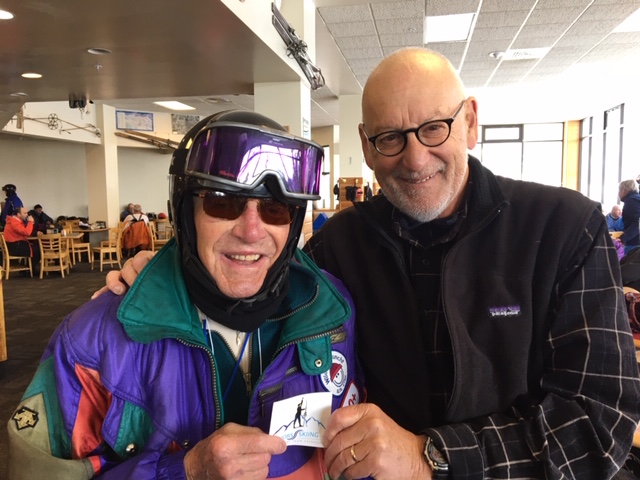
This week, I had the privilege of taking a few runs with George Jedenoff, the 103-year old Californian who enjoys skiing at Alta.
He was there with the 70+ Ski Club, one of 160 people on its annual Utah trip.
George and Jon at Alta.
I had arranged to meet Richard Lambert, the capable proprietor of the 70+ Ski Club, and learned that George would be there as well.
We were in Alf’s, the day lodge near the Supreme and Sugarloaf lifts. George entered, all smiles, shaking many hands.
We sat and chatted. I had looked at his autobiography on Amazon and knew a bit of his story. Parents fled the Russian Revolution when he was a toddler. Arriving in the US in 1923. Working as a miner in California for 50¢ an hour. Graduating with honors from Stanford University. Serving the US in WWII. Entering the steel industry, eventually rising to president of Kaiser Steel.
Quite the impressive story.
In the lodge, young and old asked to have their pictures taken with George, a symbol of skiing’s possibilities.
Frequent SeniorsSkiing.com contributor, Harriet Wallis, was there. She, Richard Lambert, and I met George and his son outside. We followed him down some Sunnyside trails. His turns were smooth and graceful. A few times, he entered chopped powder on the side of the trail for more turns.
The Alta photographer took some shots for Alta’s Photo of the Day.
George and his son had taken several runs before we met at Alf’s. Now, we were taking several more.
The sun was shining. The air was brisk. The snow was great. George didn’t want to stop skiing.
[authors_page role=contributor]