

Short Swings!
[Editor Note: SeniorsSkiing.com is asking our readers to contribute to support our online magazine. Yes, we have grown in the number of subscribers and advertisers. But our expenses have also grown. You can help us defray some of these expenses by helping us out with a donation.]
Support SeniorsSkiing.com by clicking here.
______________________________________________________
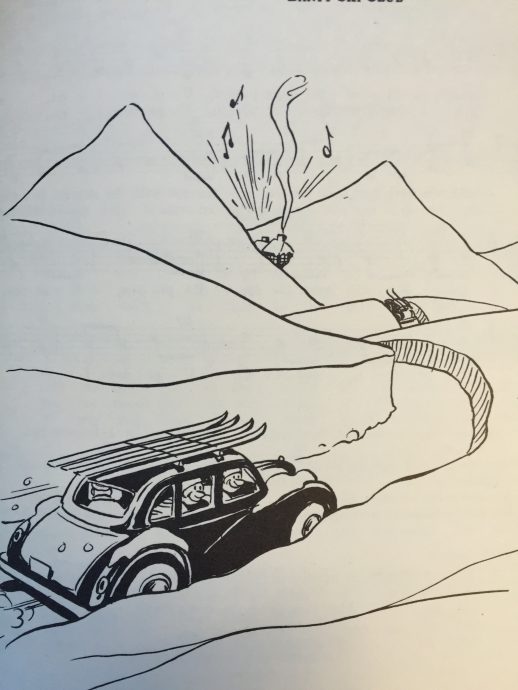
How many of you have taken a skiing road trip recently? Over the past few seasons, I’ve ridden lifts with numerous retired couples skiing their way across the continent; getting the best value from their Epic, IKON and Mountain Collective passes.
Using cars and RVs, they traverse from one resort to another, taking occasional non-ski breaks. It’s a return to the collective skiing fantasy promoted by ski magazines and filmmakers for as long as I can remember.
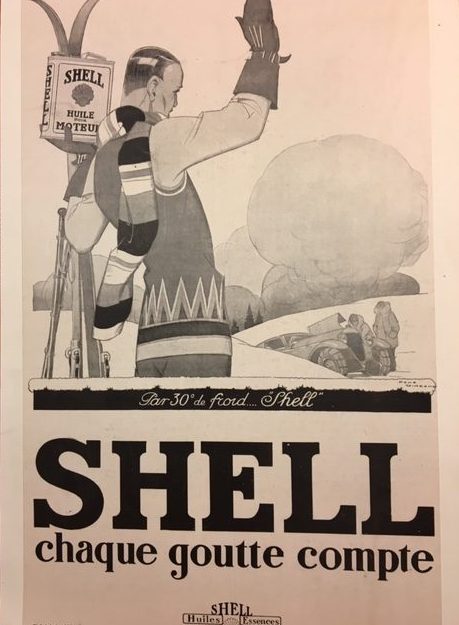 As romantic as the skiing road trip seems, moving from one place to another can be a pain. There’s packing and unpacking. Moving stuff in and out of hotel rooms and friends’ homes. Waking up in unfamiliar places, etc. etc. It gets old, especially as we get older.
There are exceptions. Last season, we toured the Dolomites on a guided ski safari. That week skiing from mountain inn to mountain inn, enjoying great food, beautiful scenery and our small group’s camaraderie made it one of our all time best skiing experiences.
But I’ve reached a point where I no longer want the hassle of moving around. I thought that renting a place in Salt Lake City for the season would do it. But that, too, requires a drive to one of the nearby areas. Because the place has become so overpopulated, Ski Utah and Ski City USA, two of the local ski promotion entities, encourage people to use public transportation to get to the resorts. At this age, I prefer to drive.
The solution, which many of you long ago discovered, is in the form of staying on or very close to the hill.
Our Vail friends have the good fortune of walking to the end of their driveway and stepping into a private community van for a short ride to the lift.
And our Deer Valley friend simply walks down his heated driveway and up his community’s heated road to reach the slope.
Talk about skiing luxury!
For those of us without homes on or near the hill, there are the hotels, lodges and inns  that are. They can be pricey at big name resorts. But some digging can produce surprising bargains.
For example, from March 6-15, Chalets Montmorency at Mont Sainte Anne in Quebec has a five-night deal for $175 (Canadian) per person, double occupancy.
Generally, exchange rates make skiing in Canada a good deal.
And, as I’ve explained in past columns, Europe has many great bargains. Click on the adjacent Inspired Italy or Alpskitour ads to get a few ideas.
Ski club trips also can be economical. 70+ Ski Club consistently offers well-priced trips with slopeside lodging. Click on its ad to learn more.
It turns out that for this aging couple, the season has had a few too many moves. And the way things are scheduled, there will be more.
I’m not sure where we’ll ski next year, but wherever we go, except for when we’re on the hill, we won’t be moving around.
RIP: Mammoth Mountain Founder, Dave McCoy,
Dave McCoy, who started and developed Mammoth Mountain in California, died February 8. He was 104. McCoy started Mammoth in 1942 and operated the resort for 68 years. When he was 22, he was the California State Skiing Champion. He skied until he was 92. Watch the video about Dave and Mammoth, produced when he was 98.
OOPS!

Last week’s appreciation of Alta neglected to make reference to the Wild Old Bunch, the group of older skiers who gather daily for lunch at the large round table in Alf’s Lodge and Wednesdays for dinner at 5:30PM at the Chuck-o-Rama in South Salt Lake’s Fashion Place Mall.
Avalanche At Alta
This week’s issue has a not-to-be-missed letter from Harriet Wallis advising her nephew to exercise more caution in the backcountry. Last week, avalanche danger and control closed Alta, Snowbird and Little Cottonwood Canyon for two days. During the shutdown, Mac Charval was able to video a slide as it tumbled across the road heading for the Alta Peruvian Lodge. My understanding is that there was no damage.
https://twitter.com/SeanDNeves/status/1226174442637672448?s=03)
Apple iWatch DOES Like Skiing, After All
Thanks for reader Steve for advising that iWatch users look under “D” for Downhill Skiing in the device’s “Workouts” function.
Bootster Booster
Jim Cobb, who invented and manufactures The Bootster ski boot shoe horn regularly receives fan mail for this clever compact device. He sent in this comment from a senior skier: Thank YOU for creating and providing the Bootster so that all of us “old and stiff” skiers (and our old and stiff boots too!) can keep getting on the snow even as time marches on. The Bootster is essential for any skier grappling with the ordeal of getting boots on. Click on the adjacent ad to learn more.
Prevent Cold Temp Phone Failure

Typically, even when my phone is in an inside pocket, it loses juice on cold days. Yesterday, at Alta, it was 21F, time to try a product I picked up at the Snow Show in Denver. It’s an air-activated warmer, similar to a disposable glove warmer. But this one has a peel-off layer that exposes a tacky surface to affix the warmer to the back of a cell phone. I stuck it onto the back of the phone’s protective case. I checked several hours later and the phone was warm and almost fully charged. It’s made by Ignik Outdoors. A 10-pack costs $19.95; 30-pack, $29.99. (Use discount code WarmSenior15 for a 15% discount exclusive to SeniorsSkiing.com readers through March.) The company also makes hand warmers. All of its disposable warmers come in resealable pouches, which, when used correctly, extend the life of each warmer.
Please Help
February is when we pass the SeniorsSkiing.com collection plate. Donation messages are posted throughout the site. When we started this labor of love six years ago, we decided to make it weekly and free. Since then it has grown substantially, forming a global community of older skiers. By the end of this season, there should be 20,000 subscribers. As we grow so do our expenses. Advertising and your donations help cover some costs. Mike and I cover the rest. For those of you who have donated, we appreciate your support. If you enjoy SeniorsSkiing.com, please click here to help.
“I Felt Like I Skied One Run, Not Eight”
[Editor Note: SeniorsSkiing.com is asking our readers to contribute to support our online magazine. Yes, we have grown in the number of subscribers and advertisers. But our expenses have also grown. You can help us defray some of these expenses by helping us out with a donation.]
Support SeniorsSkiing.com by clicking here.
______________________________________________________
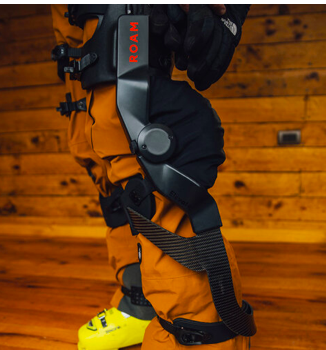
Roam Elevate is a computer-driven exoskeleton that anticipates turns and adjusts knee and quad support to aid the skier’s natural motion. It helps people ski stronger and longer by offloading up to 30% of the user’s body weight from the skier’s quads and by reducing painful knee joint compression.
Elevate can be rented at several Western ski resorts and will be available for sale next season.
To get a better understanding of how Elevate works on the hill, we asked Rick Hovey to give it a test drive.

Rick Hovey and his signature turns.
Rick is 65 and is a longtime resident of Park City. A Level II PSIA instructor, he skis 100+ days a year. Last season, despite a diagnosis of chondromaiacia patella (arthritic knees), he skied one million vertical feet.
Rick has put off recommended partial knee surgery, opting instead for Physical Therapy. He has given up teaching and reduced his time on the hill.
He tried the Roam Elevate a few weeks ago and submitted this report.
Clay, the Roam Robotics rep, showed me how to use the straps to attach the exoskeletons to my boots and then to my lower and upper legs. It was simple.
The product uses a slim backpack that contains a lightweight laptop, battery and compressor. Two connectors per side come out of the pack to attach to each exoskeleton. One connection is an air hose; the other is a connection to the computer.
While walking, the apparatus felt light and unencumbering, even if the exposed carbon fiber and wires made me feel a bit like RoboCop.
We clicked into our skis as Clay explained the available settings. The controller is mounted on the shoulder strap and easy to use with gloved hands. There are levels of assist and speed adjustments to suit your style and desired terrain. The speed adjustment sets how fast the computer tells the compressor to release the assistance pressure. In general, the idea is to quicken the speed adjustment for short radius turns or where unweighting is needed quickly.
As soon as we pushed off I lost the sense I had an exoskeleton on and that it was assisting the load on my legs. It felt completely natural and improved my sense of stability.
There is a noticeable vibration from the compressor in the pack, which Clay says to think of it as a massage for your back (bonus!). The vibration became less noticeable after one lap.
A few runs later, we played around with different settings. I really liked the high assist and slow speed setting for the easy cruisers with long radius turns. I felt stronger and forgot about protecting my arthritic knee and I experienced more complete turns with less effort. It also gave me the confidence to lay down deeper carves than I would without the device.
We then changed the settings and tried linked, short radius turns on steeper groomers. I was impressed with how well this worked with no encumbrance of the inside ski hanging-up because the pressure was released right when needed. I used this same setting on a long bump run and was equally impressed.

Roam Elevate backpack and control device
The apparatus always seemed to agree with what I was doing, while enhancing my skiing in a controlled and predictable way.
I should mention the “chop.” Rough snow was on the edges of the groomed runs, just enough to rattle the bones if going fast… this is where I would normally take the first exit to Smoothsville. The Roam Elevate seemed to absorb the bumpiness; no jarring of the knee joints or loss of control. It was like a good suspension on a mountain bike.
After numerous fun and various runs, Clay and I did a final, fast top-to-bottom cruiser. At the bottom, I told Clay my legs and knees felt like I just skied one run, not eight!
I would recommend the Roam Elevate to any skier who has knee and/or leg strength issues. And, if it helps you avoid surgery and extends your skiing life, the value could be great.
The Roam website is taking first-come, first-served reservations for a slimmed down, next generation product for $3500 (includes a 30% discount). To learn more, click on the Roam Elevate ad on the home page.
Mystery Glimpse: Water Color With Snow
[Editor Note: SeniorsSkiing.com is asking our readers to contribute to support our online magazine. Yes, we have grown in the number of subscribers and advertisers. But our expenses have also grown. You can help us defray some of these expenses by helping us out with a donation.]
Support SeniorsSkiing.com by clicking here.
______________________________________________________
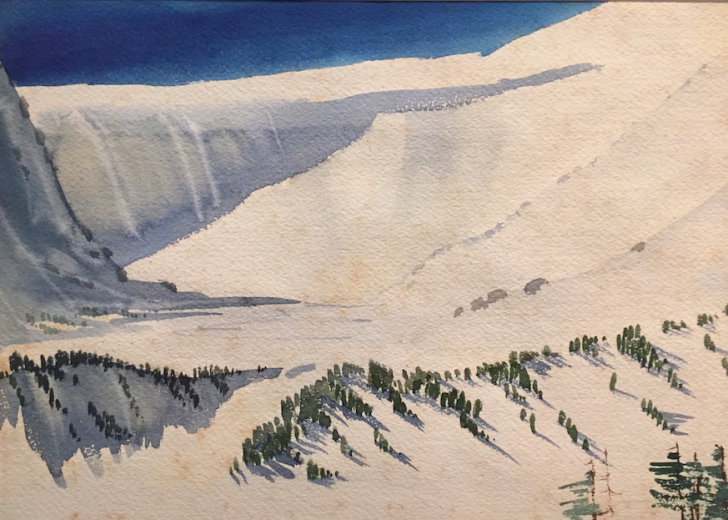
You Can Probably Guess Where, But Who’s The Artist?
Many thanks to the New England Ski Museum, North Conway Branch, and Executive Director Jeff Leich for letting SeniorsSkiing.com use this beautiful water color.
Last Week

Credit: Thad Quimby, Peak Resorts
Yes, Suzy “Chapstick” Chaffee. And the location is Fountain Mountain, Mt. Snow, VT., probably during a photo shoot.
A major skiing celebrity, Suzy is a former Olympic alpine ski racer and actress. Following her racing career, she modeled in New York with Ford Models and then became the pre-eminent freestyle ballet skier of the early 1970s. She is perhaps best known by the nickname, Suzy Chapstick, from the 1970s, when she was a spokesperson for ChapStick lip balm.
She was inducted into the National Ski Hall of Fame in 1988.
As a social activist, Chaffee championed Title IX legislation (equal opportunity for women in school sports). She was the first woman to serve on the board of the U.S. Olympic Committee, and has been a member of the President’s Council on Physical Fitness under four U.S. presidents. She was a co-founder in 1996 of the Native Voices Foundation, an organization that seeks to develop Olympians from among Native American tribe.
Suzy combined two great skills: Ballet and Skiing, becoming a key player in the free-style movement back in the 1970s. She also was a pioneer in the fitness craze, writing a book about fitness, and remaining committed to athletics and exercise long into her career.

Suzy embraced skiing and ballet to provide a foundation for freestyle.
[authors_page role=contributor]