


A Letter To A Very Stupid Nephew
[Editor Note: SeniorsSkiing.com is asking our readers to contribute to support our online magazine. Yes, we have grown in the number of subscribers and advertisers. But our expenses have also grown. You can help us defray some of these expenses by helping us out with a donation.]
Support SeniorsSkiing.com by clicking here.
______________________________________________________
Avalanches Don’t Care Who You Are; They Kill You.
Ted, you do not want to meet this on your bluebird, outback ski day. Credit: UtahOutside.com
[Author Note: I wrote this as a letter and emailed it to a college student nephew who’s experiencing his first Utah winter with lots of snow and avalanches. He thinks he’s infallible.
If you have grandkids or others who are new to snow country, you’re invited to copy and send any part of this story to them. They probably won’t get this kick in the pants anywhere else.]
Hi Ted,
The photos of your ski adventure into the backcountry are beautiful. The ski is blue, the snow is deep, and the mountain you climbed is extremely steep. You must be very proud of yourself.
And you are lucky to be alive. You acted stupidly. Avalanches do not play favorites.
Craig Gordon, a forecaster with the Utah Avalanche Center says backcountry skiers who get caught in an avalanche have already made three bad decisions before they get swept away and killed. Gordon’s examples include exactly the bad decisions you made.
- It’s a beautiful day, let’s go.
- It’s fresh snow. I want to ski it.
- We’ll be okay because my friend is going.
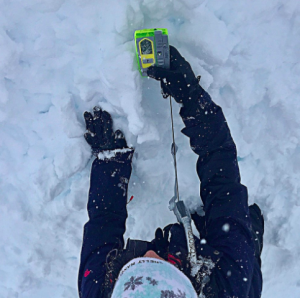
Your pal has 18 minutes to find you and dig you out. That’s it. Credit: Mountain Savvy
Furthermore, if you’d checked the avalanche forecast—the very first thing you should have done—you would have learned that many backcountry areas were closed and others were under extreme avalanche danger warning. But you went anyhow.
I know that you were dead set on getting an avalanche flotation bag that you would hope to inflate and ride out an avalanche if caught in one. But absolutely no piece of equipment can compensate for stupidity.
Perhaps you equate an avalanche with a Disney World ride. Whoopee! I’m riding down an avalanche. It’s not like that. Avalanches don’t care who you are, what your college GPA is, how much you work out in the gym, or what your life’s goals are. Avalanches kill.
An avalanche doesn’t care about Mother Nature either. Avalanches snap off trees and rip up boulders. If you’re caught in an avalanche you’re pummeled with broken tree trunks, tossed around with boulders, and thrown over cliffs and buried. The snow quickly sets like concrete. You are entombed.
If you haven’t already died from blunt force trauma, you have 18 minutes to live before you die from asphyxiation from being sealed in an airless tomb. Your buddy had better know how to use his avalanche beacon, his probe and his shovel and use them furiously fast.
There is no time for your buddy to see if his cell phone works out there in the backcountry. It won’t do any good to call 911. He has to dig you out within 18 minutes. Just 18 minutes.
Avalanche burials frequently become body recoveries.
Ski patrols work to reduce the avalanche danger in-bounds, but that does not guarantee in-bound safety. But the moment you leave the in-bounds by stepping through a gate, you are totally, completely, absolutely on your own—even if your are only 10 feet out of bounds.
You were lucky this time. You did everything wrong, but you were lucky. Pull a stupid stunt like this again, and you might be dead.
Being macho won’t save your life. Take an avalanche course. Courses include field work where you dig snow pits, learn to calculate slope angles, and learn to use your avy beacon, probe and shovel. Then practice in one of the many avy beacon “parks” at ski resorts and trailheads.
Craig Gordon also says: Time your buddy while he practices in the beacon park. If he’s slow finding the buried target beacon, he’ll be slow finding you if you’re buried—so don’t go into the backcountry with him. You need to be quick and expert with your equipment.
Practice. Practice. Practice. You can’t learn to drive a car in one lesson. You can’t be proficient with your avy equipment in one lesson. Practice. Avalanches don’t give you a second chance.

An avalanche is not an amusement park ride you can race. If you try, you will lose. Credit: KUTV
Slope Safety Reigned Supreme In Far West
[Editor Note: SeniorsSkiing.com is asking our readers to contribute to support our online magazine. Yes, we have grown in the number of subscribers and advertisers. But our expenses have also grown. You can help us defray some of these expenses by helping us out with a donation.]
Support SeniorsSkiing.com by clicking here.
______________________________________________________
During the second annual Ski California Safety Day, some 15 resorts in California and Nevada held a slew of events to promote on-slope safety.

Avy dog demos were a big hit at Sierra-at-Tahoe. Credit: SkiCalifornia
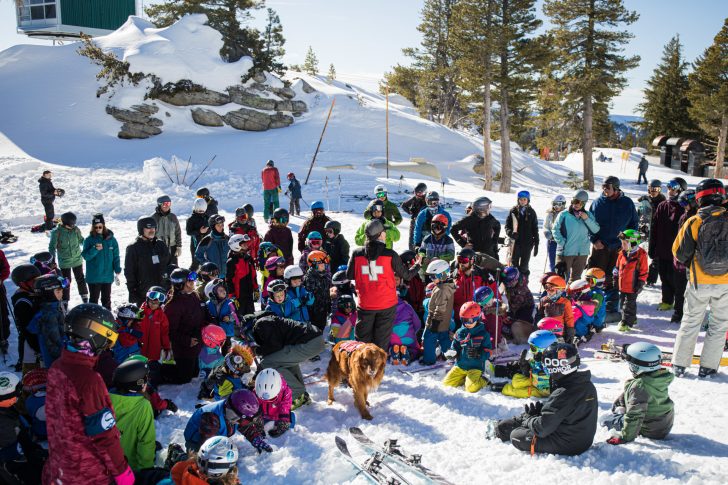
On the last Saturday in January, slope safety was in the air at more than a dozen ski resorts from the Sierra Nevada range in the north to the San Bernardino mountains in the south. The occasion was the second annual Ski California Safety Day, during which Ski California, the state’s ski industry trade organization, premiered its fourth ski safety video and participating resorts held a wide range of fun and fascinating demonstrations and events to promote safety on the slopes.
According to statistics gathered by the National Ski Area Association, the 42 fatalities reported in the US during the 2018/2019 wintersports season accounted for one fatality per one million skier/snowboarder visits; the 31 reported catastrophic injuries accounted for 0.52 such injuries per one million visits. So the odds of a skier or snowboarder being killed or seriously injured on the slopes is one or 0.5 in a million, yet that is little solace for those who were injured or for the families of those who died. Surprisingly the majority of these deaths and injuries were not the result of avalanches but rather males under the age of 30 skiing or snowboarding on intermediate terrain and having collisions with other people, trees, or stationary objects, or falls on the snow surface. So on-slope safety awareness is key to making skiing and snowboarding safer for all.
NSAA is promoting three actions for skiers/boarders to keep in the forefront of their minds when they hit the slopes: 1) Always be ready and in control so you can slow down or avoid objects at any time; 2) Always be alert to what is going on around you, from other skiers to snow conditions; and 3) Plan ahead, including looking uphill when you merge onto a larger slope from a trail, being aware of blind spots, scoping out a run slowly the first time you ski or board it, and giving other skiers/boarders a wide berth. Advice to skiers and boarders is all well and good but resorts believe that leaving safety awareness to individual skiers and boarders is not enough. There is now a concerted effort underway among California and Nevada ski resorts and the Ski California association to greatly reduce these statistics, and Ski California Safety Day is a vital part of that effort.
Resorts are going an extra step, holding events where they have captive audiences that will hear the safety messages loud and clear and retain what they hear. Says Michael Reitzell, president of Ski California since 2015, “Over seven million people ski and snowboard in California and Nevada annually. While the risk of serious injury remains extremely low, we are proactive about educating wintersports participants about the importance of safety. If we can prevent just one serious injury, our extra efforts are worth it.”
A couple of ski areas came up with quite ingenious ideas to promote safety on the slopes. Kirkwood Mountain Resort, for instance, cranked up its “Bars for Bars Down” program: anyone using a chairlift restraint bar at the proper time on the resort’s Timber Creek beginner chair was handed a candy bar when getting off the chairlift. At the top of Chair 2, ski patrollers enticed people getting off the lift with hot dogs so they’d stick around and listen to an avalanche awareness talk given by the Sierra Avalanche Center and get the chance to pet some “avy dogs.” Mammoth Mountain came up with “Know the Zone,” painting a few big circles in the snow, each with a 15-foot radius and a mannequin in the middle, beneath the Broadway Express Chair, its busiest chair, to help chairlift riders visualize the optimum distance skiers and boarders should leave between each other on the slopes.
Boreal/Woodward Tahoe hosted a “Helmets Are Cool” event during which participants could decorate their helmets with various stickers and view a “Helmets Are Cool” video. Homewood Mountain Resort also focused on helmets, offering free helmet rentals all day. The resort also had ski patrollers and instructors on hand, along with Ruckus, the avy dog, at five interactive stations at the base area during the lunch hour, talking about a wide range of safety topics.
Heavenly Mountain Resort went all out with terrain park safety clinics, avalanche dog demonstrations, avalanche beacon park and backcountry preparedness beacon hunts, various ingenious raffles, and a “Helmet Head” photo booth where folks could post on social media photos of themselves wearing helmets.
Sierra-at-Tahoe had a great turnout at its avalanche dog demonstration, during which the resort’s ski patrollers talked about avalanche danger and how the dogs are trained. This was followed by a ski patroller actually being buried in the snow and “rescued” by one of the avy dogs. The patrollers also demonstrated the various safety devices available today, from beacons and whistles to AvaLungs and airbags. Northstar California followed suit with its own avalanche/rescue dog demonstration and also emulated Kirkwood with its own “Bars for Bars Down” event on selected chairlifts .
Sugar Bowl hosted an on-slope Scavenger Hunt and a poster contest for kids aged 12 and under. Squaw Valley/Alpine Meadows set up safety booths, held a raffle, and had a meet-and-greet with the ski areas’ patrol dogs. Tahoe Donner held a few demos on slope safety, and Diamond Peak offered a behind-the-scenes tour of its Village Terrain Park that included discussion of its construction, safety, maintenance, and boarder etiquette. Mt. Rose Ski Tahoe treated its guests to an “On-mountain Safety Poker Run” and free hot chocolate or coffee for anyone who reviewed the skiers’ Responsibility Code at its welcome booth.
In the Southland, Big Bear Mountain Resort went the Hollywood producer route, hosting an on-mountain Instagram story contest, in which participants had to create an Instagram story highlighting five safety items and tagging their creations with a series of hash tags. China Peak gave visitors a chance to accompany the ski patrol on its rounds, and Snow Valley Mountain Resort offered a free lift ticket to anyone who purchased a helmet at the resort’s sports shop on the 25th.
Mike Reitzell sums it all up, saying about safety, “You can never do enough for ski resort guests. We are committed to a consistent and constant effort to increase safety awareness. The resorts are all in this together; we’re not competing with each other [in this area]. As an industry, safety is at the forefront. We ultimately want to say to skiers and boarders: Come skiing; we have the safeguards in place.”

Ski Patrollers explain safety rules to kids at Sierra-at-Tahoe Safety Day. Credit: SkiCalifornia
Reporting From the Annual OR/SIA Snow Show
[Editor Note: SeniorsSkiing.com is asking our readers to contribute to support our online magazine. Yes, we have grown in the number of subscribers and advertisers. But our expenses have also grown. You can help us defray some of these expenses by helping us out with a donation.]
Support SeniorsSkiing.com by clicking here.
______________________________________________________
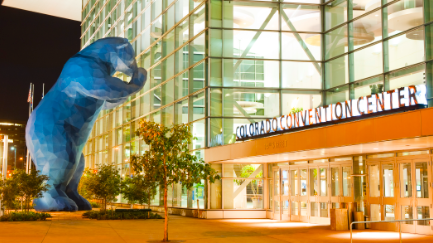
The week before last, more than a thousand manufacturers and marketers of every conceivable product related to winter outdoor sports gathered at Denver’s Colorado Convention Center for the annual OR/SIA Snow Show.
The three-day marketplace is where orders for next season’s merchandise are written.
The big name brands generally occupy large sections of real estate. Lesser known brands and products have smaller exhibits, some limited to an 8’x10’ table. For the most part, exhibits for similar products are clustered in the same areas of the exhibition hall.

One of the more innovative exhibits
Most of the attendees were under 50. The oldest person in the room was the venerable Klaus Obermeyer who turned 100 in December. Klaus is the founder of ski clothing brand, Sport Obermeyer.

Klaus and Jon and the SeniorsSkiing.com sticker
There was an abundance of swag in the form of product samples, advertising promotional items, and other tchotchkes. A long time ago, I learned that most of it is useless, and everything adds to the weight being carried.
Two relatively new categories caught my interest. One, battery-warmed gloves and garments; the other, CBD products touted to reduce pain, help sleep, boost energy, etc., etc.
Of the battery-warmed things, glove liners seemed to make good sense because they cost less and can be used with existing gloves. The downside is that each model I saw uses a relatively bulky battery pack. Of the lot, the ones from FIRedup seemed most interesting. They utilize Far Infrared (FIR) technology which heats only the surfaces it contacts. It uses less power than wire-heated technology and there are no wires to break.
Lightweight, battery-warmed layers also look like a practical way to stay toasty. Fieldsheer has been manufacturing electric clothing for years, primarily for garments for construction workers and motorcyclists. The company is now entering the outdoor recreation market with a variety of good-looking items with strategically placed heated panels.
Each afternoon, exhibitors broke out beer and bands, and the show morphed from sales to party atmosphere. I wandered into the snowboard section where the feeling was rowdier and the air more infused with cannabis.
Friday afternoon, the circus packed its tents and that part of the annual spectacle came to an end.
On Monday, a smaller version popped up at the base of Winter Park Ski Resort. This annual post-show on-snow event gives attendees the opportunity to demo skis, boots, and accessories. Several miles away, at Devil’s Thumb Ranch, a similar event catered to the cross country and snow shoe markets.
I was at Winter Park and tried several different skis. Day One started sunny and got darker and colder as it progressed. Day Two, morning temperatures hovered around -7°F. I overcame second thoughts about taking a few runs and was rewarded with a few inches of fresh snow.
The skis that left the best impression were the Head Kore 93 and the Black Crows Camox. Both have soft shovels and tails and skied beautifully on packed and in the few inches of fresh.
As I drove away, it occurred to me that, ultimately, all of the time and effort that goes into keeping the gears of the industry turning will be for naught if governments and their leaders don’t cooperate on the planet’s environmental and climate issues.
[authors_page role=contributor]