


Reporting From the Italian Alps
Italy’s Aosta Valley: Gateway to great skiing
Italy’s Aosta Valley is rich with history; even richer with places to ski. The Romans used the valley as a route to Gaul. In the intervening centuries, more than 100 castles were built. Starting in the early 1930’s, the Italians, the Swiss and the French started building ski lifts. They haven’t stopped.
The valley provides easy access to some of the world’s greatest ski resorts. At one end is Courmayer on Mont Blanc. Drive up a side canyon and you’re in Cervinia, on your way by lift and ski to Zermatt. Another short drive, and you’re at Monterosa.
We’re in centrally located Saint Vincent, a scenic and charming walking town, where every day we journey through scenic alpine villages to a different resort.

Centrally located Saint Vincent
It’s only the second week of March, and Saint Vincent is beginning to bloom. We’re staying in the aptly named Hotel Bijou, a gem of a hotel overlooking the town’s central plaza. The main street is lined with colorful three and four story buildings housing attractive stores and restaurants specializing in Aosta’s regional cuisine. Just a few blocks in either direction are an elaborate mineral bath complex reached by funicular and a sizeable casino.
After a full day of skiing, we don’t have energy for either.
We’re here with the owners of Alpskitour, a local guide service and SeniorsSkiing.com advertiser. Mauro Cevolo has taught and coached skiing in Italy, Austria, France, New Zealand and the US (Mammoth). Andrea Jory teaches mostly at Cervinia and Champoluc. He was on Italy’s national bobsled team and competed in the 1980 Lake Placid Olympics. Both are magnificent skiers and highly enjoyable companions. They’re intimately familiar with the many resorts in and around the Aosta Valley, including the best places to ski and where to stop for a gourmet lunch in an authentic surrounding.
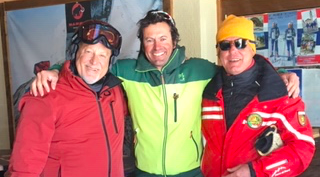
The author with world speed ski champ, Simone Origone and Andrea Jory, Alpskitour
Wherever you go with them they’re warmly greeted. At lunch the other day, they bumped into Simone Origone who for 12+ years held the record for the world’s fastest man on skis (about 157 mph!).
An important benefit of staying in Saint Vincent over one of the resorts is the ability to decide, last minute, where to ski. The other day, when high winds had forced many of the resorts to shut down, we drove to the city of Aosta, boarded a gondola and climbed the mountain into magnificent mid-winter conditions at the Pila resort. Accustomed to Rocky Mountain resorts, Pila was a big surprise…emphasis on big. But it is small, relative to where we’d be going over the coming days.

La Thuile in Aosta Valley
The next day we drove past high-perched castles, ancient stone villages, and up a series of hairpin turns to reach Espace San Bernardo. We started at La Thuile, and after a gondola and a chair entered a landscape of endless peaks and glaciers. Following several long runs and more lifts, we crossed into France and descended to La Rosiere, another sizeable resort. After a few hours of skiing, we rode two long Pomas, crossed back into Italy and skied to Maison Carrel, where we lunched on regional cuisine in a modernized 19thCentury stone barn. I had cabbage soup topped with a thick layer of Fontina cheese, one of many Aosta Valley products exported across the globe.
Combined, La Thuile and La Rosiere have 39 lifts servicing something like 7800 acres of terrain, mid-sized for the Alps. Nonetheless, it’s size is slightly less than Whistler Blackcomb, North America’s largest.

Monterosa’s Champoluc-Frachey
The story gets better. Yesterday we drove to Monterosa’s Champoluc-Frachey and skied two of its three massive valleys. We started on a super-steep, rail funicular and throughout the day used cable cars, gondolas, and a variety of open and bubble chairlifts. This place is humongous. Looking up into remote snow fields were tiny specks skiing gondola-accessed backcountry. We stayed on trail, at one point dropping down a long and steep sun-drenched trail…my kind of skiing.
The West won this season’s snow lottery. Last year, that prize went to the Alps. Coverage is adequate at the moment and skiing is a lot of fun. If it were deep powder, I’d be able to enjoy a handful of runs before calling it a day. We’re probably skiing 15,000 – 20,000 vertical.
Today is a self-imposed rest day. We’ll visit some of Saint Vincent’s treasures and drive into the city of Aosta to see its Roman ruins. Tomorrow we’ll be back on another mountain. Which one is a decision Mauro and Andrea will make in the morning. One thing I know: it will be big, beautiful, and interesting. That’s what defines skiing in and around the Aosta Valley.
More on this fantastic ski experience next week.
Ski For Light: A Blind Skier’s Experience
Part 1: The Skier
[Editor Note: We met Chris Leghorn in a local North Shore community acoustic music jam. She sang and played her Martin HD 28 with both gusto and gentleness, depending on the song. In talking with her, we learned she had taken part in 19 Ski For Light events since 2001 as a cross country skier. She started going to Ski For Light just as she was starting to experience adult onset blindness. Her story is inspirational and certainly worth hearing. In Part 1, we will tell Chris’ story; in Part 2, we will hear from a volunteer guide. We interviewed Chris after she returned from the Ski For Light 2019 gathering which took place this year in Granby, CO.]
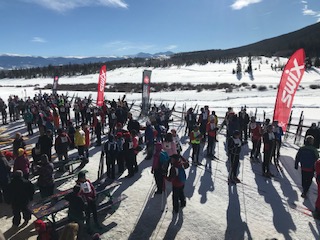
Ski For Light is an all-volunteer, non-profit organization founded in the US in 1975 and modeled after the Norwegian Ridderrenn, a program that teaches blind, visually-, and mobility impaired people to cross-country ski. Each year, the US-based organization holds a week-long cross-country event at a different host resort. About 240-280 people attend, 100 or so blind or visually-impaired, another 12-15 mobility impaired, and the rest volunteer guides and organizers, some of whom travel from Norway, the UK, China, and even Barbados for the event. Many of the attendees return to SFL year after year. Aside from coming to learn or just enjoy cross-country skiing and to grow in independence, the SFL gives blind or mobility-challenged attendees a chance to not think much about being disabled for the week. They are just another participant at the event. The motto of SFL is “If I can do this, I can do anything” describes the attitude that drives the organization’s mission.

Chris with her guide at Ski For Light. Credit: Pam Owen
SeniorsSkiing.com: Chris, how did you get involved with Ski For Light?
Chris: I had heard of Ski For Light in 2001 when my eyesight was getting worse. I read some inspiring articles about the event that motivated me to try it out. I knew I needed to find a way to do things I loved with assistance. So, I went to my first SFL that year when I still had some vision.
SeniorsSkiing.com: What attracted you to SFL?
Chris: To my knowledge, SFL is the only event of its kind in the US. Many Alpine ski resorts have programs for blind skiers, but SFL is unique in what it offers. The program was imported to the US from Norway where the Ridderrenn provided an opportunity for blind people to enjoy the winter. [Note: The Ridderrenn or “Knight’s Race” was started in 1964 by Erling Stordahl, who is blind, when he found he could ski with confidence in the tracks of army trucks without being afraid of bumping into anything. That basic idea formed a framework for Ski For Light.]
I had skied in my college years and had lived on a farm where there was a lot of opportunity to be on skis and outdoors in the winter. But, before SFL, I hadn’t skied in 25 years. I was always athletic and loved the outdoors, and I needed to find a way to do activities in a different way. I still am very active, despite my blindness. I also do long-distance cycling, hiking, and kayaking. I have completed three Blackburn Challenges in my double sea kayak. I am always looking for people to participate in these activities with me. [Note: The Blackburn Challenge is a 20-plus mile, arduous ocean rowing race around Cape Ann, MA.]
SeniorsSkiing.com: What is it like to ski with a guide?

Chris and Guide placed in end-of-week race. Credit: Pam Owen
Chris: It is awesome. We are paired with a guide for the whole week. New guides are given some training before the event. Everyone learns a common language to use like “half-track right”, “tips left”, and things like that. But we also talk about how we like certain directions. For example, if we are turning, does the skier prefer degrees or hands of a clock for reference. Or does the skier want constant feedback or just some communication before a big turn or terrain change. I like to rank hills according to steepness from 1-5 and also length from short to long, i.e., a “long three”. This communication helps me accurately determine what’s ahead.
The skier and the guide ski side-by-side in parallel tracks about four to six feet apart. Some skiers, however. prefer the guide to be ahead of them, others behind. Again, it’s a preference you have to work out together. Once you work out the communications, it’s a matter of just heading out and doing it.
Every year, I try to express the depth of my gratitude to my guides for giving so much of themselves so that I can have a beautiful week of feeling free on the snow. Their response to my gratitude is always, “We are the winners here.”

Skiers and Guide ski in parallel tracks. Credit: Pam Owen
SeniorsSkiing.com: What have you learned about yourself through SFL?
Chris: I’ve learned that I take my attitude about my blindness too seriously, or rather my fear of how I am being judged about my blindness. There are many amazing sight-impaired people at SFL, and, in their presence, I have learned to be more relaxed about who I am as a person with failing eye sight. There is an incredible spirit of positivity that words can’t explain at Ski For Light.
When I am cross-country skiing beside my guide, I feel so free because I am not attached to my [guide] dog or holding onto someone’s arm. It’s a freedom I don’t feel much anymore, and it’s very special.

Mystery Glimpse: 1964 Racer
Who Do We Have In The Tucked Position?
Lots of clues here. Who’s in the speed suit?
Thanks again to the Tread of Pioneers Museum, Steamboat Springs, CO, for contributing this picture from its archives.
Last Week
 If you recall, Brodie Mt was nicknamed “The Irish Alps”, because on St. Paddy’s Day it was definitely the place for skiers to be. It was also the domain of a creative, ingenious, leprechaun-like operator who invented a why-didn’t-I-think-of-that machine.
This is the famous ice grinder designed and manufactured by Brodie Mt.’s Jim Kelly in 1970. The Ashford, MA ski area operator was a true entrepreneur, inventor, and eternal optimist. When the winter delivered scarce snowfalls that turned whatever hard pack was left to block solid ice, Jim Brodie figured out a way to keep people skiing. It was simple: Grind it. That resulted, said Brodie at the time, in what was good enough to call “powder”. We have a feeling there was a bit of the Blarney stone stuck out there in the Berkshires.

Jim Kelly with a working Hard Pak Pulverizer which made “powder” from ice, according to him.
Brodie built what he called a Hard Pak Pulverizer, based on a debarking machine used at this dad’s lumber company. The heart of the concept was a rotating cyclinder with projecting metal teeth. After several failures over three years of experiments, Kelly found that a 100-horsepower Deutz diesel could handle the torque needed to make the cylinder turn hard pack ice into a skiable surface.
Ever the inventor, Kelly even came up with a home-grown snowmaking idea. When it was really cold, his crew would shoot water on the slopes, wait for it to cool, and give it the once over with the pulverizer.
Jim Kelly marketed the Hard Pak Pulverizer to other ski resorts. Ed Herte, the then owner-operator of Little Switzerland, Slinger, WI, bought one of Kelly’s devices. His assessment: “The snow the machine makes is better than the best man-made snow I’ve ever seen.” Has someone else been kissing that magical stone?
Jim Kelly’s story of the Hard Pak Pulverizer was first reported in Skiing Area News, Winter, 1970.
[authors_page role=contributor]