

At Great Glen Trails, Nordic Skiing and Activities for Everyone
New NH Cross-Country Resort Offers Winter Sports Alternatives.
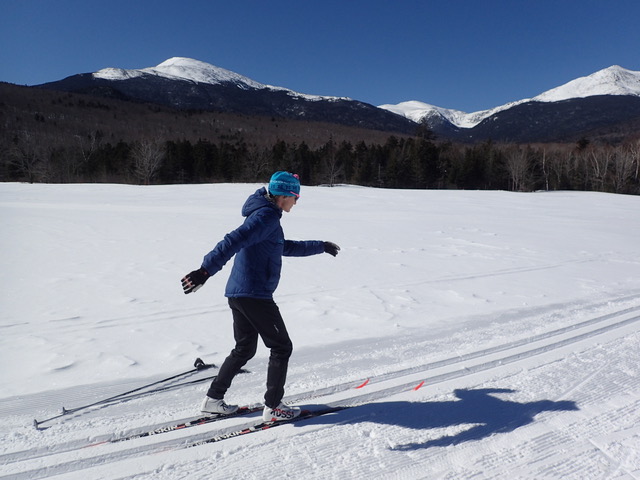
Olympian Sue Long Wymess demonstrates “Gorilla Arms” technique at Great Glens Trails. Credit: Tamsin Venn
Great Glen Trails Outdoor Center just past Wildcat on Route 16 in New Hampshire, sits at the base of the towering Mt. Washington. At 1,600 feet in an area known as the Glen, the snow is plentiful, and the managers cut Nordic trails to perfection daily for both classic and skate.
Cruise around a 45-km network of groomed and backcountry trails. Most trails are double tracked, for two-way traffic.
“Great Glen has some of the finest designed trails for cross country skiing in the world. The late John Frado is famous for designing them for quality and whimsy that the Great Glen trails beautifully convey,” says Roger Lohr, SeniorsSkiing.com cross-country editor and publisher of XCSkiResorts.com.
“The Meister program at Great Glen may be the most successful in the country with a fat bike component, too,” he adds of the weekly locals’ race series.
Learn from the best. Ski School Director Sue Long Wemyss, a U.S. Ski Team member from 1983-86, competed in all four of the XC races in the 1984 Olympics in Sarajevo. She offers a lesson package of three one-hour private lessons.
Heads up. Nordic equipment has changed radically in the past decade. You can rent or buy skis that are waxable, waxless, or skinned. A new adjustable binding system lets you move your weight forward or backward with the turn of a dial. The new skin skis are much faster than the old mohairs (“slohairs”). Music to our ears: “You can enjoy skiing more with the new gear,” says Great Glen XC shop director Nate Harvey.

A scavenger hunt for grandkids will keep them searching for forest friends. Credit: Tamsin Venn
Take the grandkids out on the green trails and let them spot all their furry friends at animal cartoon stations. Punch all the holes on the map and they earn an official Trails Tracker button.
Come and stay awhile trailside. Just opened in September, The Glen House is the fifth hotel on this site (four others burned down). It’s an airy building that manages to be both rustic and sleek. Thanks to the efforts of Great Glen Trails General Manager Howie Wemyss (Sue’s husband), the hotel uses state-of-the art green technology to harness geothermal for heating and cooling and eventually solar and hydro. Half the hotel’s 68 rooms have balconies facing the Northern Presidential mountains and the Carter Moriah range. The Notch Grille and indoor heated saltwater make après ski relaxing. In the great room, two story windows face the peaks of Mt. Washington, Jefferson, Adams, and Madison, and Architectural Digest recently named it “The Most Beautiful Bar in New Hampshire.”
Great Glen is a good spot to try a new activity or for everyone in the family to enjoy themselves. Choose fat biking, snowshoeing, tubing, or taking the SnowCoach up Mt. Washington to timberline into an Arctic winter wonderland. Ski and stay packages are reasonable. Summer brings a whole other basket of activities.

The Glen House hotel has a truly beautiful bar with dramatic artwork. Credit Tamsin Venn
Nordic Rates: Season Pass Seniors $100 (62 Plus), $75 if bought by Dec. 1. Day pass Senior (62 Plus) $12. Two for 1 Mondays and Fridays (non holidays).

Trails are groomed to perfection at Great Glen. Credit: Tamsin Venn

My Knee Replacement Story
Conditioning Makes A Huge Difference To This Skier’s Post-Op Experience.
A lifetime of abusing my body never really bothered me until it did. Coming down a blue trail five miles long at Park City, UT, one of my all time favorites because of the killer views, suddenly posed a problem.
My knees were killing me. The pain traveled into my hips and the last three miles of the slope seemed to be as long as a trip around the world. It was never going to end. My knees seemed to be grinding into each other.
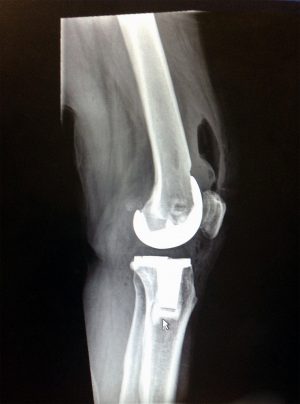
What a new knee looks like when it is all over. Credit: Bob Nesoff
At the base, the skis came off, and I used them as crutches on the way to the lodge. With some help, I made it back to our accommodations and iced my knees. Walking they felt as though the bones were rubbing against each other. Fortunately, this was the last day of the trip, and before the flight home, I called and made an appointment with my orthopedist.
The day after arriving home, he x-rayed my knees and, as I feared, was told my ski season was over. The bones in the joint were actually rubbing against each other and the only realistic course of action was a replacement. The question then became one knee or both at the same time.
The skier’s mind went to work. I’m 80 years old and not getting any younger. The surgery won’t be any easier when I’m 81 and why do one at a time and then have to come back and rehab all over again.
With a recommendation from my doctor, I made an appointment with Dr. Gregg Klein of the Hartzband Center for Hip & Knee Replacement, Paramus, NJ. Doing due diligence, I looked them up and found out that they arguably do more knees and hips than any other medical facility in the country. That gave me some comfort.
Meeting Dr, Klein for the first time I was pleasantly surprised to learn that he too was a skier and was able to not only answer my questions, but had an understanding of my special desire with regard to skiing.
“Age is not a problem in knee replacement surgery,” Dr. Klein said. As long as the candidate is in relatively good health, there is no adverse problem.
“However,” he said with a smile on his face, “you won’t be doing moguls any more. You’ll be able to ski more comfortably, but stay away from high impact slopes.”
Physical conditioning is one of the most important factors both prior to and following the surgery. Dr. Klein prescribed six weeks of physical therapy, three times weekly, both prior to and following the operation. I added another two days of workout at my home gym. That, I was told later, made the operation and recovery go faster.
Three hours after the surgery I was up, standing and walking. No great distance, but there was far less pain that I anticipated. That, according to the nurses was due to my pre-op workout regimen.
After only two nights in the hospital, I was released and the following week a therapist visited daily for two weeks. He called my recovery “absolutely amazing,” again due to the workout I had done before surgery.
The two weeks at home were followed up by six weeks of outpatient physical therapy three times a week. Here I threatened the life of my therapist when he bent my legs into positions God never intended them to go.
Less than three weeks following surgery, I was walking without a walker. For jaunts outside of the house I used a cane but was able to walk comfortably without one at home. Another couple of weeks and things returned to normal.
There is some debate as to whether holding the prosthesis in place with special cement or using one that adheres to the bone is better for sports such as skiing. The cement holds and heals more quickly. Waiting for the bone to adhere to the replacement will take longer. The opinion appears to be that one is not better than the other.
“If you are a good skier and enjoy the sport,” Dr. Klein commented, “keep on doing it.”
There are a couple of long scars on my knees but they’ll fade with time. I won’t be doing moguls or extreme blacks, but I don’t care. I’m working out on a regular basis and by the time of the first decent snowfall in the fall of 2019, I’ll be waxing my boards and heading for the hills. As a prelude to the ski season, I’m also planning on making a parachute jump this summer. Hey, George H.W. Bush ain’t the only one who can do that kind of stuff.
Snow In Literature: The Winter’s Spring
By John Clare (1793-1864)
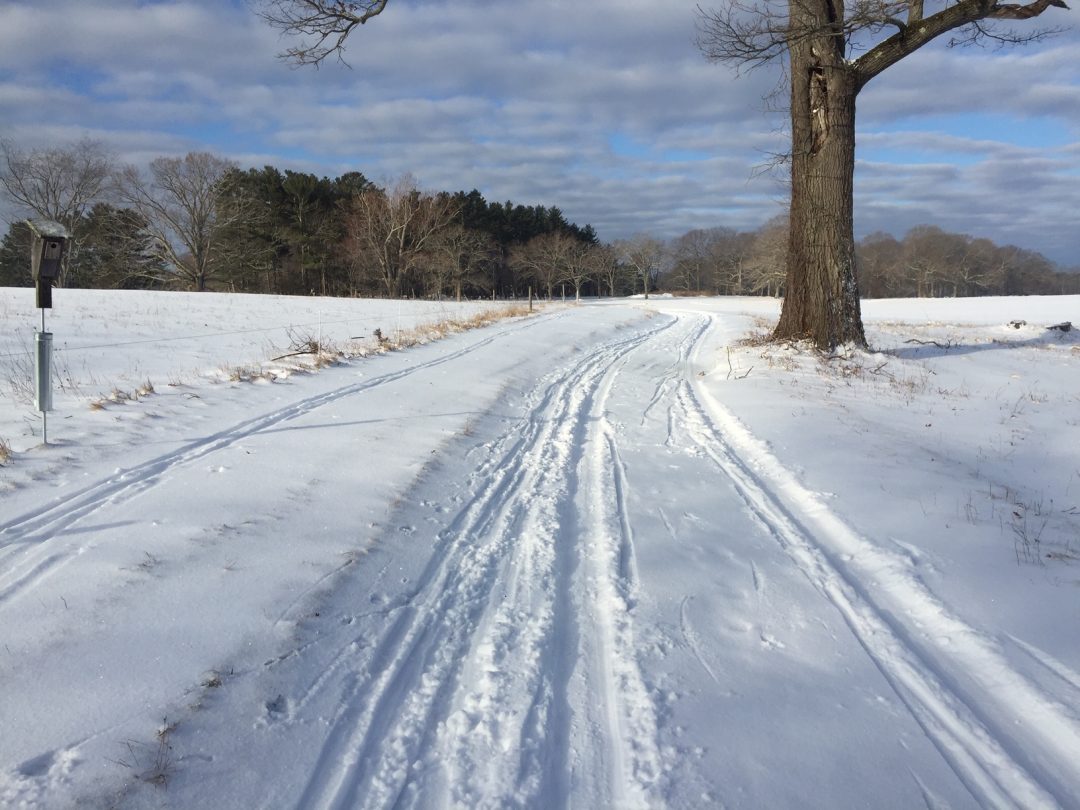
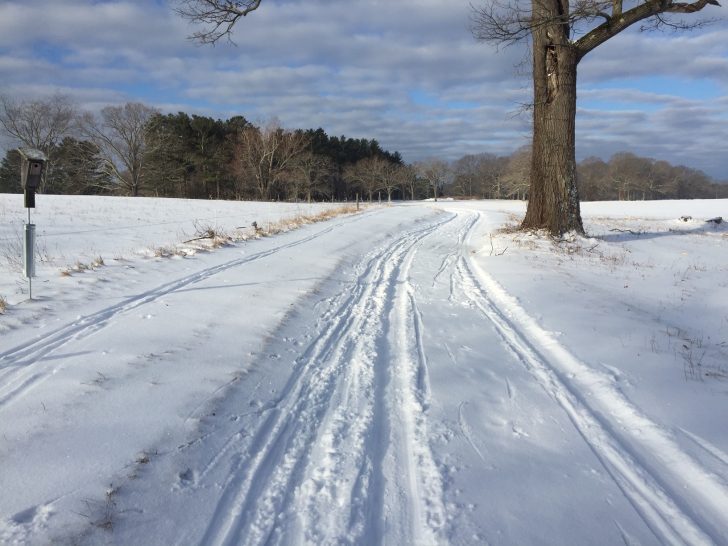
Appleton Farms, Ipswich/Hamilton, MA. Credit: Mike Maginn
The winter comes; I walk alone,
I want no bird to sing;
Tho those who keep their hearts their own
The winter is the spring.
No flowers to please—no bees to hum—
The coming spring’s already come.
I never want the Christmas rose
To come before its time;
The season, each as God bestows,
Are simple and sublime.
I love to see the snowstorm hing’
‘Tis but the winter garb of spring,
I never want the grass to bloom:
The snowstorms’ best in white.
I love to see the tempest come
And love its piercing light.
The dazzled eyes that love to cling
O’er snow-white meadows sees this spring.
I love the snow, the crumpling snow
That hands on everything,
It covers everything below
Like white dove’s drooding wind,
A landscape to the aching sight,
A vast expanse of dazzling light.
It is the foliage of the woods
That winters bring—the dress,
White Easter of the year in bud,
That makes the winter Spring.
The frost and snow his posies bring,
Nature’s white spurts of the spring.

Appleton Farms, Ipswich/Hamilton, MA. Credit: Mike Maginn
[authors_page role=contributor]