


Mystery Glimpse: Erin Go Grind
Read The Hints, Connect The Dots.
Boiler plate, locally manufactured, Happy St. Patrick’s Day, Irish-tinged ski area. Got it? What is this? Who invented it?
Last Week
 This is the famous Al Johnson, ski legend of the Rockies. According to the Colorado Snowsports Museum, which contributed this picture, Al was a superb skier before he came to Crystal, CO, from Canada in 1880 to prospect for silver. He became the legendary skier of the “Snowshoe Express.” He was Crystal’s first postmaster and carried the weekly mail and supplies between the mining communities of Crystal and Crested Butte on eleven foot long skis. His mail run was a dangerous trek through the narrow Crystal Canyon. During his twenty year career, he became a living legend. He was involved in starting a series of races between the miners in 1886, the “first one down buys cigars and oysters” for the other competitors. Just think, Al Johnson, a postman, store owner, outdoorsman, inaugurated the first ever ski races in the Rockies. That was a lot of races ago.
Thanks to the Colorado Snowsports Museum for this great picture. Check out the Museum’s collection by clicking here.
And for more on Al Johnson, click here for a story from the Aspen Times.

Ask An Expert: Knee Replacement
Advice From An Orthopedic Physician.
 A reader asks:
I need a knee replacement. Is there one implant (Zimmer, Depuy, Stryker, etc.) that is better for returning to skiing?
Here’s the reply from Dr. Peter Schmaus, Orthopedic Spine and Sports, Paramus, NJ:
Have a question about technique, gear, destinations, travel, or any other aspect of winter sports? Send it to mike@seniorsskiing.com, and we’ll do our best to find an expert to respond.

Sometimes Our Bodies Need Help
There are times when we can benefit from some extra help, especially as we age or develop chronic medical conditions.
Nick Manley, a remarkable athlete with a degenerative neurological condition, swears by the Ski-Mojo knee bracing system. The product’s shock absorbing springs reduce the load on his knees, allowing him to continue to race and ski for the entire day without tiring.
I haven’t used it, but I have talked with Nick and at least a dozen other older skiers who tell me that it has made a profound difference in their skiing experiences. Ski-Mojo also helps maintain correct posture while skiing and makes it easier to ski longer.
If you feel you could benefit from some assistance, my strong suggestion is to visit Ski-Mojo’s site.
Now, on a limited basis, there’s another innovative approach to helping your knees. I wrote briefly about it a few months ago, when the company started advertising. The product, being developed by Roam Robotics, is called Elevate. It is a computer-influenced soft exoskeleton that utilizes pneumatics to assist movement in your legs and knees.
It may sound sci-fi, but it’s for real. Starting March 9, the company is making Elevate available on a unique demo basis in three locations: two in Lake Tahoe; one in Park City.
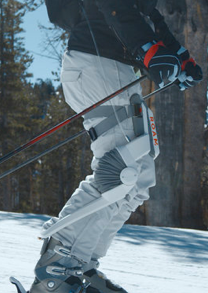
Rent the device, and Roam will arrange for one of its trained ski hosts to accompany you for a few runs or for the entire day, based on your preference. If you’re staying within a certain radius of their facilities, the company will deliver the device to you the night before and provide enough orientation so you’ll be good to go the next morning when you meet your ski host on the hill.
If this sounds a little protective, it is. As a product, Elevate is ready for prime time, but the concept is so new that the company wants to provide hands-on education about its use. It also wants to collect information about customers’ experience to improve future versions. All of this is to assure a smooth roll-out when it ramps up production and makes Elevate available more broadly in seasons to come.
The cost for a one-day demo is $109, which includes drop-off and ski host services. If you are in the Tahoe or Park City neighborhoods and want to try an entirely different approach to protecting your knees and getting more out of your ski day, this is your opportunity. To reserve a demo, click here.
[authors_page role=contributor]