

This Week In SeniorsSkiing.com (Feb. 22)
Thank You So Much for your supporting SeniorsSkiing.com. Your response has been gratifying. If you haven’t sent a donation, please help us defray expenses. There are different premiums for different contribution levels. Please click here to make a donation.
Senioritis, RV and Ski, Flat Light Blues, Mystery Jump II, More Gratitude

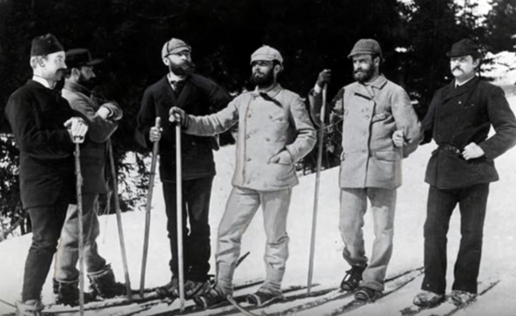
Not us.
When we started SeniorsSkiing.com, we struggled with what to call this senior-focused online magazine for snow sport enthusiasts. Geezer Ski Gazette, Elder Skier, Flyin’ Old Folks, Boomer Bombers didn’t pass the silliness test. We settled on SeniorsSkiing.com and almost immediately got feedback from readers who said they didn’t consider themselves “senior.” To them, a senior was someone like your grand daddy, but not you. Don’t call me a senior! Our Boomer subscriber base, it seemed, had Senioritis.
Clearly, our readership is defined by their engagement with activity: skiing, snowshoeing, even biking in winter, and all kinds of sports from kayaking, sailing, hiking to fishing, tennis, and even fox-hunting in non-snow months. It’s not about, or maybe in spite of, age. We still rock to and even play the “good” music of the “old” days, participate on teams, raise goats, make pots, paint, volunteer. No rust on us.
This week, the Boston Globe published a story about the disconnect between the self-image of today’s “seniors” and community senior centers,senior associations, and senior non-profits which are struggling to attract members or customers. What caught our eye, was a comment made by SeniorsSkiing.com reader, Jack Murray, 70. When asked by friends to join them at the local senior center in town, he said, “No interest.” Jack spends his time skiing when he can in Bretton Woods, NH. Other interviewees said when they think of senior groups, they think of old people. Joining them is not an option.
Here’s the point. These various senior-focused organizations realize they have to treat today’s 60+ crowd differently than before. Out with the bingo, in with kick boxing and poetry slams at the Senior Center. And serious book clubs, exercise programs, and yoga. “We have to refresh ourselves to bring in new talent and energy,” said one director of a senior program in Boston.
Now, shouldn’t management of ski resorts, manufacturers of equipment, travel companies, and other stakeholders in the winter sports business be “refreshing themselves,” too, to better serve a changed senior population? Remember, there are more of us every day, and we aren’t going away.
Alpine Ski History Video
Here’s a kind of okay video about Alpine ski history. Kind of okay because some of the narration doesn’t quite fit the image on the screen, but it is interesting. Worth a look.
https://www.youtube.com/watch?v=NzOJeFbAJKI&fbclid=IwAR1jLDb8TwwVX4ADS72Vu7cBIQ0s4L5ZtHkQbtLS8PlvchHJTc6Gy20Eows&app=desktop
This Week
Correspondent Marc Liebman offers some advice on coping with the flat light blues. We know from personal experience that flat light conditions can cause the day to end after a couple of runs. Marc mentions some techie googles and other tips. What works for you? Heading back to your car? Gingerly working each trail? Sticking to a single run?

If you RV, chances are you won’t be alone. Credit: Practical Motorhome
When you were younger, you may have thought living in a trailer in a ski resort parking lot was not only cool, but also economical. After all Warren Miller started his snow career as a ski bum gypsy in a tiny trailer. This week, we offer some basic thoughts about how you can RV your way from resort to resort, perhaps a little more comfortably than you did in the 70s or 80s. Thanks to this contribution from Bill Widmer who has an RV podcast worth checking out.
Our Mystery Glimpse picture this week is another ski jump. Last week’s was identified by some very savvy readers who nailed it as the Big Nansen jump in Berlin, NH, built in the late 30s.
Finally, Roger Lohr, publisher of XCSkiResorts.com and SeniorsSkiing.com cross-country editor, offers a book review of Snowboarding In Southern Vermont, From Burton To US Open by Brian Knight. From his report, those were pretty wild days.
Thanks again for reading SeniorsSkiing.com. Please tell your friends, and remember, there are more of us every day and we aren’t going away.

Sarah Hendrickson’s jump from a restored Big Nansen in 2017. Credit: Red Bull

Short Swings!
Many thanks to each of you who has generously responded to SeniorsSkiing.com’s fund raising campaign. We soon will be sending out decals, patches and hats. The campaign will run through February.
The Things We Carry
What do we really need for a week or two on the hill? Answers will vary depending on whether we’re flying, driving, or returning to a mountain home. Other factors are weather and whether or not skiing will be just one part of the journey.
Some of you may be familiar with Marie Kondo, whose organizing principles are presented in the new Netflix reality TV series, “Tidying Up With Marie Kondo.” Her process involves piling everthing in one spot, sorting though, and keeping only those things that “spark joy.”

Let me admit something my wife has been telling me for years: Some things I find hard to toss. Recently, I cleaned out my boot bag. You may ask, why even bother with a boot bag? It’s an important way to keep boots and accessories organized. I found a lot of old, expired, unnecessary stuff in there. One balaclava is enough. I got rid of two. Disposable hand warmers are always handy, but several were years past their due dates. Then the miscellaneous lip coatings, expired sunscreens, etc. I have a separate bag for powder cords, and over the years have assembled quite the collection of those colorful ribbons, not because I needed more, but because they were at home when I needed them at the mountain. The boot bag now has a single set. It no longer has dried-up contact lenses; ancient pain killers, old area maps, expired passes, multiple goggle defogging products, etc. etc. My boot bag now sparks joy.

I also have a large, rolling duffle with many zippered compartments, including a full-length “basement.” The monster is large enough to hold multiple parkas, ski pants, more layers than a Bermuda onion, socks, shirts…wardrobes for most skiing scenarios, après ski scenarios, receptions with royals, and a quick trip to the beach. The operative word here is “rolling,” and that’s helped by both a soft handle and a hard one that extends from the frame.
As I prepare for an upcoming, extended journey in the Alps and in big and small cities, that bag, intelligently packed and organized, will be a godsend.
Another confession: Since I don’t have the mental discipline to anticipate every possible travel scenario, I limit travel and ski garb to combinations of black and gray. Truth be told, that pretty much defines my wardrobe, in general.
Everything else – laptop, chargers, spare glasses, things to read, meds, and toiletries – go into a backpack that stays with me on plane, train and automobile. Everything, except for credit cards and cash; I’ll need those to purchase the things I forgot to pack.
West Coast Snow Report: DEEEEEEEEEEEP!!!!
Well Worth Reading
Jackson Hogen, publisher of Realskiers.com (SeniorsSkiing.com subscribers can subscribe to Realskiers.com for $9.99) sends out weekly short essays about different aspects of the sport. His current piece, titled, “To Ski Better in All Terrain, Tweak Your Tactics,” offers sound advice on making small adjustments that render big results. Click here to read.
The One-Off Tesla Ski
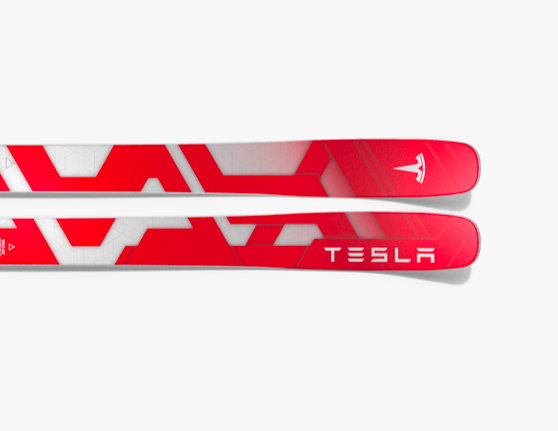
Renoun is an award-winning maker of high-end skis. Among other innovations, it uses HDT, a putty-like material that causes skis to feel stiffer as they go faster. The Burlington (VT) company says the HDT makes them ski smoothly and with greater control. Renoun recently sent Elon Musk a custom pair sporting the Tesla logo. “The guy is a badass. He deserves badass skis,” said Renoun CEO, Cyrus Schenck.
March 2 Mont Tremblant Fund Raiser
Skiers young and old are invited to join the 6th Legends Classic, a giant slalom fundraiser where participants rub shoulders with Tremblant’s mountain legends while supporting the Canadian Hall of Fame and the Canadian Ski Museum. Racers are eligible to win prizes, and spectators and racers are welcome to compete in the Vintage Skiwear Contest held during the Awards ceremony.
Fun Vintage Cartoon
Walt Disney’s “The Art of Skiing,” features Goofy learning to ski. Produced in 1941, and seen by millions, this 90 second excerpt will bring a smile. Click here to view.

Book Review: Boarding Southern Vermont
[Editor Note: SeniorsSkiing.com is again asking our readers to contribute to support our online magazine. Yes, we have grown in the number of subscribers and advertisers. But our expenses have also grown. You can help us defray some of these expenses by helping us out with a donation. This year, we have a mix of premiums for different level of donations, including stickers, sew-on patches, our new SeniorsSkiing.com ball cap. All donors will be entered into a drawing for a pair of bamboo Polar Poles to be drawn in late March. You can donate by clicking here.]
How Did A Then-Revolutionary Sport Become Mainstream? Hint: Epic Parties.
[Editor Note: Roger Lohr is the publisher of XCSkiResorts.com and SeniorsSkiing.com’s cross-country editor.]
 The book Snowboarding in Southern Vermont: From Burton to the U.S. Open” by Brian Knight on History Press is a snapshot of the 1980s and 1990s during the early days of snowboard lore. The book is a fine encapsulation of snowboard history with an amazing collection of photos of those early days at the region’s ski areas Stratton, Bromley, Magic Mountain, and Snow Valley.
The book traces Jake Burton Carpenter’s life through Londonderry, Manchester, and Stratton Mountain, VT, as he became the proprietor of Burton Snowboards. He shared the spotlight with Donna Carpenter, a woman he met whom he eventually married. She is cited in the book for “heavy lifting” in the early development of Burton Snowboards which was to become a significant force in the sport. Jake’s infectious enthusiasm and the lengths he went through to get Burton Snowboard started required visionary decision-making and resulted in a very influential company in the snowsports world.
There are hundreds of names that are weaved into the Southern Vermont story such as Paul Johnston the Stratton mountain manager, who had an open mind about snowboarding in the beginning; Lyle Blaisdell, the backhoe operator with the half pipe-carving Midas touch; and other snowboard dignitaries such as Tom Sims, Chuck Barfoot, the Hayes brothers, Neil Korn, Lindsey Jacobellis, Mark Heingartner, Craig Kelly, Dave Schmidt, Terje Haakonsen, Tricia Byrnes, Ross Powers, and Shaun Palmer.
The book’s vibe of the times is also expressed with tales of epic parties and Burton home-grown spirit. The competition parties perhaps far-out shined the half pipe competition. Spectators at the U.S. Open experience left the event site littered with beer cans and booze bottles, enjoying debauchery and mayhem at “snowboarder residences” throughout the region. The parties hosted by Burton and other purveyors of every imaginable snowboard-oriented product were often topped by the Hayes’ brother infamous gatherings.
The early days were rife with teenage posse behavior both on and off the slopes and age antagonism as skiers fought back to reject the newcomers at the ski areas. The book outlines the certification concept which was a test that snowboarders took to earn the right to get access to the slopes at Stratton. There were many nights when sneaking snowboarders walked up the ski area slopes to make some runs.
The U.S. Open was established as an institution before snowboarding got any television coverage. The time when the Olympics gobbled up snowboarding as a prime time hook for viewers was still in the distant future. During the sunrise of snowboarding, the camaraderie between participants was more important than winning the Open. But the event declined as limits were continually pushed with profanity, violence, and even death when two guys snow caving in the parking lot were crushed in a very sad mishap.
The road to the Olympics was very bumpy for snowboarders coming out of Southern Vermont. Jake Carpenter called the Nagano Olympics, which was the first of the quadrennial competitions to feature snowboarding, “kind of a disaster.” The U.S. Open grew each year and eventually mainstreamed with the elimination of alcohol, superior rider athleticism, and a send off to Stratton’s Sun Bowl so it was not in the main area.
Southern Vermont in the late 80s may have been the epicenter of snowboard culture and the U.S. Open was the crown jewel of snowboard contests. By 2012, that sub-culture had run its course, and it was the end of the era. The event was moved to Vail. The book states “The Vermont brand can launch a business but rarely can sustain it.” For years, coverage of snowboarding was invariably about the jargon, the fashion, and the rebelliousness rather than the joy of floating in powder, dodging trees after a snowstorm, or twisting in the air. “Snowboarding in Southern Vermont” is a quick read that establishes the record of snowboarding’s early days there, and we should be thankful that this record is now public for all.
[authors_page role=contributor]