


Take A Ski Trip In An RV
[Editor Note: As the new year begins, SeniorsSkiing.com is again asking our readers to contribute to support our online magazine. Yes, we have grown in the number of subscribers and advertisers. But our expenses have also grown. You can help us defray some of these expenses by helping us out with a donation. This year, we have a mix of premiums for different level of donations, including stickers, sew-on patches, our new SeniorsSkiing.com ball cap. All donors will be entered into a drawing for a pair of bamboo Polar Poles to be drawn in late March. You can donate by clicking here.]
For The Peripatetic Skier, Adventure Awaits In A “Mobile AirBNB” With Wheels.
[Editor Note: This article was written by Bill Widmer, a former full-time RVer and skiing enthusiast. He’s also a content creator, travel lover, and co-host of the Better Life Better Business podcast.]
A rolling hotel. An adventure to some, a frugal alternative to others. Credit: Frank Valentine, Upsplash
Have you ever taken a ski trip in an RV?
If not, maybe you should try it! In this guide, you’ll learn exactly how to rent an RV for your next ski trip, why you should go this way, and some suggestions on where to stay.
Taking an RV allows you to have a little tiny slice of home with you and can be way more affordable than booking a room at a resort.
RVing offers the flexibility to stay at one ski resort or to visit several. You get the convenience of being able to explore on your terms while still having the comforts of home.
The Best RVs for Cold Weather & Snow
Given that most RVs have very little insulation and not all of them have great heat, you have to choose wisely. Here are some of the best RVs to make your ski trip memorable (and not freeze your butt off):
- The Jayco Redhawk 26XD. It has a pretty decent furnace (30-BTU auto-ignition) and a six-gallon water heater.
- The Lance 4 Seasons Travel Trailer. This bad boy is heavily insulated to keep you warm, even if it is frigid cold outside. It also has a winterized hot water heater so you aren’t stuck with cold showers!
- The Forest River Arctic Wolf is great if you get one with the extreme weather package. It comes with a heavy duty furnace, an enclosed and heated underbelly, and an insulated upper decking.
- The Jayco 327CKTS Eagle is another awesome snow option. It comes with dual pane windows to keep in the warmth and a tankless water heater with thermostat for hot showers to warm up on demand!
- The Keystone Montana is a luxury fifth wheel that has insulated everything from the slide out floors to the walls to the underbelly. Pair that with a high-powered furnace and you will stay nice and toasty.
How to Rent a Winter-Ready RV
If you don’t want to buy one of the above RVs (they are pretty expensive if you’re not going to use them often), renting is your best bet.
We recommend renting from a reputable peer-to-peer RV rental company, such as Outdoorsy or RVshare.
Try searching for any of the five RVs listed above. If you can’t find any of those models in the area you want to stay, search for Amenities > Heater. That’s the key ingredient you are going to need in a winter RV rental.
You can also search for handicap access if you need it. But make sure you ask the owner if their RV is winter-friendly. They are the best judge to help you decide on which camper to rent. You can message them right through the rental site or even call them if they listed their phone number.
If you need more options, click here to see a list of other winter-ready RV models.
Five Campgrounds to Stay At For Skiing
Wondering where to stay during your RV ski trip? Here are five RV campgrounds that are on or near senior-friendly ski resorts (campground on left, ski resort on right):
- McCall RV Resort – Tamarack Resort
- Tiger Run Resort – Breckenridge
- Taos Valley RV Park – Taos Ski Resort
- White Fish RV Park – Whitefish Ski Resort
- Coachland RV Park – Northstar California
And that’s all there is to it! It’s an adventure and, for some, a way of life. Perhaps you’ll get the urge to go RVing on other vacations, or take it up as a lifestyle. Many seniors have hit the road and found communities of like-minded folks. Click here for more information on RVing.

If you RV, chances are you won’t be alone. Credit: Practical Motorhome

Mystery Glimpse: More Ski Jumping
[Editor Note: As the new year begins, SeniorsSkiing.com is again asking our readers to contribute to support our online magazine. Yes, we have grown in the number of subscribers and advertisers. But our expenses have also grown. You can help us defray some of these expenses by helping us out with a donation. This year, we have a mix of premiums for different level of donations, including stickers, sew-on patches, our new SeniorsSkiing.com ball cap. All donors will be entered into a drawing for a pair of bamboo Polar Poles to be drawn in late March. You can donate by clicking here.]
While We’re On Ski Jumping…
Two jumpers? Looks like a long time ago.
Last week, a few readers who know their ski history, nailed the Mystery Glimpse Big Jump as the Big Nansen Jump in Berlin, NH (see below). Let’s see if anyone can identify what is happening here and where. Hint: Not New Hampshire.
Last Week
 The Big Jump is Big Nansen, the venerable jump in Berlin, NH. Some highly knowledgeable SeniorsSkiing.com commentators got the facts exactly right. Built circa late-1930s, Big Nansen dominated US ski jumping for many decades. Here is an excerpt about the jump published in the Journal of the New England Ski Museum (Winter, 2018):.
“Built on steep trusses and towering 171 feet high, the Nansen jump was at the time the largest ski jumping tower in the world. In 1938, the jump’s inaugural winter, the Nansen hosted the Olympic trials. Over the next several decades, it would be the site of the myriad jumping competitions, from Winter Carnival events to four U.S. Ski Jumping National Championships in 1940, 1957,1965, and 1972 before falling into relative obscurity.”
The last competition was held there in 1985. A severe accident to a college-age ski jumper in 1977 had brought a lawsuit to the US Ski Association, the Nansen Ski Club, and others that added to the jump’s decline. However, in recent years, the Friends of Nansen Ski Jump was formed to revive the jump and the sport in Berlin. Red Bull, the energy drink folks, happened to be working on a documentary about US Ski Team Jumper Sarah Hendrickson, and became interested in restoring the jump. In 2017, Hendrickson took off from Big Nansen, the first jump from the structure since 1985. She went on to compete in the Pyeongchang Olympic games.
The Friends Of Nansen are planning to use the site as a training ground for young jumpers.
SeniorsSkiing.com highly recommends exploring The New England Ski Museum and its well-researched Journal. The Museum has two locations in New Hampshire, one at the base of Cannon Mountain’s gondola in Franconia Notch, and a newly opened Eastern Slope Branch in North Conway. For more information, consider visiting online and in person.

Sarah Hendrickson’s jump from a restored Big Nansen in 2017. Credit: Red Bull
Coping With Flat Light
[Editor Note: As the new year begins, SeniorsSkiing.com is again asking our readers to contribute to support our online magazine. Yes, we have grown in the number of subscribers and advertisers. But our expenses have also grown. You can help us defray some of these expenses by helping us out with a donation. This year, we have a mix of premiums for different level of donations, including stickers, sew-on patches, our new SeniorsSkiing.com ball cap. All donors will be entered into a drawing for a pair of bamboo Polar Poles to be drawn in late March. You can donate by clicking here.]
Ski In It If You Must. If You Must, Here’s Some Advice.

Go slow and watch the snow. Credit: MechanicsOfSport
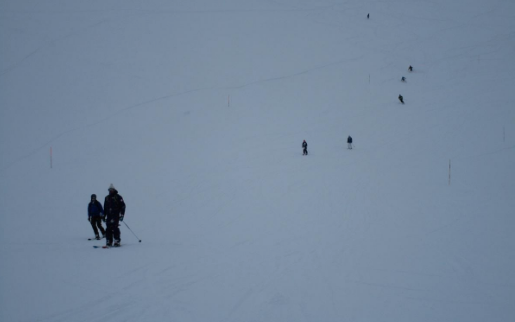
If you’re like me, skiing in flat light isn’t fun, but it beats not skiing. It is as if one is skiing inside of a milk bottle. Like different types of snow conditions, we’ve all had to deal with it.
For the record, flat light occurs when there’s no contrast, and one can’t see shadow and/or gradients of light that define shadows. On a mountain, flat light occurs when it is snowing, or under a thick overcast or when you are skiing in the clouds and sunlight can’t reach the trail on which you are skiing. In other words, there’s little or no contrast, and you’re eyes can’t see the “texture” of the snow surface.
Flat light affects everyone differently and us older folks are more affected than young whipper-snappers. You can’t change the weather that leaves three choices: Ski only when the sun is out; ski wearing goggles that improve contrast; and/or alter the way you ski.
Not skiing is, at least to me, not an option so let’s move to goggle technology. The buzzword is visible light transmission or VLT. Lighter tints of amber, yellow, rose, green, gold colored lenses transmit more light than the same level greens, copper, browns and gray tints. Flat light varies from on one slope from another and day to day. Sp, if you need goggles to manage flat light, wait until you get to the ski area and step outside to see what shade lens works best.
To see “better” in flat light, years ago, I tried yellow and other colored lenses which helped but….still not great. Frustrated, I tried a pair of yellow Ray-Ban shooting glasses that were better than goggles with yellow lenses. On my last trip, I wore polarized sunglasses with the brown Serengeti tint. They were better than yellow lenses, but not practical when it was snowing.
Goggle makers such as Oakley, Smith, Scott, Giro all have products they claim help you see better in flat light. Be prepared to spend big bucks, i.e. $200+ for a pair. How well they work depends on the ambient/flat light, lens color, tint of your glasses or contacts, the health of your eyes, and other variables.
There is something that works and doesn’t cost a dime. It is how you ski the mountain. Here are four tips that will improve your flat light ski experience.
- Tip 1: Ski near the trees, snowmaking guns and lift towers along the side of the trail. They provide contrast, faint shadows, and reference points.
- Tip 2: Avoid skiing bowls, wide-open areas, and trails because in flat light, the subtle differences in “height” needed to create shadows doesn’t exist.
- Tip 3: Slow down, give yourself more time to react to moguls, surprises in the terrain, and avoid obstacles.
- Tip 4: Wear bright or ‘dayglo’ colors. You want other skiers to see you.
Best advice for flat light is be careful and ski within your limits so you can enjoy the skiing. If you’re uncomfortable or tense, find a trail that works for you and stick with it.
Decide for yourself if this is for you. Credit: MechanicsOfSport
[authors_page role=contributor]