

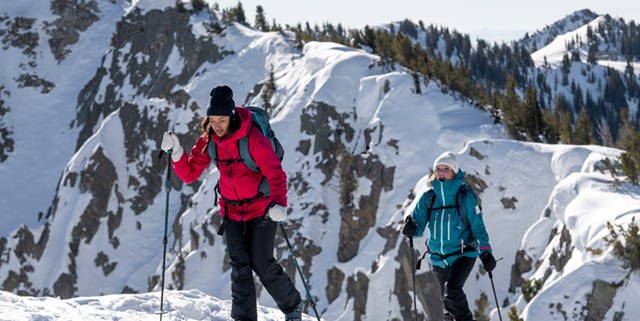
Skiing Yellowstone’s Backcountry
Why would you hike up a mountain just to ski down when you could ride a chairlift to accomplish the same thing with a lot less bother? As an 80-year-old backcountry ski guide in Yellowstone National Park, let me explain.
As active seniors, we all know the benefits of maintaining a vigorous, active lifestyle, particle in a natural outdoor setting. Combine that with skiing truly untracked powder – and there you have it. Any backcountry ski adventure can be rewarding, but skiing Yellowstone’s backcountry is beyond rewarding – it’s magical.
Yellowstone is the wildest landscape remaining in the contiguous US, and in fact, one of the few fully intact temperate zone ecosystems on the planet. Combine that with the rich cultural history of the world’s first National Park, and what more could you ask? Oh yeah, how about setting tracks in pristine snow that might not see another skier the entire season.
Here are some tips to transition from a polished resort skier to a backcountry adventurer.
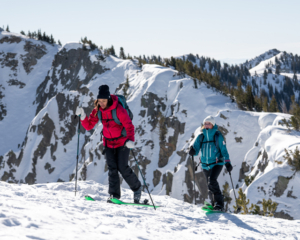
Backcountry Skiing
With modern BC equipment, the skiing skills we already have seamlessly transition to the backcountry, but that leaves two issues – fitness required to climb a mountain and dealing with the objective risk of skiing in a wild, unmanaged setting. As seniors who maintain an active lifestyle, we are already positioned to transfer aerobic fitness from these other activities to backcountry skiing. Fortunately, skinning up a mountain is exactly the type of conditioning required to – skin up a mountain. A great way to get in shape and connect with nature.
As far as risk, it’s a tradeoff. Swap a resort with squadrons of unguided missiles for an unmanaged environment where misidentifying a safe travel route could end badly. No way would I trade the antiquated long narrow, straight skinny skis and leather boots I learned to telemark on for today’s light in-bounds gear. But the old days had the advantage of a long, slow learning curve spent with knowledgeable friends and learning safe downhill skills by osmosis.
Today with modern gear, the siren call is to immediately jump into challenging terrain, that coincidently, also holds high objective risk. As legendary avalanche guru, Bruce Tremper, is fond of saying, “The trouble with learning backcountry skills on your own is that the final exam might come before the introductory lecture.”
Such objective risk might be the single greatest barrier to a senior skier interested in venturing beyond resort boundaries. The question becomes, how do you mitigate this concern? Of course, learning backcountry travel in the company of experienced friends is an option, but you had better trust them.
As a skiing partner of mine would say, “You can be friends with anyone you want in the bar, but you had better choose your friends wisely in the backcountry.”
Gradually stepping into the ‘side-country’ is also an option. Many resorts allow uphill travel, a great conditioning tool and a good way to become familiar with backcountry gear, hone your uphill technique, and make similar-minded friends. Backcountry guiding has also blossomed in the past few years.
Long a European tradition, there are many qualified backcountry guiding services, like Yellowstone Ski Tours, the outfit I work for. Others include licensed backcountry guides from Big Sky and from Jackson Hole, the two major downhill resorts closest to Yellowstone National Park.
Jesse Logan skis more than 100 days a year in the backcountry in the NE corner of Yellowstone National Park. He has guided backcountry skiers for a decade and enjoys skiing with anyone wishing to broaden their backcountry experience to include the rich natural and cultural history of the world’s first National Park.
Confessions of a Former Non-Helmet Wearer
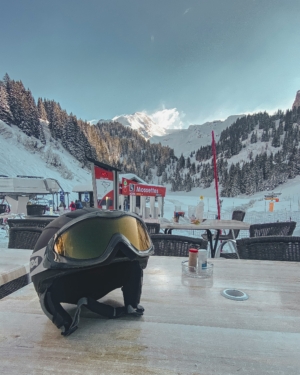
Photo by Sam Clarke on Unsplash
For decades, as in almost seven, the only time I wore a helmet while skiing was running a downhill race. During my 18 years of flying helicopters and fixed-wing airplanes in the Navy, I wouldn’t think of climbing into the cockpit without a helmet. When riding my bike, I wore a helmet. In a race car, I wore a helmet.
Helmets while skiing? Nah!!!! They’re for little kids who might run into trees or lift towers, but not for me. Neither of my adult children wore helmets past age six.
The cold wind whistling past my face and ears was the order of the day. On warm sunny days, it was baseball hats and sunglasses.
Over the years, helmets began to proliferate but neither my brother who is 13 years my junior, nor I owned a helmet for skiing. The first of the non-helmet wearers in the family to fall was my son. He’s another Naval Aviator and is involved in test flying. On one trip, he showed up wearing a ski helmet!!!
OMG!!!
That’s when the chorus from my grandchildren about wearing a helmet began. “Grampy, you need to wear a helmet. We like skiing with you, but you’re old, and we don’t want you to get hurt.”
Another refrain was “Helmets are cheaper than brain surgeons.” That’s when my son, the mechanical engineer and test pilot sent me an email listing the top-rated helmets and a description of the rating system. His note said, “Buy one!”
I turned the shaming at the other hold-out, my brother. We both bought the same helmet before we went to Whistler last winter.
My advice is by one that meets ASTM standard F2040 or if you live in Europe, CE EN 1o77. Also, try it on in the shop wearing what you wear on the slopes. Bring your goggles because they may not be compatible with the helmet.
Here are some lessons learned from skiing with this newfangled thing called a ski helmet. One, I seem to ski faster with the helmet because the sensations of speed going past my ears is different.
Two, will need to figure out how to keep your ears warm. I won’t ski when the wind chill is well below zero, but even when I did, in my pre-helmet days, ears were toasty warm under my 100% wool Moriarty hat. Wearing a helmet is another reason not to ski when it is -100 F outside and the wind chill makes it -300. There was a time when I would, but not anymore and now I can blame my helmet.
[authors_page role=contributor]