

Save Money – Buy Passes Now for Next Season
Photo by Karsten Winegeart on Unsplash
There’s still plenty of time left in this season for downhill turns and apres friendships, but that should not distract you from grabbing one or more of the next-season deals which just went on sale. Buy now and save money then.
These early-season prices should be in effect until around Memorial Day, when they have increased in past years, with another price increase around Labor Day. So – again – the sooner you buy, the more you save.
Indy Pass
We are putting this one first, because the number of annual passes is limited, and when they are gone, they are gone. It’s a great deal – starting at $299 for the Adult Base Pass for renewals and $349 for new buyers – for smaller, independent mountains.
New for next season are five additional mountains including Burke Mountain, Vermont; Tenney Mountain, New Hampshire; Corralco Mountain Resort, Chile; Rauriser-Hochalmbahnen, Austria; and Pila, Italy.
2025/26 Epic Pass
Prices are up around 6% for all pass types, including the full Epic Pass, which now costs $1,051, up from the current $982. It still provides unlimited and blackout-free access to more than a dozen resorts, including Beaver Creek, Park City, Hunter Mountain and Okemo.
Next season’s Epic Local Pass is $783, up about $50 from the current season, with unlimited and blackout-free skiing and riding at resorts including Breckenridge, Crested Butte, Mount Snow and Stevens Pass.
Although no new resorts have signed up for next season, Switzerland’s 4 Vallees is adding access to additional pass types.
Visit the Epic Pass website for more information, including new prices for strictly local and senior passes including the Northeast Value pass and Tahoe Local.
https://www.epicpass.com/passes/epic-pass.aspx
Mountain Collective
New for next season is a bonus third day at the member resort of your choice, which includes Alta, A-Basin, Jackson Hole, Snowbasin, Sun Valley, Taos and Valle Nevado (Chile). The pass costs $639 USD and $849 CAD for ages 18 and up, for 26 resorts around the world. There also are 25% discounted day tickets for friends and family.
Ikon Pass
There are big changes to this pass next season, with new resorts added, one leaving, and the end of the Base Pass Plus, plus price increases.
Pricing for the full Ikon Pass now starts at $1,329 and $909 for the Ikon Base Pass, up $50-$80 over the current season. The multi—day Session Pass remains the same, at $259.
Base Pass Plus provided access to premier destinations including Jackson Hole, Deer Valley and Snowbasin. The end of that pass apparently means those upscale destinations move into the full pass.
Windham Mountain Club is leaving the Ikon Pass at the end of this season, but Jiminy Peak and Cranmore in the Northeast and Wild Mountain and Buck Hill in Minnesota have joined as “bonus” mountains, offering two days each.
Also new is Ischgl, a resort in Austria that borders Switzerland.
See you on the slopes!
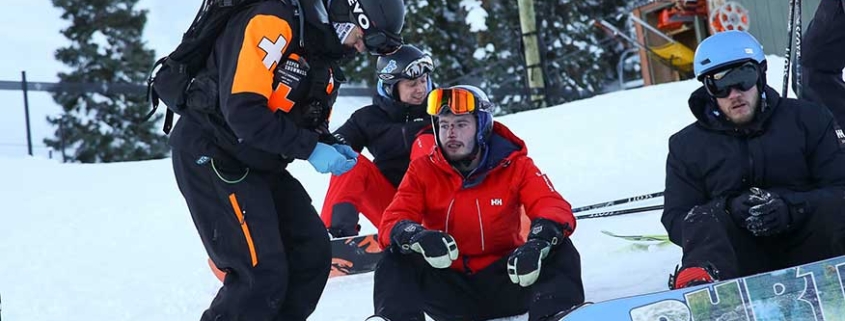
Ski Safety is a Full-Time Thing
AspenSnowmass Ski Patrol injury
January is promoted as Ski Safety Month, but our attention to safe skiing and riding, and avoiding accidents, should not be limited to one month. It’s a season-long thing.
These common sense tips from the Aspen-Snowmass Ski Patrol – and from me – will help keep all of us safer on the slopes.
Check Your Equipment
Be sure your equipment functions properly. Don’t let malfunctioning bindings or edges ruin your day. Have a local shop do a function test on your bindings.
· When was the last time you had your skis or board waxed and/or sharpened? They should turn like steak knives, not butter knives.
Stay warm and comfortable out on the slopes with goggles, helmet, hat, neck gator, gloves and layers.
· Use the pockets in your parka with sunscreen, lip balm, water and snacks.
Know The Rules Of The Slopes
The Responsibility Code is printed on every trail map and reads:
Always stay in control and be able to stop or avoid other people or objects. People ahead of you have the right of way (it is your responsibility to avoid them; you must not stop where you obstruct a trail or are not visible from above ‚ whenever starting downhill or merging into a trail, look uphill and yield to others; always use devices to help prevent runaway equipment; observe all posted signs and warnings (keep off closed trails and out of closed areas); and, finally, prior to using any lift, you must have the knowledge and ability to load, ride and unload safely.
Be Aware Of Seasonal Conditions
Patrollers keep areas closed until they are safe for everyone. There are hidden obstacles and holes in terrain during any part of the season; hazards exist that are not marked. Large snow storms and/or wind present potential avalanche hazards.
· Skiing or riding closed trails could cost you your lift pass – or worse.
Know What To Do When An Accident Happens
Cross skis or place the snowboard above the injured; make note of potential injury type and location of the incident (look for landmarks).
If possible, stay on the scene until patrol arrives. Patrollers are highly trained— most have at least EMT certification at most resorts — and some are paramedics, so you can trust that the care following an accident on the hill is very professional.
Don’t let an injured person ski or ride down.
· It’s a good idea to load the number of the Ski Patrol on your phone before you get on the first chairlift, gondola or tram of the day. Just in case, and especially if you are skiing along.
Know Your Limits
One of the most essential safety tips is to stay within your skill and fitness levels. Ski and ride only where you are comfortable and don’t let friends talk you into places that will get you into trouble.
· Remember, if you’re caught skiing or riding too fast, you could lose your pass, so stay in control and avoid accidents.
Venture Into The Backcountry At Your Own Risk
If you venture beyond ski area boundaries, be educated on backcountry conditions and special equipment for necessary precautions, and some offer classes to prepare you for the special conditions and safety requirements.
Larger resorts offer backcountry guides and equipment including avalanche beacons.
· Don’t go into the backcountry without the proper gear – or alone
Be safe out there, so we can see you on the slopes the rest of this season and seasons to come.
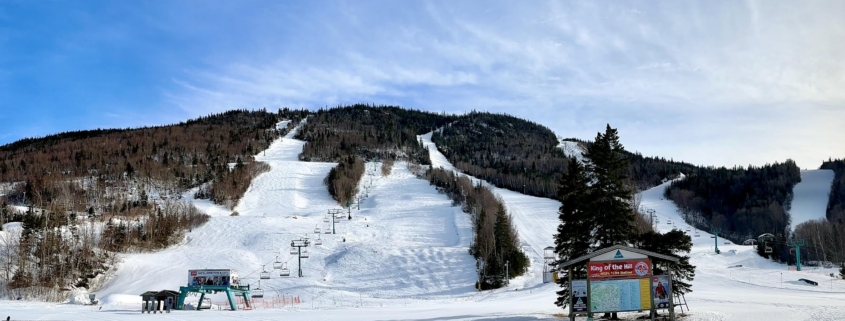
Come From Away – To Ski
Marble Mountain Newfoundland
I had never kissed a cod. Or toasted bannock over a fire. Phrases like Owshegettinonb’y don’t flow off my tongue, and I didn’t know the meaning of mauzy. These experiences were all rites of passage when I skied Marble Mountain in Newfoundland, in eastern Canada.
Bannock is a strip of dough wrapped around a stick that you roast, marshmallow-like, over a bonfire. Owshegettinonb’y translates in the local dialect as “How are you?” and mauzy means muggy. And that flirtatious cod was part of a “screech-in” ceremony popular at pubs: recite anoath, chug a shot of rum, smooch the fish…. and I became an honorary Newfoundlander.
A land of fjords and barren mountains, Newfoundland is indeed a place apart, an island 11 miles from the Canadian mainland. It didn’t become part of Canada’s confederation until 1949—it had been a British dominion. Even its time zone is quirky, offset from Atlantic Standard Time by 30 minutes instead of the conventional hour.
Marble Mountain Resort rises above the Humber River Valley. Although the mountain has the longest vertical drop (1,700 feet) of any resort in Atlantic Canada, most of its other stats are piddling: just 250 acres and 43 trails. But those ski runs are very, very steep, interspersed with stands of fir, spruce, and birch that pack in powder for tree skiing after a storm. And snow it does: Marble receives an average of 16 feet of snow each year, compared to 12 feet for Mont Tremblant in Quebec.
It feels like a time warp back to what ski resorts were in the 1970s. People leave their regular shoes in cubbies in the airy post-and-beam base lodge and brown-bag it for lunch. Lift ticket prices are also Old School: about $US 40. The resort has been operated by the provincial government since 1988.
Although the vibe is folksy, lifts and grooming are 21st century. Wait lines are rare for the Lightning Express high-speed detachable quad that carries skiers and boarders from the base to the summit of Mount Musgrave. From there, choose black into MacLeod Nine or Deep Bight; blue for Chilliwack, Knute Chute, and a bunch of other cruisers; or green onto Country Road, a three-mile wrap-around trail overlooking the Humber River.
I especially enjoyed the “over the river and through the woods” feel of the intermediate runs. They meander past copses of fir, swoop over dips, and skim ridges overlooking the river. For fast-lane carving, the wide, perfectly pitched Blow Me Down black diamond is almost always groomed. Long-timers still call this trail OMJ—an acronym for “Oh My [fill in the blank]—the reaction of unwitting skiers when they pop over the ridge into the steep descent.
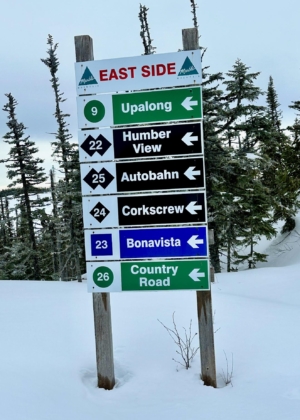
Marble Mountain Newfoundland Signs
Since Marble Mountain is mainly a family ski area, experts can usually suss out untracked powder lines, such as the gladed trees flanking the double-black diamonds of Boomerang and Ugly Stick and the groves along the ski boundary near Tuckamore Tangle.
Nearby Gros Morne National Park, a UNESCO World Heritage Site, offers backcountry skiing, cross-country skiing with 13 miles of groomed trails and snowshoeing. It’s one of the few places where you can actually see the earth’s mantle (middle layer), a stark orangish expanse exposed by 400 million years of weathering.
Deer Lake is the nearest airport. Air Canada offers flights from Montreal Toronto and other cities.There is base area lodging at Marble Villa.
The kindness with which Newfoundlanders welcome strangers is legendary. After the 9/11World Trade Center attacks in 2001, nearly 7,000 airline passengers were diverted to the island’s Gander International Airport. Residents took stranded travelers into their homes, cooked them meals and shared their wardrobes. Their generosity touched hearts worldwide and inspired the Broadway musical Come from Away.
That friendliness continues on the mountain today. Be prepared to chat a lot on chairlifts. “Where are you from?” locals ask when they’re seated next to an unfamiliar face. That question is almost always followed up by another: “And how do you like it here?”
“A lot,” I answer.
[authors_page role=contributor]