

Why You Should Travel with Apple AirTags
Photo by Erwan Hesry on Unsplash
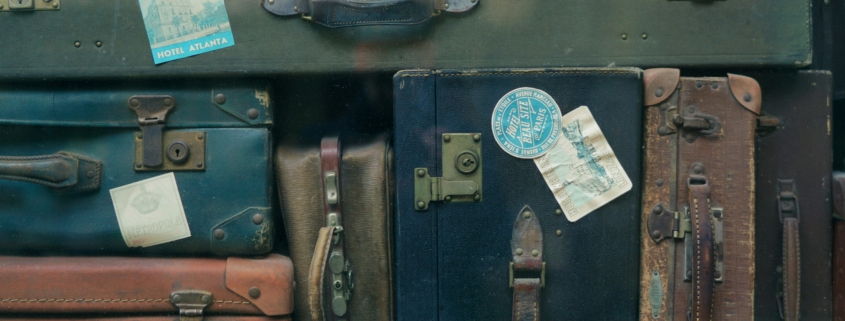
AirTags are brilliant little tracking devices a little bigger than a quarter, which integrate easily with Apple’s Find My App. Every piece of luggage you travel with – including your skis – should have one, to tell you exactly where it has been left behind by an airline, tour bus, forgotten by you, or even stolen.
Recently, I was on a tour bus in Europe when a fellow passenger screamed out, “Stop, stop. There’s luggage falling out of the bus.” By the time the driver could pull off the highway, my fellow traveler advised that, “You just lost my bag and it’s a half-mile behind us!”
How did she know? There was an Apple AirTag inside it. The driver, who apparently had not properly secured the latch on one of the luggage bays, ran back to retrieve her bag, surely cursed by drivers who nearly hit it. Score one for AirTags.
On the way home, due to a missed connection, my own bags didn’t make it onto my flight, and were left behind. How did I know? Yes, AirTags again.
These efficient little devices can track any item for you, including pets, when within range of any Apple device, even if the AirTag and its owner are thousands of miles apart, even internationally, as mine were.
In fact, the same woman whose bag fell out of the bus said she was also tracking her cat back home in the USA. I tracked the two-day trip my bags took home and delivery to my house.
United Airlines recently became the first major carrier to integrate AirTags into their app. Star Alliance partner Lufthansa has joined them. Customers can now securely share the location of an AirTag or Find My network accessory with customer service agents for faster bag recovery and an even better overall travel experience, the airline stated in a press release.
United says it expects the integration to drive a “much-improved customer service experience for the fewer than 1% of customers whose bags arrive on a later flight.” By sharing AirTag information, United and partner Lufthansa say they will be able to find delayed bags and reunite them with customers more quickly – including because the AirTag owner can track every movement every moment.
Additional domestic and international airlines are expected to join the AirTag program.
AirTag lithium batteries meet the low threshold airlines require for use in baggage, so no worries about putting them in checked luggage. Each AirTag is powered by a CR2032 coin cell battery, commonly found in many auto key fobs, which is user-replaceable and lasts about a year.
A four-piece set of Apple AirTags can be found on sale for about $70. It’s a very cost-effective way for individuals to benefit from a reliable tracking solution. Or, get a secure waterproof AirTag stick-on to attach directly to your skis for under $15, far less than the price of replacing lost or stolen skis.
However, AirTags are not without flaws. Privacy concerns, limited functionality for non-Apple users, and potential misuse are significant drawbacks that warrant consideration.
There are similar products available for Android devices.
What are your experiences with delayed or lost baggage, especially ski equipment? We welcome your comments.
Steppe-ing Up in Kazakhstan – Skiing at Shymbulak
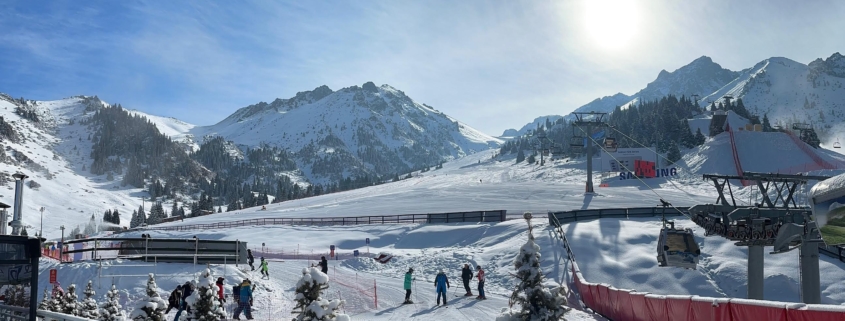
It looks like a typical ski area. Skiers and boarders clamber onto Doppelmayr gondolas and high-speed quads from Leitner and there’s a ski school for learners. I paid 8,000 Tenge ($15) to dress in fox pelts and hold an irritable Golden eagle for a photo op, cafés serve koumis—fermented mare’s milk – the local beer is Karagandinskoye, and a day lift pass is only $35.
Welcome to Shymbulak (SHIM-bu-LAK) Mountain Resort in Kazakhstan, the largest ski area in Central Asia, in a precipitous mountain gorge just 16 miles from Almaty, the country’s largest city. Ask most Americans about Kazakhstan and—if anything at all comes to mind—they’ll mention the satirical Borat films, or stutter something about “steppes.”
But Kazakhstan also has steeps, including the Ile Alatau mountains, portion of a range that stretches for 1,550 miles across Central Asia. Since it was part of the Soviet Union from 1936 to 1991, Shymbulak’s early history is Soviet-tinged. It opened in 1954 and became the Olympic training center for U.S.S.R. skiers.
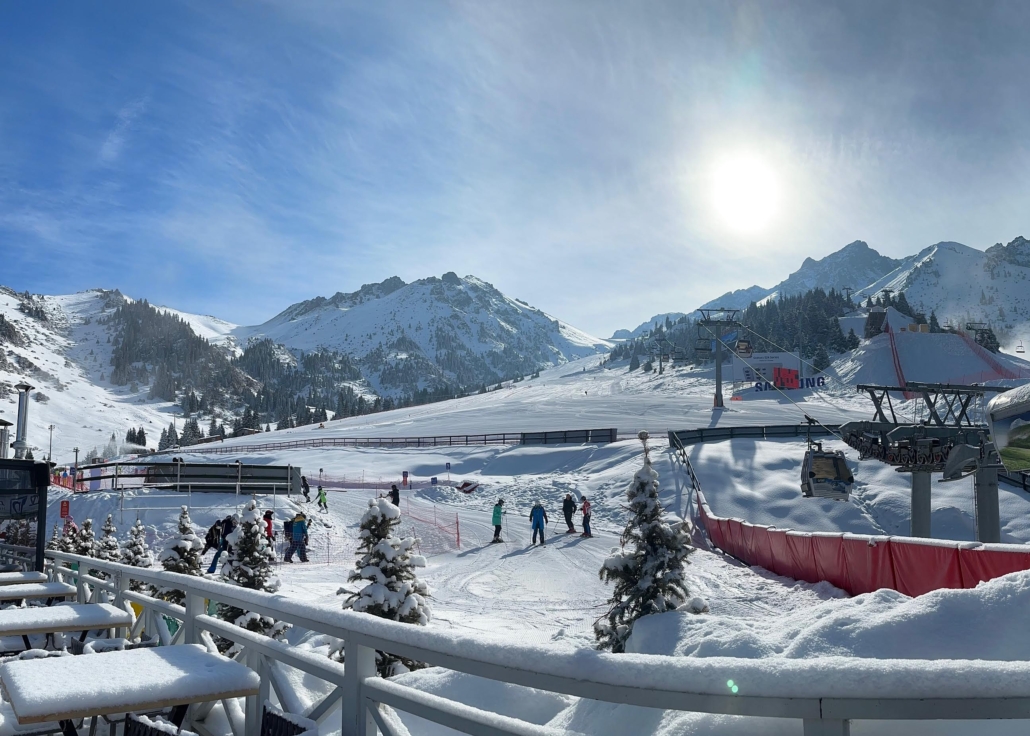
Shymbulak base area credit: Risa Wyatt
Today, skiing is more than a notch-in-your-belt curiosity. It is a World Cup venue: the FIS Freestyle Ski Moguls and Aerials were held here in 2024, and it was a finalist to host the 2022 Winter Olympics.
The resort offers nearly 3,100 feet of vertical and 12 miles of groomed trails. Terrain is a mix of gentle inclines for beginners, wide-open snowfields for intermediates, chutes and moguls for experts. Guides are available for backcountry touring. In addition, it holds the Guinness Record for the world’s highest night-skiing slopes.
Stats are nice, but it’s the scenery that astounds, with razor-sharp peaks that soar above the upper terminal of the gondola, at 10,500 feet and runs are mostly above tree line. On clear days, you can see Almaty below. Other times, foggy inversions sandwich brightness between clouds. The ski season is December to March, and there are good quality rental shops both in Almaty and at the base area.
Shymbulak’s layout needs explaining. Once you reach Medeu Base Station, you aren’t anywhere yet. It’s a 20-minute gondola ride to the ski area, passing the world’s highest ice rink. The actual base, at 7,400 feet, offers rentals, ski school, and restaurants. Then, ride a two-stage gondola (another 20 minutes) to the summit or head directly to lifts for beginners and terrain parks.
The gondolas make it easy for non-skiers to reach the top. I encountered sightseers (mainly Russians) trudging to overlooks for selfies, creating a bottleneck for down-loading the gondola when the sightseeing tourists hindered the skiers. After missing five cars, I shoved past the chit-chatterers, earning scowls and probably further derailing American/Russian relations.
Speaking of which: You can’t avoid geopolitical reality. One of my travel companions shared a gondola with three Russian draft dodgers avoiding the Ukraine war. Another day, a Kazakh woman overheard me speaking English and came over to discuss her anxiety about a Russian invasion, for its rich oil reserves near its western border with Russia.
Looking ahead, Shymbulak plans an expansion linking it to eight other regional resorts, including Oi Qaragi and Ak-Bulak. New lifts and terrain would double its size, adding nearly 20 miles of trails.
Although Russian is the main language—a Soviet holdover—many locals eagerly try out their English or Google Translate app. Don’t be surprised if they ask, “How old are you?” It allows them to show respect for elders. They giggled when I answered, “70.” Senior skiers are rare here.
“Meet a guest as God’s messenger,” says an old Kazakh proverb. Traditions were born among nomads living in the harsh steppe, so hospitality to visitors is sacred, and you’ll feel truly welcomed.
Skiing in Kazakhstan isn’t just about snow. The beauty includes exploring the surrounding area, so add time for Almaty, known for Green Bazaar, a cacophonous market with everything from spices to pig snouts, and the Russian Orthodox church that’s one of the tallest wooden structures in the world.
When you learn about a new culture, it lives on in you as well.
Pros and Cons of Skiing the New Powder Mountain
Photo by Colin Cassidy on Unsplash
Over the past six years, I have been a happy part of a group of friends skiing Powder Mountain the first week of February. This year was different, because Powder Mountain is different.
We loved skiing there, not because the skiing was free for over 75 ( although that was a plus) but more for the laid back feel of the entire area including its uncrowded slopes. I have called it the friendliest place to ski.
However, since an ownership change things are different.
The 75+ crowd, which used to ski free, now is charged a season ticket of around $1,400. And if you don’t have the season ticket of any kind, you can’t ski there on a weekend in February.
Even with a pass, the allowable area to ski has been reduced, saving the rest for the homeowners who have invested upward of $ 2.5 Million for a lot and God knows how much more for a structure to live in. In addition, each homeowner has the privilege to pay an additional $30,000 to $100,000 per year to ski on their private terrain, but they can also ski on the public side if they choose to ski with us common folk.
So, in sort of a protest, I decided that I would purchase a season pass at Snowbasin across the valley from Powder Mountain for $549. Snowbasin has plenty of skiable terrain – 3000 acres of groomed and ungroomed terrain, plenty of high-speed six-packs and gondolas and about 2000 feet of vertical, comparable to Powder Mountain, including for lift-served terrain, and far better for lodges and other facilities.
The only drawback to Snowbasin is that they are on the Ikon pass and I have never seen more people at any ski area than I saw on Saturday and Sunday while I was there.
So the issue at Powder Mountain, which I no longer consider the friendliest place to ski, is it still might be worth spending the few bucks extra for the peace of mind that you won’t be run over by the crowds.
Will my buddies and I return to Powder Mountain next season? I don’t know. Stay tuned.
[authors_page role=contributor]