

Short Swings for April
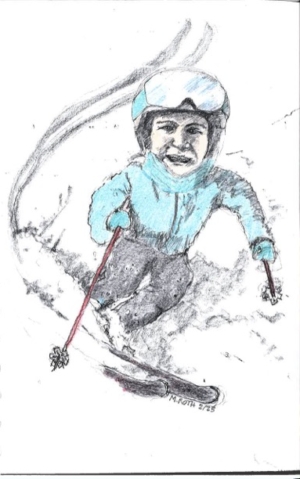 The end of the season is on its way, which means an abundance of pond skimming contests, outdoor music and active SPF for lunch and apres on the deck of wherever you are using your lift ticket.
Speaking of lift tickets – passes for next season are on sale now at the best prices. See our recent article about Ikon, Epic and Mountain Collective prices and perks for next season.
https://seniorsskiing.com/save-money-buy-passes-now-for-next-season/
There also are many local and regional passes which might fit your needs.
Note that these early bird prices won’t last long. Expect price increases by Memorial Day, even sooner.
First, though – two good news tidbits about next season –
Snowbasin confirms they will have RFID scanning gates next season, so no more taking out your pass to be hand-scanned at each lift. Also, they are replacing one of their oldest lifts, Becker, being upgraded to a high-speed quad. It will get you to the top terminal in six minutes, half the current 12.
Killington confirms it is replacing the sometimes-cranky Superstar Express Quad – which dates from 1987 – with a new high-speed six-pack. It’s a $12 Million investment scheduled to open in December 2025.
Now for some local and regional season pass choices – note that these early bird prices don’t last long. Some evaporate at the end of March, others the end of April.
Access to Sunday River, Sugarloaf, and Loon Mountain Resort, offering a total of 388 trails, 2,647 acres, 17 terrain parks, and 47 lifts, and sister resort benefits including to Big Sky and Brighton. Benefits include Buddy tickets, retail, dining and tuning discounts. There also are discounts for 65+ available for some passes.
Gold New England Pass – The most popular pass with unlimited access to Sunday River, Sugarloaf, Loon, and Pleasant Mountain, plus 3 free days at Big Sky Resort, Brighton, and other western Boyne resorts, 50% off on additional full one-day tickets and 50% off at Mountain Collective resorts.
- Renewal: $1,389 Adult, $599 Youth
- New Purchase: $1,449 Adult, $599 Youth
- Add an Ikon Base Pass or Loon MTB Plus Pass for $299
Silver New England Pass – Daily access except for 12 blackout dates, plus 50% off full one-day tickets at Pleasant Mountain, Big Sky Resort, Brighton and other western Boyne resorts.
- Renewal: $999 Adult, $459 Youth
- New Purchase: $1,039 $489 Youth
Bronze New England Pass – Valid Mondays through Fridays except for blackout dates and expanded weekend access during early and late seasons at select resorts.
- Renewal Purchase: $679 All Ages
- New Purchase: $729 All Ages
Afternoon New England Pass – Ski and ride starting at 12:00pm, with no blackout dates, all season long.
- Renewal Purchase: $599 Adult, $379 Youth
- New Purchase: $599 Adult, $379 Youth
Saddleback, Maine
An unrestricted Adult Season Pass, with no “blackout dates” is $1,099. That’s more than for the current season, but includes some new benefits.
Returning Benefits Include:
- FREE SKIING for the remainder of the 2024-2025 winter season
- Buddy Tickets: 50% off lift tickets for friends
- 50% off ski lessons at the Roger Page Ski & Ride School
- Demo, Tuning and Retail Discounts
New Benefits for 2025-2026 Season Pass Holders:
- Free UNLIMITED Summer Chairlift Rides
- Free UNLIMITED Summer Mountain Bike Park Access
- Summer Retail Discount: 10% off logo wear
https://www.saddlebackmaine.com/season-passes/
Taos, New Mexico
Taos celebrates its 70th Anniversary next season. Passes purchased now include lift access for the remainder of the season.
Super Deals – Five-Day and 80+ Ski FREE
- The best deal – five days of skiing, with limited blackout dates, for $495.
- Free 80+ and 6 & under season passes are available on Opening Day.
Kachina Pass:
- $1475 or $1395 for passholders in the last 5 years, for unrestricted skiing/riding 7 days a week, with no blackout dates
- $250 credit per season to the base area hotel, The Blake, plus discounts for Ikon and Mountain Collective pass holders.
- Two unguided days at Silverton Mountain and one free heli-skiing drop in December or January.
Value:
- $925 or $875 for passholders in the last 5 years for skiing and riding 7 days a week, with holiday blackouts
- One unguided day at Silverton Mountain, one free heli-skiing drop in December or January. Starting March 24,
Midweek:
- $525 or $495 for passholders in the last 5 years for unlimited skiing and riding Monday-Thursday, with holiday blackouts.
High Noon:
- Also $525 or $495 for passholders in the last 5 years, for unlimited skiing after 12 PM, 7 days a week, with holiday blackouts.
Visit www.skitaos.com for more information.
See you on the slopes!
Comparing Alpine and Nordic Skiing
While comparing Alpine and Nordic skiing does not approach the debate about the best basketball player of all time (Michael Jordan or Lebron James), here is some fodder for the analysis on the snowsport discourse.
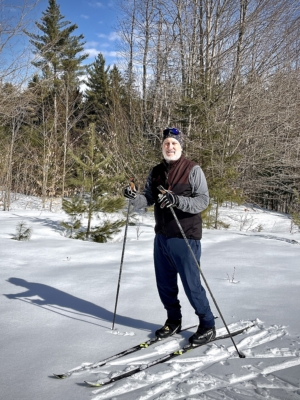
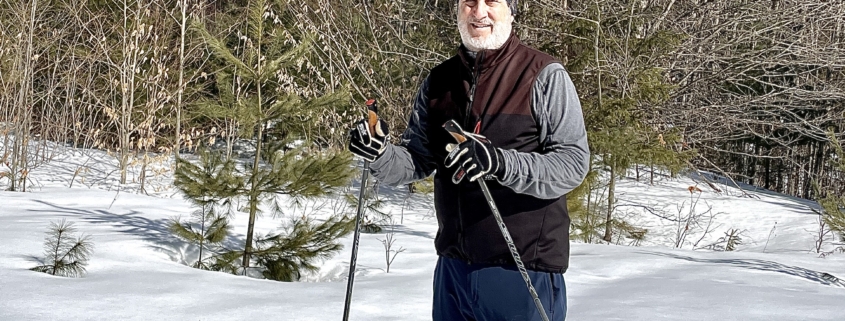
RB Lohr at Mt. Tom
During a career in the snow sports industry (mostly XC skiing), I have always avoided speaking negatively about Alpine skiing, (which is also referred to as downhill skiing and includes snowboarding) when comparing it to Nordic skiing (also known as XC skiing or cross country skiing). I’ve preferred to view XC skiing in positive terms, yet there are both similarities and differences between the two segments of snow sports. Another related aspect in the dialogue is to consider why Alpine skiers might want to try XC skiing or vice versa. Full disclosure: My annual outings this winter so far are 85% XC skiing and 15% snowboarding.
Both of these sports on snow provide the respective enthusiasts at any age with an experience outdoors in nature which is a good thing in the winter because we tend to stay indoors too much. It is also good to get into nature outdoors because of its impact on our psychological and spiritual well-being. It would seem that the differences in the two disciplines relate to speed. XC skiing through the forest at a slow pace may very well bathe our souls more fully compared to skiing or riding down a slope at even moderate speed. While I prefer the slow immersion of XC skiing for the smell of the forest and sound of the rolling brook, I concede that Alpine skiing can be equally beneficial for getting outdoors.
FITNESS
XC skiing is known as a leading aerobic exercise and using it to attain fitness is clearly advantageous compared to Alpine skiing. I’m not going to quote scientific aerobic studies or government recommendations about the number of minutes or hours per week necessary for a person to become fit, but this issue is obvious. XC skiing impacts all the body muscle groups and can be used as a successful cross training activity in the winter. I am aware as a snowboarder that there are Alpine skiers who get a great workout (particularly when doing bump runs), but on this issue XC skiing is the clear winner.
OPTIONS
The various options for XC skiers are plentiful. They can ski on groomed and marked trails or in the backcountry. They can classic ski or skate ski. XC skiers can go to commercial ski centers, local trails or parks, the snow covered golf course, even in the backyard or anywhere there is snow cover. Alpine skiers usually require lifts at the ski area. Backcountry skiing, split-boarding, alpine touring, and uphill skiing at ski areas are in the Alpine ski category but they may actually fall into the XC ski category, since the skier is moving uphill and across the terrain. Alpine skiers can enjoy groomed and marked trails but also gladed areas and terrain parks. They can float in the deep fresh powder and maintain excellent control on hard packed snow or bouncing down on moguls. Free style skiing is tantamount to gymnastics on the snow and rarely seen ski ballet dancing may be described as poetry on skis particularly when it is synchronistic and performed by couples.
Both Alpine and XC skiers can choose either easier or more challenging outings. With XC, for example skiers can go at their own pace across flat trail terrain or climb uphill to return on a thrilling run downhill on narrow trails. Alpine skiers can choose easier flatter slopes or more difficult steep slopes with moguls. Equipment for both Alpine and XC has been improved substantially providing better control and performance to make the sports much easier than in years past. XC skiers will cover terrain on the flat areas, up hills, and down hills. Their equipment either helps or hinders this form of transportation depending on the characteristics of the equipment and the terrain it is on. Soft wide steel edged skis are wonderful in untracked snow skiing down a hill but they are too slow providing minimal glide when skiing on a groomed flat trail. Narrow XC skis are great on the tracks or groomed trails but are difficult to control in untracked or broken snow going downhill. Alpine skiers and snowboarders are both able to acquire different equipment for different specialty interests.
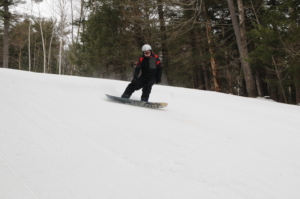
RBL snowboard at King Pine
INJURY SUSCEPTIBILITY
The injury issue is an area of substantial difference between Alpine and XC skiing. I’ve been injured doing both activities. The speed associated with Alpine skiing is a key component to the potential severity of injury. Falling at high speeds even on soft snow can cause twisting, bouncing, and bruising that has bad consequences for the skier. Another big concern is getting hit by another skier who may be out of control. XC skiers who do not ski regularly often complain of muscle soreness on the day following an outing. Many XC skiers get exhausted if they ski too long or too far, but it is very rare for an XC skier to have a crash with another skier. Snowboarders are susceptible to upper body injury (head, neck, wrist, shoulders, rib bruises, etc.) and Alpine skiers can suffer leg issues such as knee and ACL injuries. The possibility of severe injury is more of an Alpine skiing concern compared to XC skiing. The lighter XC ski gear and not being attached to the ski at the heel perhaps make XC skiing somewhat safer, but let’s face it, if you are going fast down a steep hill, bad things can happen if you fall. Crashing into a tree even at slow speeds is unhealthy, no matter what type of equipment you are using.
SOCIABILITY
Both sports have an exceedingly wonderful social component. Alpine skiers strike up conversation as they meet strangers on almost every ride on the lift. XC skiers come upon others on the trails and always smile and say hello. The crowd factor is a difference among the two snow disciplines. Rarely are there too many people among the XC skiers at one place or on one trail, while the liftlines at Alpine ski areas can be notorious for overcrowding requiring crowd control techniques. It is true that experienced Alpine skiers can adjust to take lesser-used lifts on the mountain while the hordes may not be aware of where and when to find these lifts. Additionally, when there are too many skiers on a given slope at an Alpine ski area, there is increased danger for crashes to occur.
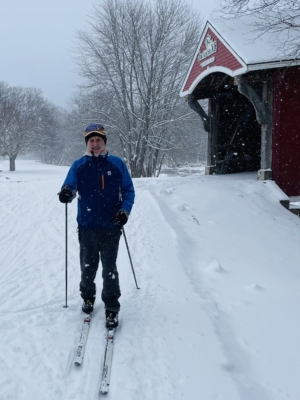
RBL at Jackson XC
COSTS
This brings us to the cost of the ski disciplines. Without getting into specific prices at different locales, it is safe to say that Alpine skiing is substantially more costly. Many skiers are purchasing season passes for skiing at a number of different venues. Daily passes can range from $50 to $300 per day for riding the lifts while XC skiing is either free in the park, or at a commercial XC ski area a trail pass can range from $15 to $30 for a day (or a couple of hours). The season passes are also significantly more costly for Alpine skiing, but we must remember that Alpine skiers can take multiple lift rides up the mountain which is a most incredible value. While the cost of XC ski equipment has increased, it is still substantially lower than Alpine ski gear – a fact which is undeniable and probably includes all categories of quality products and services such as hard goods, clothing, accessories, and services (ski tuning and repair).
THE VERDICT
Taking the above analysis into account, one may think that XC skiing has many advantages and that would be true on many fronts…but the fun factor must also be applied in the comparison. Clearly, the accomplished Alpine skier or snowboarder appears to be having fun (defined as something that provides amusement or joy) and thrills. What’s not to like taking the lift up the mountain and pushing off down the hill to get the rush of wind in your face while maintaining your speed under control…or floating on a snowboard in untracked powder down a narrow path through the trees in a silent glistening forest. Some of the ski areas have great food options in comfortable restaurants situated on top of the world with panoramic views of wintry awe and beauty. Ahhh. But there is something to XC skiing despite the images of Olympic competitors falling at the finish line in complete exhaustion. While it may be difficult to label XC skiers as having fun (most people perceive XC skiing as “too much work”), upon completing an outing on XC skis, one feels a sense of accomplishment. According to scientific evidence there are very positive biological, psychological, and medicinal impacts derived from the activity associated with outdoor activities like XC skiing. The sensory experience of getting outdoors is a kind of eco therapy and a prescription for lowering stress, restoring attention, and boosting mental health and cognitive clarity. Alpine skiing does indeed have similar effects on people, but the slower pace and level of immersion associated with XC skiing may provide an advantage for mental health and associated wellness.
Personally, I love a long glide in the tracks on my XC ski equipment AND a powder run on my snowboard. I call it an even draw.
[authors_page role=contributor]