

What’s New in New Hampshire for the 2024/25 Season
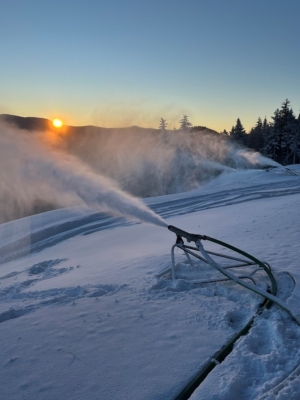
Sunrise 2024 at Bretton Woods Credit: Ski NH
New Hampshire’s downhill and X-C areas have been busy all summer expanding snowmaking, widening and reconfiguring trails, renovating buildings, and adding new technolgogies to make it easier and faster to get to the lift.
Several of the improvements are one phase of a multi-year plan.
Here’s what’s new up north, in alphabetical order, since that’s the only fair way.
Attitash Mountain
In preparation for its 60th Anniversary this season, Attitash has been sprucing up its facilities, including a new haul rope on the Abenaki, and is bringing back the Hunky Dory trail for natural skiing and riding.
Cranmore Mountain Resort
The new Lookout building is being completed, adjacent to Cranmore’s new Fairbank Lodge at the base of the mountain, plus the resort has added 17 new residences with ski-in/ski-out access
In addition, Cranmore’s patrol team is getting its own state-of-the-art ski patrol facility. double the size of its predecessor, strategically located opposite the base of the Skimobile Express. It will feature a small urgent care room with two emergency treatment beds donated by Memorial Hospital, two oversized treatment recliners and an electric garage door with rollers for smooth trauma sled delivery. Let’s hope you never need to use it.
Crotched Mountain
New fiber optic lines will enable large amounts of data to be transmitted reliably at higher speeds. This will result in improved communication for both guests and operations personnel across the mountain.
Great Glen Trails
This smaller resort also invested in energy-efficient snowmaking, adding power to the top of the tubing hill so that the snow guns will be electric-powered.
Gunstock Mountain Resort
This year’s phase of a $4.8 million capital expense plan included $1.6 million for snowmaking expansion on the mountain, widening one trail, and extending and reconfiguring another.
Additional plans include expanding a deck for outdoor dining at the Stockade Lodge, and a new Campground and Nordic Skiing Welcome Center. The new $1 million structure will provide visitors with modern facilities, a spacious check-in lobby and expanded retail space for equipment, clothing, provisions and sundries.
Jackson XC
The popular Kellogg Trail has been rebuilt to make it more weather-resistant and easier to ski, by moving it away from an eroding river bank, and reconfigured to make it more skier-friendly. Adjustments on the Ellis River Trail reduce the amount of climbing and ease some previously challenging curves. Other trailwork was done to improve conditions for the Riverbank Trail, a beginner trail that includes the popular Storybook Path.
Improved pumping capacity will help extend snowmaking to include additional distance on the Wentworth Resort Loops.
King Pine
The resort in East Madison has refreshed the snack bar for easier access, and is revitalizing its Nordic program with a new grooming machine to get more trails open this season.
Good Deal – One of the most anticipated events on the King Pine Calendar is Founders Day, with $4 tickets. This season it takes place on Dec. 19th. $4 lift tickets for anybody and everybody. Tickets must be bought online in advance.
Loon Mountain Resort
Loon has added more than 100 new semi-automated snowmaking hydrants on Loon Peak and North Peak trails, including Haulback, Brookway, and Bear Claw Extension. Snowmaking upgrades have also been expanded to South Peak trails including Cruiser, Ripsaw, Escape Route, and Chipper.
Additionally, snowmaking has been installed on Upper and Lower Stinger. Together, nine trails will see improved snowmaking coverage.
A new snow-melt surface has been installed on The Octagon Lodge Patio, to keep it clear, and there’s a new walkway that improves flow to and from the Octagon Lodge.
Mount Sunapee
There are 20 new upgraded snowguns. Along with low-e snowguns, these will improve snow production, snow quality, and energy efficiency.
Pats Peak
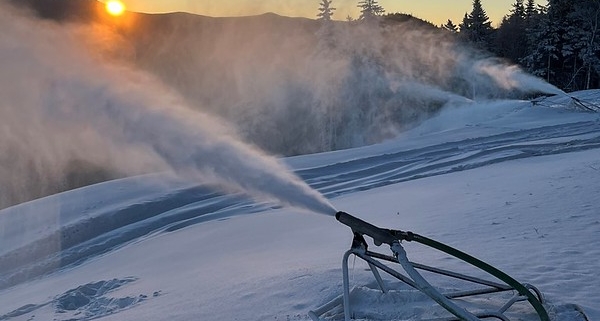
The resort in Henniker is installing 12 new HKD Impulse snow guns on Downdraft trail. This equipment provides an efficiency boost of at least two degrees, which might not seem significant, but in the realm of snowmaking, the difference between 26 and 28 degrees is substantial.
There is also a new 19,000-square-foot Operations Building, which will expand maintenance capabilities by over 400% and streamline operations.
Whaleback Mountain
The new Sunkid surface lift next to the Lower Spout racing trail will provide a more direct path to the racing trail, along with improved access to Canyon and Scrimshaw trails, home to Whaleback’s terrain park. This additional lift will help improve skier/rider flow during peak periods, and in providing access to the lower mountain, enable the ski area to open earlier.
Also, with a $100,000 grant awarded through the Northern Border Regional Commission and matching funds the Enfield is installing additional snowmaking guns, a water pump and an upgraded electrical supply, effectively doubling its snowmaking capacity.
New RFID Technology
Radio Frequency Identification (RFID) is a technology that uses radio waves to passively identify a tagged object. It is integrated into season passes, day tickets, and other products at ski areas, including to automatically open lift gates. It can be reloaded from the comfort of home or during the car ride up, allowing guests to go right to the lifts.
This year, Bretton Woods, Cranmore Mountain Resort, and Pats Peak are introducing RFID ticketing.
Ski New Hampshire
Thanks to the statewide association, which represents 30+ alpine and cross-country resorts in New Hampshire, for providing us this “what’s new” information.
For more information on ski areas, trail conditions, vacation planning, and events at Ski New Hampshire resorts, visit SkiNH.com.
For statewide travel info, go to VisitNH.gov.
See you on the slopes!
Ski Guardian Your Safety Companion on the Slopes
It’s not often SeniorsSkiing.com gets to tell you about a product that can potentially save lives on the mountain. We want to introduce you to the Ski Guardian; your safety companion on the slopes.
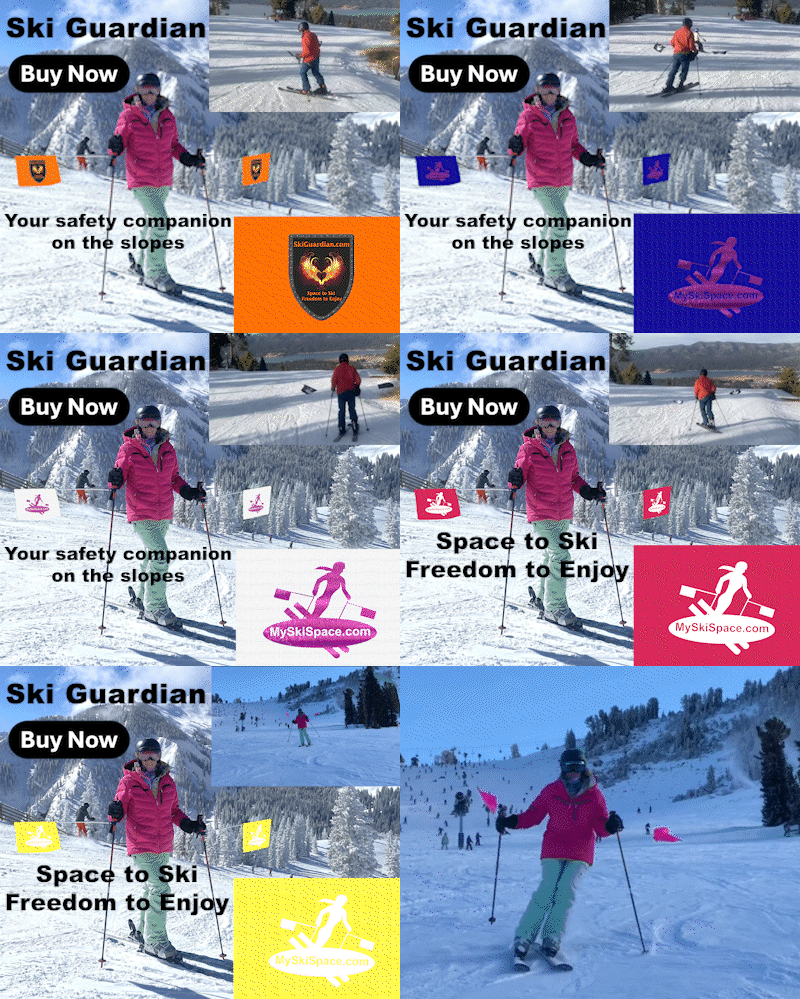
Safety on the slopes is a top priority, and that’s where Ski Guardian shines. This lightweight and versatile personal flag system is designed to create a visible boundary around. It increases your visibility on the mountain to help prevent collisions, especially on crowded slopes or in low-visibility conditions. Ski Guardian encourages other skiers and snowboarders to respect the recommended 10-15 feet of distance, offering peace of mind for riders of all ages. The device has two flexible 32-inch-long polycarbonate rods with flags at the ends, providing 32 inches of protection on each side.
The Ski Guardian attaches easily to your ski poles with two small screws and a Hex key which are provided. They can be removed without damage if you change poles. They can also be trimmed to fit a kid’s ski poles. One of the key features of Ski Guardian are its collapsible rods, which are perfect for navigating narrow areas or getting on and off the lift. With the rods collapsed, they never become an obstacle or inconvenience. This safety accessory ensures you can ski confidently, knowing you’re doing your part to prevent accidents.
The extended flags can increase visibility during emergencies too, helping you stay visible to rescuers and other skiers or snowboarders. The flags also provide a social element by helping friends and family find you on the slopes. They are great for ski clubs since they can easily identify members on the mountain. Ski Guardian can also accommodate flags with custom made club or company logos. Want to use a personal flag of your own? The Ski Guardian can also be purchased at a reduced price without the flags so you can put your own personalized flags on the rods.
Ski Guardian is more than just a safety tool—it’s peace of mind. It’s simple yet powerful design creates a visible boundary, urging other skiers and snowboarders to maintain a safe distance, especially in crowded or impaired conditions. We all know the recommended 10-15 feet distance is often overlooked on the slopes, but with Ski Guardian, that guideline becomes much easier to follow.
In conversations with many ski patrollers in the United States and Canada it’s clear patrollers believe the Ski Guardian can effectively reduce ski-related injuries or fatalities. The Patented Ski Guardian safety devices should become as common as helmets are now. Like helmets, which were once optional and are now essential, we believe Ski Guardian is on the verge of gaining the same level of acceptance. The concept is simple, but its potential to enhance safety is undeniable. With more exposure, Ski Guardian can become the next critical safety accessory for everyone on the mountain—whether you’re a beginner or a seasoned skier.
Addressing Climate Change: Meteorological Malpractice
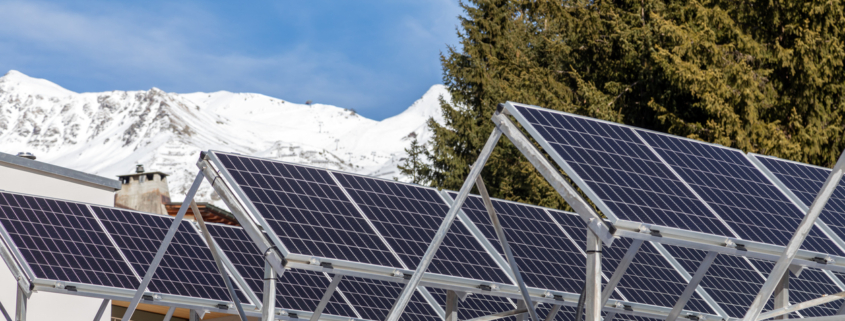
Flat roof solar power plant in the alps Photo Credit: Canetti
The snow sports industry has been in a quandary about climate change. Some in the industry see snow sports as the “canary in the coalmine,” which translates to ski areas facing shorter seasons due to global warming. Statistics show that the snow sports population and skier visit numbers have mostly plateaued in recent decades. Relevant factors regarding the lack of growth include the aging population of skiers, economics and the cost of skiing, available time, and global warming (climate change).
In a recent North American Snowsports Journalists Association (NASJA) discussion session, a panel of interested parties discussed climate change and the snow sports industry. One long-time snow industry pundit, stated that “global warming is already baked in” and “some owners in the industry are preparing exit strategies and maximizing their profits before they go,” commenting that this is how Wall Street works. The meteorologist on the panel stated that “December is now a fall month and many broadcast weather personalities only reference the daily weather and astrological information while being guilty of meteorological malpractice because they refuse to educate and alert the public about climate change.”
There was also a clean energy/government consultant panelist who was comparatively more optimistic than the other panelists, stating “the Inflation Reduction Act will take about a decade to show results, and there is a need to deliver the climate facts in a nonconfrontational and unbiased manner.” She also saw clean energy as an investment opportunity that is preferable to the fossil fuel industry. The panel discussed various related issues including snowfall history, shrinking European glaciers and even mentioned a coming book about climate change and ski racing, but they never mentioned adaptive skier behavior.
Last Winter in New England
I learned that a local New England Nordic ski area’s 2023-24 winter season operation was open for 65 days and was closed for business from December 16 to January 17. The 10-year average of the number of operational days for the area is 93 days, so last year there was a 30% decline of operational days including loss of the December holiday period.
The Nordic area had four days above freezing during the season and significant snowfall occurred only 4 times once each in December, January, February, and March (64 total inches of snow for the winter). On a monthly basis the amount of snow alternated with January and March getting more than two feet while December and February received about two inches! The local alpine ski areas can make snow for more consistent conditions, but warm periods and rain events suggest that they were impacted similarly. A local alpine ski area reported a 74 day season in 2023-24 compared to normal 90 day seasons.
Were the last season statistics due to annual weather patterns or longer trend climate change – science proclaims the answer, but I suppose that we are not aware of the amount of impact annual weather versus climate change is responsible for a given day on the slopes or trails. As a New Englander who relies on Nordic skiing and snowboarding for mental and physical wellness during the winter, I Nordic skied 51 times in 2023-24 and about 20% of the days were skiing on slushy or icy short loop trails. I went snowboarding 19 times. This is what semi-retirement looks like for the snow sports aficionado, who lives in snow country. But I’ve incorporated the impact of global warming in my snow sports activity and there is evidence of ski behavior adaptation that seem to be related to climate change.
Skiing Behavior Adaptations
Personally, I like to ride on sunny days and before I leave my home for the slopes, I pay attention to hourly daily temperatures and I often plan to arrive at the ski area on warmer days for softer snow conditions. My advance planning includes the use of ski area weather reports, webcams, and so on and it has worked very well.
It is apparent at alpine ski resorts that many midweek skiers leave the area before noon and this might explain why so many small ski areas only open their mountain restaurants on the weekend. One day last year I was excited about a half foot snow overnight and arrived at a local ski area in the morning to find almost three full parking lots. I never stopped my car, turned around and went home deciding to return later in the week. The mega ski passes allow skiers to hit the slopes more often for shorter time periods and there are still fewer midweek patrons on the slopes. Most skiers among the weekend crowds learn to select slopes and lifts to minimize their lift line ensnarement.
Many skiers wait for snowmaking to accumulate in the early season until there are more trails open to ski. Fairweather skiers take advantage by going when the snow conditions and weather are most palatable (waiting for warmer temperatures or avoiding crowded days).
I prefer to go Nordic (XC) skiing on the weekend or when it is colder because groomed Nordic ski trails are very skiable, there are no crowds as fewer people go XC skiing and the skiers are spread out along miles of trails, it’s easier to keep warm while XC skiing (muscle utilization warms the body), and Nordic area trail passes are significantly less costly compared to the weekend/holiday rates at alpine ski areas.
For XC skiing, there are days when skate skiing is excellent on hardpacked or frozen groomed trails and other days when classic skiing makes skiing harmonious for outdoor immersion in nature.
Most ski areas and snow sport product suppliers are investing in sustainable efforts in their operations such as renewable energy sources, waste reduction, operational and snowmaking efficiencies, electric vehicles, political lobbying, and so on. These efforts are worthwhile and commendable but they’re a drop in the bucket when it comes to combatting global climate change, but most of the companies in the snow sports industry are moving forward.
Snow sports are important as a winter recreation for people but there is a substantial cost paid even in the snow sports business in terms of climate change. Scientists claim that they are able to forecast outcomes and calendars but we do not know the type of adaptations that will be undertaken for the snow sports business to continue, nor do we know how quickly global warming may change how and when we ski. But we can guarantee that skiers will continue to adapt as necessary to continue enjoying their winter pastime.
[authors_page role=contributor]