

Pre-Season Advice: Carving The Modern Ski Turn For Seniors
A Ski Instructor Reviews How To Turn On Shaped Skis.
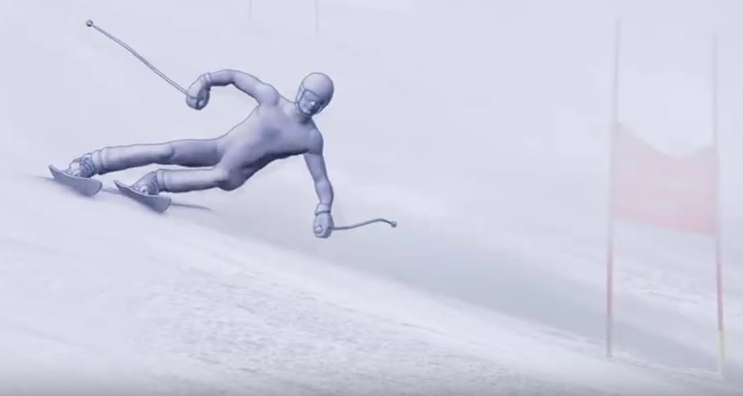
You don’t have to ski hard over like Ligety, but look how he bends those skis into the turn. See how those ankles flex? From the New York Times tutorial on Ligety’s approach.
Credit: New York Times
[Editor Note: Our Spring Survey 2016 revealed an interesting statistic. About 30 percent of seniors take one or more lessons during a ski season. For those of us who are still skidding around turns and wondering how other skiers make those clear, sharp, carved ski tracks, PSIA ski instructor Pat McCloskey has some advice. But, it’s one thing to read about and even see a video of carving turns, it’s another to perform on a hill. Our advice: Take a lesson and learn how to really navigate on those new skis.]
Remember when we had to up-unweight to make a pair of skis turn? In the old days, the skis were longer and had minimal side cut so the only way to release the gripping edges at the end of a turn was to literally up-unweight, rotate the tips downhill and finish the turn.
As skis developed more sidecut, the up-unweighting became more subtle and edge engagement was easier facilitating more of a carved turn. The modern ski turn is aided by shorter skis with radical sidecuts that virtually eliminate up-unweighting. The movement is more lateral across the skis where the skiers center of mass seeks the next turn. I call it belly button to the next turn.
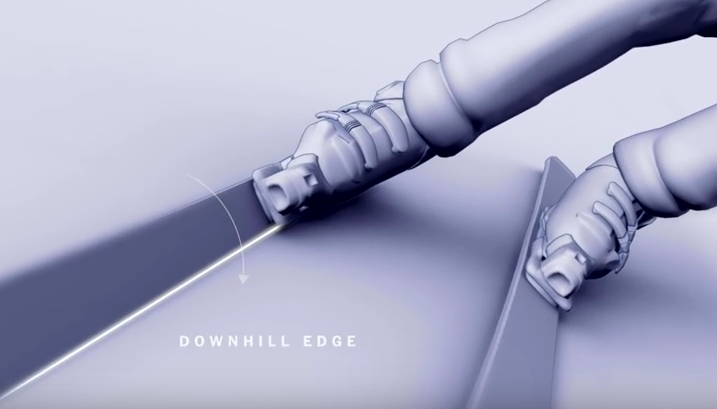
Ted Ligety, US Ski Team star GS racer, says that the reason he is faster than the competition is that he starts his turns earlier than most competitors by getting on a high edge early in the turn. He then pressurizes the ski with a good ankle flex, finishes the rounded turn across the fall line and then releases the pressurized skis which actually slingshots him into the next turn.

Key moment in Ligety’s carved turn, engaging the uphill ski earlier. Flexing the ankle puts pressure on the edge.
Credit: NY Times
If we slow that down for the mortal senior skier, the key is to engage the new edges early in the turn by getting that belly button to face towards the next turn. Then as the turn progresses, the ankles flex in the boots to hold the pressurized edges and the skier can finish his or her turn controlling the skis with a carved turn instead of a skid.
There is an element of trust in what the modern ski can do when you engage it early. But if you are patient and trusting, allow the edges to grip and carve; you can use your ankles to micro manage turn shape which controls speed. One of the keys to success here is to make sure you have a ski than can easily flex and a pair of boots that can also flex. A race boot is sometimes not the best choice for a senior skier. Make sure you can flex your ski boots which is critical during the progress of a modern ski turn. You especially need that flex at the end of the turn to pressurize the skis to make a strong, across the fall line, rounded turn. Just like Ted.
Check out his carving in this video clip below. For a more complete explanation of Ligety’s approach to the turn, click here for a tutorial from the New York Times and clips from the 2015 Sochi Olympics.

Most Active Seniors Probably Have This Problem
But, There’s A Free Miracle Drug You Can Take.
You can live better when you’re hydrated.
Credit: TreeHugger
At the risk of sounding like a spam email headline, I have re-discovered a miracle drug. It’s completely free, it acts quickly, and it can be found anywhere and everywhere. It’s a drug that can directly change your life for the better. I say re-discovered because I knew about this drug, loved its restorative properties, but like many things, I took it for granted and thoughtlessly stopped taking it as much as I should have, especially this summer. The impact of stopping was immediate and perplexing.
Of course, I’m talking about water. And what happened to me just over the summer is what can happen to any senior who is active. You forget to or ignore taking a water bottle to the gym, or you don’t drink after a walk or bike ride. You don’t ask for water with a meal. You spend a sunny day on the water fishing, sailing, kayaking, drinking sodas or beer with a sandwich.
You probably don’t think much about drinking water, but if anyone asks you why you don’t, your rationale is brilliant. Mine was: I have enough coffee, wine, tea, etc. during the week to keep me floating, or that water with a meal takes away my appetite, or I don’t like the taste of water at home because the well is low. (Common in parts of New England these days.)
Or glasses of water are for kids, right?
For me—a fairly active senior, the result of ignoring to hydrate was not positive. My symptoms: Logy, headache, irritability, lower than normal blood pressure (got a heads up during a routine visit), rapid resting heart rate, musty, dark-ish urine, and frequent, yes, frequent urination. I never once connected these to my being dehydrated, just getting a little more senior by the day.
But what signaled that I might have a hydration problem was a gym class instructor mentioning in passing that stiff joints might come from not having enough water onboard. Click. I had developed stiff joints and muscles this summer. I found walking a distance challenging because my hip flexors, psoas, hamstrings and glutes were tightened up. Stretching didn’t seem to help as much as it should have. I thought I was the victim of sitting at a desk for long stretches. That contributed, but lack of drinking water as a clear accomplice.
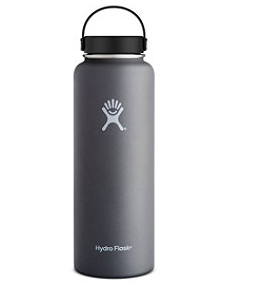
Expensive HydroFlask water bottle, insulated, vacuum.
Credit: LL Bean
My remedy is to start drinking water again, simple as that. I now have at
Reasonably priced, Nalgene water bottle.
Credit: LL Bean
least three eight-oz. glasses before noon and three after. I use spring water to replace the mineral-filled well water. When I first started this regimen, the results were immediate. I felt more alert, energetic, upbeat, and the muscle/joint stiffness—combined with dutiful and targeted stretching—is gradually going away. At least, this is working for me. Your mileage may vary.
I am not a medical professional, but I’ve learned that most seniors tend to walk around in a dehydrated state. Medications, living at high altitude, certain conditions like diabetes, just getting older can all contribute to dehydration. And forgetting to drink.
Easy tips from MedicalNewsToday:
- Drink water, juice or milk at each meal.
- Moderate how much coffee, tea, alcohol you drink. They are diuretics, and, to varying extents, take water out of your body.
- Drink small amounts of water frequently throughout the day.
- Drink small amounts during a workout as well as after to replace what you lose in sweat.
- Consider an electrolyte-type drink.
Final tip: Buy an expensive water bottle so you feel guilty if you don’t use it; keep it full and handy.
If you have symptoms or questions, see your primary care physician.
This Week In SeniorsSkiing.com (Oct. 14)
The Benefits Of Solitude, Grandkid Book Recommendation, Boot Revival.
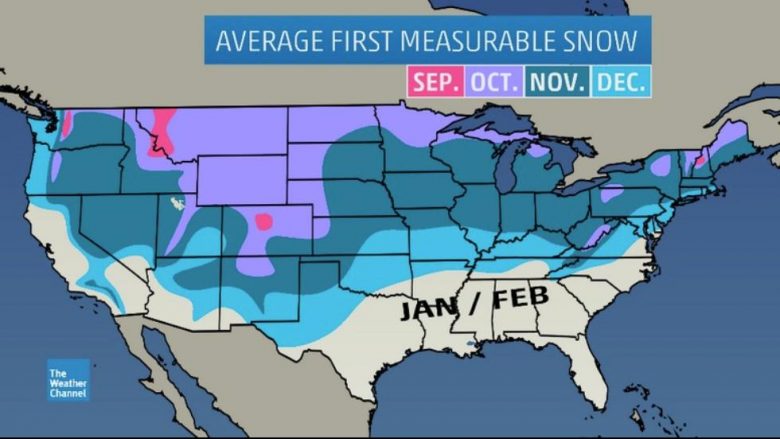
This week we are anticipating a big, big snow fall in the Pacific Northwest coming from a huge cyclone off the coast. And thanks to Snowbrains.com, a really terrific snow sport site, we learn where the snow will accumulate enough for resorts to open first. Here’s the official view from NOAA/NWS. Just a matter of days in some places.
Killington usually vies for being the first in the East. When you read this, we think lifts will be spinning in the Northwest.
Credit: NOAA/NWS. Thanks to Snowbrains.com
XCSkiResorts.com publisher Roger Lohr writes about skiing (or riding in his case) alone. Let’s face it, there are many benefits to flying solo, not the least of which is to contemplate, reflect, and/or zone out into a Zen-like state. Skiing/riding/x-c with friends is one experience; going alone is another. Clearly, there is a time when one prefers being an “ace”. Perhaps more often than not.
Co-publisher Jon Weisberg recommends a cute book for your grandkids, bunny slope, about a rabbit who skis. Adorable illustrations, fun story, something to read aloud on a snowy afternoon by the fire with a youngster or two on your lap. Fun stuff.
Finally, correspondent Jan Brunvand reflects on the re-appearance of rear-entry boots, manifest as FullTiltBoots.com. Perhaps you remember the convenience and comfort of those old Raichle, Hansen, and other rear-entry brands. Well, Full Tilt has bought the Raichle molds, updated the design and is marketing these without much fanfare, it seems. Funny, we just tossed an old pair of re-entry boots in the dumpster. Who knew they are now cool?
Next week we will be bringing you news of a great new asset for our subscribers. Hint: It has to do with skis and seniors and matching the two. Please watch for this really terrific new benefit of being a SeniorsSkiing.com reader.
And tell your friends. Remember, there are more of us every day, and we aren’t going away.
[authors_page role=contributor]