


Flying Solo
Making The Case For Going Alone.
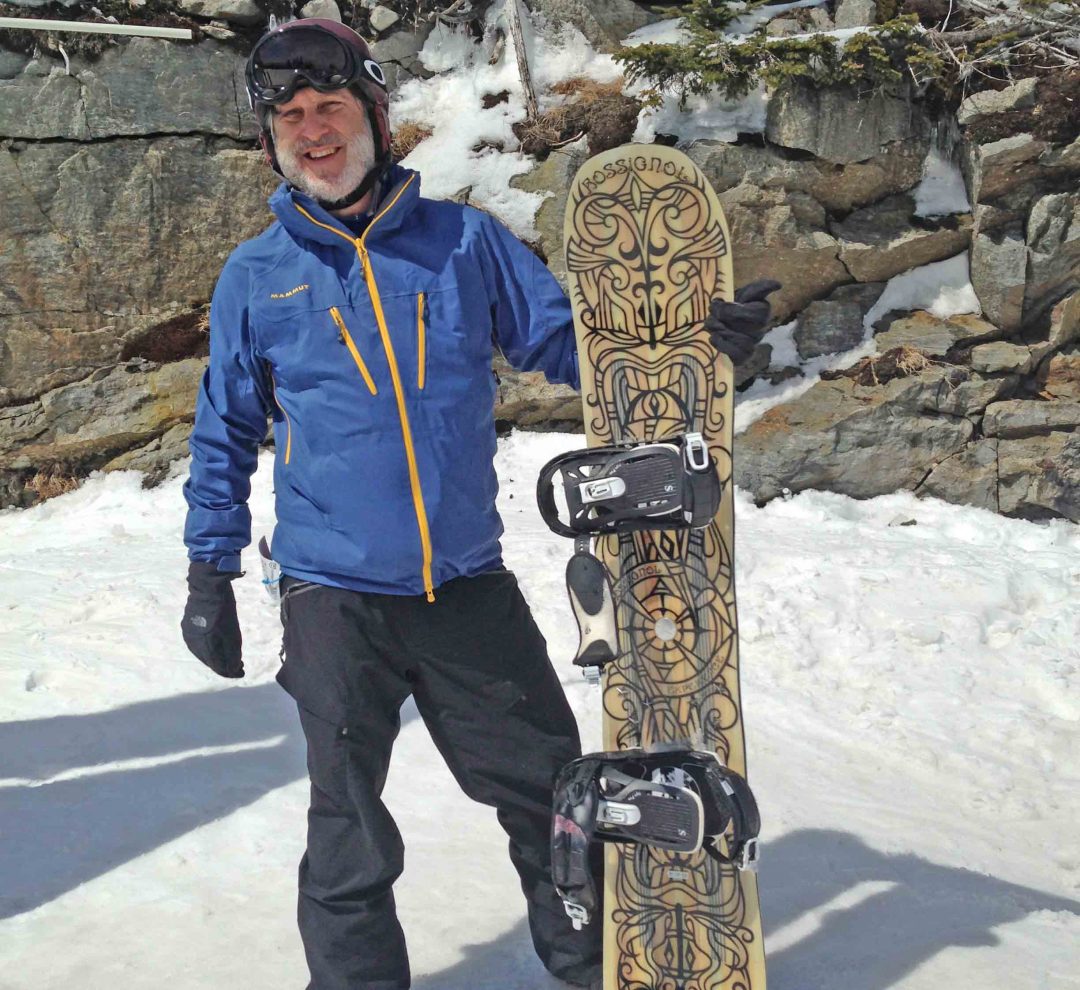
XCSkiResorts.com publisher Roger Lohr likes to go alone, sometimes on the spur of the moment. Anti-social? Expedient?
Credit: Roger Lohr
Ski areas don’t really want to hear about people snowboarding by themselves because they like the multiplier effect of groups and families. At the risk of being called a loner, anti-social, or a follower of the British punk band the Anti-NoWhere League, I can surely admit that I like going SNOWBOARDING BY MYSELF. Self centered? You betcha!
One big benefit of going alone is avoiding the negotiation about the time to leave for the slopes, meeting up, when or if to stop for some food or drink, when to go home, etc. Sometimes, I decide in the morning on a given day that it is just right to be out there snowboarding and within 20 minutes I’m in the car and off to the mountain. It just doesn’t take much time to don the base layer, put in contact lenses, grab the accessories bag, boots, board, jacket/pants and car keys.
Of course, I must disclose that going snowboarding might mean only a 10-minute drive to the closest ski area but it also could be an hour or two to a further destination that has better snow conditions. I also admit that sometimes I like my favorite mountains because they have easier runs or a better lunch selection. And being a writer, going alone allows time flexibility to go snowboarding during the week or any day for that matter. When I go snowboarding with someone else, all of these issues become a group decision.
Getting to the ski area, I get on the chair lift pretty quickly after changing in the car, getting a lift ticket, and hopping on the lift. There is no waiting for any acquaintance with their idiosyncratic snow sport rituals. I’ve streamlined my rituals and I’m happy to practice them every outing.
Always open to meeting people on the chairlift, I’m willing to put my music on pause to have a conversation about anything. Some days I don’t meet anyone willing to chat and there are some other days when I meet someone who I’ll join to do some runs. There’s also the rare occasion when I’ll befriend the person that I meet on the chairlift but, more often, I ride the lift listening to my own tunes, selecting the desired runs, and navigating the mountain as I wish.
Based on momentary whim, I do some warm-up runs, cruise some easy runs, drop in on an occasional dash into the glades, turn on the jets on the groomers, pursue powder stashes, and so on. No discussions, no joint decisions, no concerns about the partner’s prowess, boredom, or whether he/she needs to hit the head. There’s no guilt about how much I’m getting for the value of the lift ticket. There’s no worry about bailing because that day’s snow or weather conditions are not conducive to having very much fun. I like riding in a snowstorm for the freshest powder, or doing runs in the spring time mush, and there’s no concern that perhaps I drove an hour to ride only three runs and decided to leave because I wasn’t feeling it.
Yeah, I like snowboarding by myself.

bunny slopes. Wonderful Book For Grandkids Who Ski.
A Day on Skis with a Bunny Rabbit.
When my daughters were young, I read them to sleep with Goodnight Moon, Animal Cafe, and other terrific children’s books. The words and pictures of these simple stories always delighted, regardless of how many times they were read.
Now that I’m grandfather to four, I actively look for new children’s classics. It’s not easy to find books without too many words, with simple graphics and magical stories.
Last week, I found a new one about skiing that more than qualifies!
The book is bunny slopes. It’s the story of a bunny who likes to ski. The art is deliciously simple, and the book is interactive, in a clever, analog,way
“Oh, It’s you. Want to join me for a ski day?” asks the bunny.
A few pages later he wants us to shake the book to make snow. On the next page there’s snow.

When bunny wants to go downhill he asks us to tilt the book. Soon he’s headed off a cliff and we help bunny recover by turning the book upside down. A bit later, bunny drops into a rabbit hole and tumbles into a cozy den where Mommy serves a cup of something warm.

bunny slopes is written and illustrated by Claudia Rueda, a New York Times bestselling children’s book author/illustrator. It was just published (October, 2016) by Chronicle Books and is also available in French. Cost: US $15.99; Amazon lists it from $5.65 to $11.74.
For skiing grandparents who want to share their love of the sport with the little ones in their lives, bunny slopes is a gem.
Click the short video below for more bunny slopes.
Back to the Future With Full Tilt Boots
Rear Entry Boots For Comfort And Convenience.
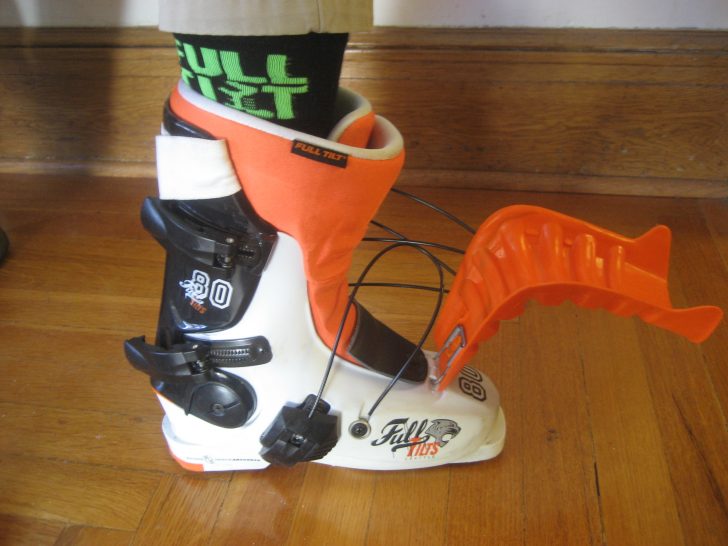
Full Tilt boots: comfort, warmth, convenience.
If you bring up the subject of ski boots among senior skiers, you’re bound to hear someone lament the demise of rear-entry boots or praise the old Raichle Full Flex boots (AKA Flexon Comps). Today when some oldsters need boot horns to get into their ski boots and boot jacks to remove them, these defunct models have a nostalgic appeal.
Rear-entry boots pivoted open from a center point to provide a wide space to insert the foot, while Flexon Comps had a tongue that hinged forward, with wires and clamps to secure them. Neither style won much appeal from ski racers, and instructors talked recreational skiers out of using them, presumably because they were not judged sufficiently stable.
True, Bill Johnson won his downhill gold medal in the 1984 Winter Olympics wearing Flexon Comps, but that wasn’t enough to save the pattern. By 1999 both models were gone.
Some devotees stockpiled the boots. Others turned to thrift shops and Ebay for boots or parts to keep them going. For most skiers these old comfort boots seemed to be gone forever.
Enter Full Tilt boots! Someone had the good sense to buy the original Raichle molds, improve the dynamics of the older models, and re-launch them in the mid 2000s. I never see Full Tilts reviewed or advertised in ski magazines, but you can find all their current boots online at www.FullTiltBoots.com and locate a dealer.
My wife and I own two pair of Full Tilts each and find them comfortable, warm and convenient. My older pair are the original black-and-yellow “Bumble Bee” style, and they even have “Flexon Comp” molded into the back side of the tongue. Nowadays they come in a variety of attractive colors and designs and are popular with freestyle skiers and other hotshots.
Once we met a group of young ladies from a college in Vermont training for freestyle at Brighton, Utah who all wore Full Tilts, so we posed with them for a picture—Grandpa and Grandma flanking the kids, all in colorful boots.
Full Tilt boots have heat moldable liners that wrap around and conform to the shape of your foot. A dealer will heat and fit the boots properly, or you can just warm them with a hair dryer and wear them around the house to get a good fit.
The boots come with a user manual detailing adjustments for liners, cables, buckles and tongues (all replaceable) for setting the forward lean or canting. We’ve never had to make such micro-adjustments; the only changes I’ve made are replacing the exterior heel pads secured by two screws about once a season.
Prices for Full Tilts are comparable to other modern ski boots, but—as with most ski gear—if you look online or check local shops off-season you can usually find some on sale.
I was on a gondola once at Sun Valley with a couple wearing Flexon Comps. I stuck out my Full Tilts for a comparison photo—comfort ski boots, old and new. You gotta love it, seniors!
[authors_page role=contributor]