


This Week In SeniorSkiing.com (Oct. 7)
More Layering Advice, Finding Ski Buddies, And A New X-C Leader Emerges.
Just to get the mind ready, here’s a micro video clip of our friend’s son, Chris Thomas, doing the powder at Steamboat last spring. Hang on folks we are almost there.
Now is the time of the year to be browsing through the ski magazines and websites for new gear and clothing. As we have learned, it pays to be knowledgable about the new kinds of clothing available for outdoor activity. So, tossing on your old waffle-weave long underwear isn’t good enough anymore. We learned the hard way on an insanely freezing day in Quebec when we clearly overdressed and chilled throughly through and through. Pay attention to Vy E.’s update on layering. He’s got some insight into how to do it right.
We are constantly asked by our readers where they find ski buddies. One very clear finding of our Spring Survey 2016 is that senior skiers want to find others to ski with. We have several ideas for how to connect with like-minded seniors in this week’s article. We hope to hear from you about your advice, too. And please use our Forum—SeniorsSkiing.com’s message board—as a way to get in touch with others.
Finally, this week we salute the new Executive Director of the Cross Country Ski Areas Association, Reese Brown. As a new Snow Sports Leader, Reese is poised to make an impact on the cross country world. We know that many of our readers love to go gliding through hills and dales on snow shoes and cross country skis. It’s accessible, affordable, and incredibly healthy for our demographic. Reese is rejuvenating CCSAA’s programs and services to the cross country industry. We look forward to hearing about changes throughout the season.
Coming Up
As we mentioned last week, we are busy at a redesign of our online magazine. We are also planning a very special bonus to our readers: Recommendations for skis that are most suitable for seniors. All of this is in the works and coming soon.
And remember, tell your friends about SeniorsSkiing.com. There are more of us every day, and we aren’t going away.
Layering Redux: More Tips For Senior Skiers
What A Modern Senior Skier Needs To Know About Layers.
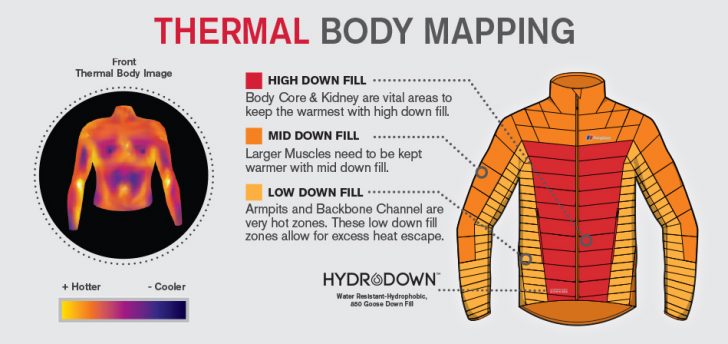
Body mapping clothing–allocating insulation in different zones–is an innovative idea being used by clothing manufacturers.
Credit: Berghaus
[Editor Note: Last September, SeniorsSkiing.com published an article about layering prompted by an unfortunate experience in extremely cold weather when we over-layered and paid the price for it. This year, here’s a list of tips from Val E., our new correspondent who has deep background in the ski industry. He’s bringing us up to date on the new technology view of layering. Here’s his advice.]
Thoughts On Hats, Gloves, Socks:
- A thin skull cap (1/32 inch thick) doesn’t add much warmth to a helmet (which has about an inch of foam). However, a balaclava protects your face, neck areas exposed to cold air.
- Let’s be real, glove liners (very thin gloves made out of silk, wool or synthetic fabric) add very little warmth to a decent pair of gloves. They also separate your fingers if you’re wearing outer mittens. But liners do keep your hands drier by taking moisture off your skin, and, most importantly, they protect your skin from exposure when you take your outer gloves off.
- Socks must be skiing-specific,(i.e., not hunting socks, etc.) made of a synthetic or wool/synthetic combination. And, a ski sock must be knee high, no exceptions. All real ski socks are, anyway. Thicker is not always better, because comfort, staying dry and avoiding blisters are critical. Avoid old school equally thick tube shape socks. And, only one sock per boot! Never use sock liner, no matter what the propaganda says. Feel cold? Get the boot fitting right, install heaters, take a break inside.
Base Layer Thoughts:
- Lightweight (thick as a nylon sock) –For warm weather or people who “run hot”
- Midweight (thick as a cotton t-shirt) –For most conditions or most people
- Heavyweight (thick as a warm flannel) –For cold conditions or people who “run cold”
- Three-quarter base layer pants are relatively new and very practical, because a skier doesn’t need to have pants extend into the boots which can get bunched up and cause comfort and circulation problems.
- Compression base layers (shirts, pants, socks) are becoming more popular. Manufacturers claim they support muscles, improve recovery time, and more. There are skiers who love them and skiers who don’t. Try a pair of compression socks to see what you think. [Editor Note: See our article on Injinji compression toe socks here.]
- These days, some base and mid layers have extended sleeves with so called thumb loops to keep the sleeves in place. Majority of outer jackets on the market have sleeves cut longer than we are accustomed to. You can adjust them with Velcro closures. The idea is to keep the wrist area well covered for people of different height.
Outer Layer Thoughts:
If you ski most of the time in:
- Wet conditions (high humidity, wet snow, rain, wind), then stick to pants and jackets made of the best waterproof/breathable fabric (Gore-tex, Dermizax).
- Dry climate and not very cold conditions with moderate snowfall, you can select clothing made of any breathable membrane fabric.
- Warm conditions with no or limited precipitation, then try a soft shell jacket. These are highly breathable, windproof and water resistant (but not waterproof!).
- Many companies use the idea of mapping insulation or “body-mapped clothing” in mid and outer layers, putting more insulation in the zones, where the skiers need them most. Mapping for women and men is different.
For an in-depth discussion of technical clothing of all kinds, check out this article from the European Outdoor Conservation Association.
And here’s a short video produced by Berghaus on its experiments with body mapped outer layers in Greenland. Worth a look.

Five Ideas For Finding Ski Buddies
Here Are Five Starter Ideas. Do You Have Any More?
 SeniorsSkiing.com’s Spring 2016 Survey revealed a pretty interesting statistic. Half our respondents—49.33% to be precise—were interested in meeting other seniors to ski with. We know that many people drop out of snow sports because their spouse either isn’t able or isn’t interested in winter sports. An alternative to quitting is to find kindred spirits. Here’s an attempt to get some ideas flowing. If you have any other ideas or are a member of a ski club or group looking for members, please go to SeniorsSkiing.com’s Forum and post a comment in the Meet Up/Get Together category.
1) Check the 70+ Ski Club. They specialize in trips but may have knowledge of standing clubs also, based on their experience with their clients. They are a SeniorsSkiing.com advertiser so just click on one of their ads on this page.
2) Next, try the National Ski Council Federation, an association of ski clubs. Look up your state and find clubs in your area. You will get the names of the clubs and the email address of the regional council president who can give you a steer. The Ski Council also offers discounts and other benefits for joining.
3) SeniorsSkiing.com has a Forum for people who want to meet up and get together. Just click on Forum in the upper right in the blue menu bar or click here. You’ll be asked to register. Please give this a try.
4) Get in touch with some of the resorts in the area you want to ski. Chances are, the General Manager or Marketing Director might know of formal or informal groups that get together mid-week. In fact, the resort might sponsor a club of its own like Waterville Valley’s Silver Streaks.
5). Click on over to MeetUp.com, a site that is specifically designed to get people with mutual interests together. You can zone in on your local area or expand outwards, depending on your interests. When we checked, there are lots of opportunities for people to get together for skiing and snow sport activities.
Of course, another option is to show up mid-week at your favorite resorts and look for the guy or gal eating lunch alone. One of the reasons we started SeniorsSkiing.com is because we saw lots of folks having lunch alone in ski lodges on a mid-week afternoon. Say hello, who knows, you might make a friend.
You are certainly not alone in looking for ski buddies. Please let us know what else can work out there.
[authors_page role=contributor]