


CADS: Where Are They Today?
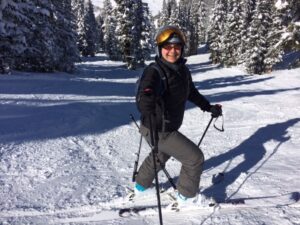
Dr. Jaime Green (circa 2016) wearing CADS.
Riding a chair lift last month, I saw them on a skier below. Ten days later, I saw them again, this time at an area 2,000 miles away.
CADS… Constant – force Articulated Dynamic Struts … the odd looking, butt-to-boots device designed to keep skiers with knee and other lower body strength and stamina issues on the slopes and skiing without pain. Twenty years ago, it was not unusual to see people wearing CADS. Two of my friends wouldn’t slide downhill without them. That was then. In recent years I hadn’t seen anyone on the slopes wearing them.
What happened?
No marketing. No advertising. No distributors, according to Walter Dandy who first imagined CADS in the 1980s while nursing a case of sore thighs riding up a chairlift at Heavenly Valley after a long run in heavy Sierra snow, he had the concept and the vision. In Tony Nespor, he found the engineer he needed to refine the parts for manufacture.
The idea was a simple one: ‘artificial strength’, a way to use upper body weight to stabilize the ski on the snow, like a suspension system in an automobile. And that strength needs to be constant. The answer turned out to be a rubber spring that kept up the pressure steady on the skis. It meant less muscle fatigue, less knee strain, and less lower back strain. .
The pully-like devise looked strange: a rubber spring at the skier’s boot is attached to a string that runs up the back of the skiers legs where it is attached to a harness and waist belt. At the end of a run, it is detached for the lift ride back up the hill. At the top it is then re-attached, which that can take as little at 11 seconds once the skier gets used to the process.
Sure CADS felt strange when first used. But as prominent ski writer Nicholas Howe wrote in Skiing Magazine, “The only strange part comes when the afternoon ends, and my legs feel as if it were still morning.”
Dandy had a prototype of “my contraption” ready to go in the spring of 1987. He approached K-2 but the ski manufacturer indicated it had no money to develop the devise. He then secured interest from George Gillette at Vail and then funding assistance from the ambassador Paul Nitze, an investment banker and former chairman of the Aspen Ski Company. The first sale was to the Dave Gorsuch ski shop at Vail where CADS were introduced to the public.
The early feedback was very solid. “95% of the early people who tried CADS, bought them.” said Dandy.
Ed Blumstein was one of those. The Philadelphia attorney who vacationed at Vail was one of the early users. ” They made me a more comfortable skier. CADS extended my skiing life 15 years.”
The early deal was that buyers would receive a box. Boots and pants would be sent back to Dandy so the device could fitted then returned. There was a money back guarantee if the purchaser didn’t like the product.
Said Dandy: “Only a couple ever came back.”
By the mid-1990s, CADS were catching on not only at Vail and Beaver Creek but also with Izzy Slutsky and Karl Plattner at Hunter Mountain and nearby Windham in New York. Said Plattner at the time: “The two best things ever to happen to skiing were snowmaking and CADS.”
There was other positive feedback too. CADS were accepted early on by orthopedists at the noted Steadman-Hawkins Sports Medicine Foundation in Vail who endorsed the devise. Prominent ski journalists across the country wrote glowing articles. The 1964 Olympic slalom medalist Jimmy Heuga who was diagnosed with multiple sclerosis skied on CADS when he could no longer walk unassisted.
So why with all the positive vibes when they were introduced are CADS not commonly seen on the slopes today?
They are still available to purchase. Today they cost $695 by mail with some assembly required.
‘We sell a handful a year.” says Handy, who still does demonstrations at his home in Vail.
And right now, that seems to be the future too. There is no distributor working the market and CADS hasn’t advertised in 25 years. Seeing the device at work on a slope these days, like I did recently, qualifies as a rare sighting. Handy estimates that there are a maximum of 1,000 people using them today.
What’s next for CADS?
Says Handy: “Maybe I should get in touch with Taylor Swift

New Don Burch Video: Wonderment of Skiing
This week Don Burch brings us A very personal account of what skiing means to him. Enjoy!
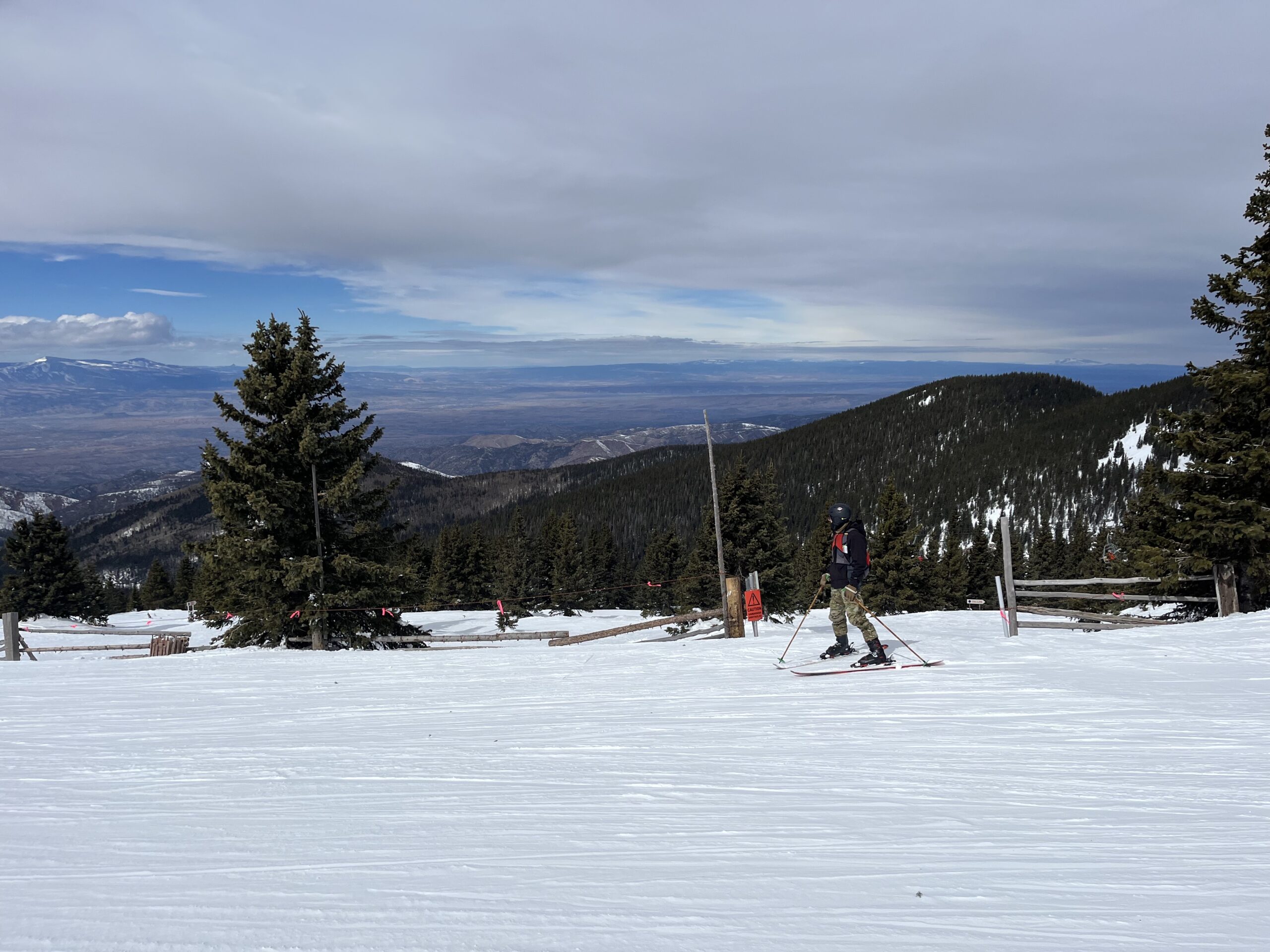
Skiing Ski Santa Fe

View from the top of Gayway
When one thinks of the first ski areas in the U.S., one thinks of Sun Valley or Stowe. Few know that in 1936, in the Sangre de Cristo Mountains east of Santa Fe, NM, Robert Nordhaus installed a rope two to haul people up the slopes of what is now Ski Santa Fe. It was used as a training area for the 10th Mountain Division during World War II.
Ski Santa Fe is about 40 – 60 minutes northeast of New Mexico’s capital, depending on your starting point. Its base elevation of 10,350 feet makes it one of the highest ski areas in the country.
After skiing Ski Santa Fe for three days over the President’s Day weekend. The conditions were excellent, and the lower half of the mountain had a mix of natural and manmade snow.
The trails remind me of skiing in New England, i.e. narrow, sometimes really steep and bordered by large trees. The trail mix of Ski Santa Fe is 40% expert, 40% intermediate and 20% beginner which tells you who skis the mountain. There are many places at Ski Santa Fe, particularly off where you can ski in and around the trees. The North and South Burn trails off the Tesuque Peak Lift are a giant glade with steep to not-so-steep routes through the trees.
For intermediates, there are many wonderful, well-groomed trails. The wide Gayway, from the top of the Tesuque Peak chair, will present an enjoyable challenge. Before you ski down Gayway, stop, and enjoy the view of the Santa Fe Valley. It is simply incredible. Each time I skied the trail, I’d stop to take it in.
On the Presidents Day weekend, there were hardly any lines after 10 in the morning. For next year, a new quad chairlift will be open which will whisk skiers from the base to the top in about four minutes.
While there, I met many locals in their 60s and 70s who were season pass holders. The mix of skiers and boarders ranges from the very young to folks my age (I’m 78).
For those who want to take lessons, the ski school offers a wide range of classes, including those for seniors taught by instructors who qualify as a senior skier. Ski Santa Fe also has an adaptive skier program. All of three of its season passes – God. Platinum and One Pass – have substantial discounts for skier.
The area also has youth and family programs geared to getting youngsters hooked on our sport. While not designed as such, the ticket prices for seniors make it a perfect excuse to go skiing with your grandkids.
Good news for your legs. Except for Lift 2, all the lifts have footrests and safety bars. The bathrooms at the base lodge are on the same level as the slopes AND there’s an elevator to take you between the floors.
More good news. Santa Fe employs a full-time safety team that works to reign in reckless skiers.
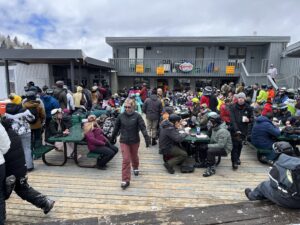
Totemoffs
There are three restaurants on the mountain. One is the La Casa food court in the base lodge, which has a wide variety of very good food. The outdoor Terrace Grill on the second floor of the base lodge has an interesting menu. If you want a real treat, try the cheeseburger smothered with green chilis at Totemoff’s Bar and Grill near the midway station on Chair Two.
One of the joys of Ski Santa Fe is that there is no lodging at the area, so you must drive up. This is both a plus and a minus. The plus is that you get to stay in one of the hotels in Santa Fe and enjoy the excellent restaurants around the Santa Fe Plaza. The minus is that you must drive up, park, carry your skis, boots, and poles to the base lodge, or put your boots on at the car before you walk up. There are lockers in the base lodge for which you need to buy tokens at $2 each.
I’ve saved the best news for last and that’s lift ticket prices. So, if you are between the age of 62 – 71, weekdays are $76, and holidays and weekends are $84 unless you are 72 and older. Then, its $16/day any day!
Net, net, I’ll be back!
Ski Santa Fe by the Numbers
Summit elevation – 12,075 feet
Base elevation – 10,350 feet
Vertical drop – 1,725 feet
Average annual snowfall – 325 inches
Skiable acres – 660
Snowmaking coverage – 55%
Number of trails – 86
Runs groomed daily – 37
Terrain breakdown – Beginner 20%, Intermediate 40%, Expert 40%
Terrain parks – 2
Lifts – 7 – 1 quad, 2 triples, 2 doubles, two conveyors
[authors_page role=contributor]