

This Week In SeniorsSkiing.com (May 13)
Survey Launch, Hiking Boots, Basics Of Fly Fishing, John Christie Passing.
Credit: Jan Brunvand
As we write this, our SeniorsSkiing.com Spring Survey 2016 was sent out just over three hours ago, and we are already approaching a 10 percent response rate. Three Hours! Thank you all so much. We really, really appreciate your support. If you haven’t responded yet, please join the crowd.
This week features Steve Hine’s story on the highlights of picking hiking boots. We went to Steve’s REI store for boots before we hiked the Routeburn Track in New Zealand. Steve’s advice was spot on, and the boots he recommended were fantastic choices for that rugged walk.
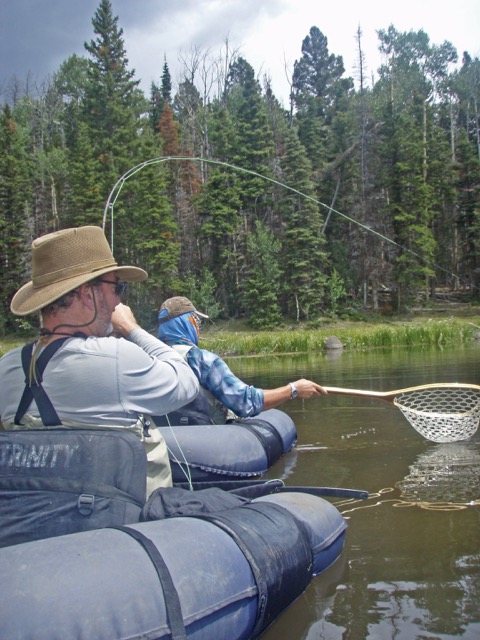
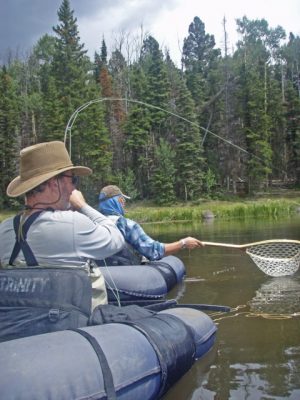
We also hear from Jan Brunvand who is switching from one favorite pastime—skiing—to another. His article on fly-fishing contains some truly wise suggestions for getting involved in this very attractive sport. Anyone can learn the simple basics of casting and fly selection in a few days. However, the intrigue and delight of fly-fishing is learning the sophisticated intricacies and arcana. That’s a long range journey. Careful, you can get hooked very easily.
Finally, the ski world lost John Christie whose presence in the business of running resorts and associations goes back at least five decades. John was a legend in Northeast skiing, founding, owning and managing some of New England’s biggest and well known resorts. We are extremely proud to have published an article in March that John submitted to us about his re-discovery of Nordic Skiing. We are saddened greatly to lose a friend and writer.
Next Week
On we go into mid-Spring. More Cycling Series, more product information, interesting historical glimpses and perhaps an oddity or two about seniors and sports.
Remember to please respond to our SeniorsSkiing’s Spring Survey 2016. And don’t forget, there are more of us every day and we aren’t going away.

The Right Hiking Boot For The Senior You
Balancing The Scales: Hiking Footwear—Comfort vs. Support.
Picking the right kind of hiking boot can make a big difference. It pays to learn the trade-offs between types. Credit: REI
At the shop where I work, questions customers often ask include:
- “I’ve been wearing the same boots for over twenty-five years, is there anything new?”
- “How comfortable should my hiking shoes/boots be?”
- “What’s the boot that gives me the most support?”
- “Which type of hiking footwear protects my ankles best?”
While hiking footwear is no longer restricted to the heavy leather boots we all wore in our younger days, the variety of hiking boots on the market today and the technology in them can help get you back out on the trails quickly and safely.
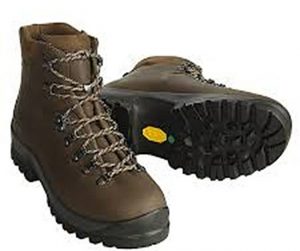
A leather hiking boot is the most supportive, but potentially has some comfort issues.
Credit: Steve Hines
I usually suggest either a lightweight and supportive boot or one of the new “mids”. A mid is a lower boot that instead of lacing above the ankle, laces at the ankle. For those who haven’t hiked in a while or are new to hiking and want to “gear up” a balance of features is best.
In a one sense, the choice between Comfort versus Support isn’t binary. Just because a boot is supportive (rigid across the sole from toe to heel) doesn’t necessarily mean the boot must be uncomfortable. Cushioned mid-soles, improved in-soles, softer grippy outsoles and proper break-in all help a boot balance the scale.
SUPPORT
A supportive boot usually needs more break-in time to become that boot you can wear all day. The best supportive boots are usually made of all leather.
Leather boots come in one of three types or “grades” of leather:
- Top grain – The lightest and most durable, but they must be cared for.
- Suede (split grain) – Resists scratches. However, thicker than top grain can make the boots heavier.
- Nubuck (split grain) –Ages nicely. Again, thicker than top grain can make the boots heavier.
COMFORT
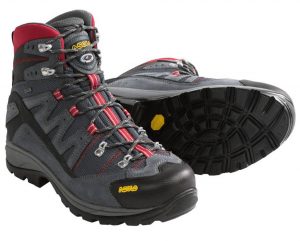
Fabric and leather boots are tipped to comfort.
Credit: Steve Hines
Common belief is that boots which combine fabric with leather pieces are more comfortable right away. It is true that combination boots break in quicker. It’s also true that a poor fitting fabric and leather boot can hurt your feet as easily as a non-broken in leather boot.
When people ask me how comfortable a boot should be I use this scenario: Imagine you are involved in some emergency situation in which you are required to have your boots on for 24 hours. Your boots should be comfortable enough that at the end of the 24 hour emergency you would not be dying to get those boots off your feet.
Seems like the hiking world is leaving heavy leather boots behind, instead opting for light weight, low boots and shoes. When I’m asked which is best I usually try to determine the kind of hiking being done and the level of hiking experience. For instance:
- Terrain – mountain trails, dense woods, higher altitudes
- Climate, season, weather
- Duration of the hike or trip
- Pack weight
In summary, find the right boot for you that will combine the right amount of support and is as comfortable as possible. Remember, a lighter weight boot can have good support and an all-leather boot can be comfortable.
Fly Fishing: Three Ideas For Getting Started
There Are Parallels Between Skiing And Fly-Fishing.
Skiers are attracted to fly-fishing because of the skills, the outdoors, and the lore.
Credit: Jan Brunvand
Ski season is over; what now? Some turn to hiking, biking, tennis, or pickle ball. For me it’s fly fishing.
The pursuit of wily trout with fake insects has things in common with skiing. Both involve exercising in beautiful places, both are great family activities, and both offer satisfying complications of gear and technique.
The daunting details of fly fishing, however, deter many from trying it. How to navigate the complex world of equipment, casting, fish behavior, and aquatic etymology? The challenges are part of the fun, but they erect a barrier for beginners.
You can sample fly fishing without too much frustration. I offer three suggestions.
First, go with a pro, if you can possibly afford it. Nobody learns to ski from the pal who takes you to the top of a run and says “Follow me.” Similarly, you usually won’t get the best introduction to fly fishing from a friend or partner. Hire a guide for your first time out.
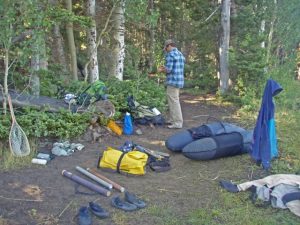
Step One: Hire a guide to show you the basics.
Credit: Jan Brunvand
A guide provides gear, lunch, flies, and coaching. Explain that you are entry-level. Guides know where and when to go, and they want you to catch fish. A day of guided fly fishing is costly, but you’ll get a good start, have fun, and learn if you want to lay out cash on rods, reels, waders, etc.
Even after years of fly fishing, if I’m on new waters or trying a different approach I like to hire a guide the first day.
Second, find a local support system. If there’s a chapter of Trout Unlimited or the Federation of Fly Fishers near you, join. Look for fly fishing classes taught by community colleges or local sports shops. Go fishing and chat up others you meet on the stream.
Third, start to read about the traditions and subtleties of fly fishing. I say “start” because you’ll never finish. For basic information, get The Orvis Fly-Fishing Guide by Tom Rosenbauer. Someday you may acquire top-of-the-line Orvis gear, but for starters buy this affordable paperback.
Even cheaper in its comic-book format is Sheridan Anderson’s The Curtis Creek Manifesto which offers excellent advice in a rib-tickling style. Published in 1976, it’s outdated as to gear, but the fish-catching techniques, including “The Curtis Creek Sneak,” are priceless.
Beyond facts, you want inspiration, so watch the 1992 film A River Runs Through It, and read Norman Maclean’s story that inspired it. Forget about the fancy “Shadow Casting,” though; that’s more Hollywood than realistic.
There’s much wonderful writing about fly fishing, but let’s keep it simple. Google Robert Traver’s “Testament of a Fisherman” and print a copy to ponder. This classic statement consists of one extended sentence less than a page long; it’s packed with emotion, whimsy, and poetry. Traver concludes that he loves the sport, “ . . . not because I regard fishing as being so terribly important but because I suspect that so many of the other concerns of men are equally unimportant—and not nearly so much fun.”
Amen!
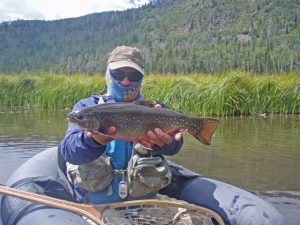
Like skiing, there’s more to fly fishing than just fishing. Traditions, literature and lore abound.
Credit: Jan Brunvand
[authors_page role=contributor]