

Senior Ski Deals for 2026 – The Runners-Up
 Following our recent post Best Deals For Seniors at 124 North American Ski Areas (2026) readers shared a lot of their favorite deals which exceeded our criteria of passes for under $50. With that in mind, here are some of the runners-up. The cost is a little more than our $50 criteria, but our editors thought they are still a good value.
| STATE | AREA | AGE |
| CALIFORNIA | Soda Springs | 60 |
| MINNESOTA | Powder Ridge | 70 |
| UTAH | Beaver Mt | 70 |
| UTAH | Cherry Peak | 70 |
| VERMONT | Bolton Valley | 75 |
| VERMONT | Jay Peak | 75 |
| VERMONT | Mad River Glen | 80 |
| VIRGINIA | Massanutten | 70 |
| WASHINGTON | Stevens Pass | 70 |
| PROVINCE | AREA | AGE |
| ALBERTA | Banff Sunshine | 80 |
| ALBERTA | Nakiska | 75 |
| BRITISH COLUMBIA | Fernie | 75 |
| BRITISH COLUMBIA | Kicking Horse | 75 |
| BRITISH COLUMBIA | Kimberly | 75 |
| BRITISH COLUMBIA | Whistler Blackcomb | 75 |
| ONTARIO | Calabogie Peaks | 80 |
While not intentional, this list may contain incorrect or out of date information. As ski season gets into full swing, some of these passes may no longer be available at super low prices or not available to purchase again until the spring.
We encourage readers to email corrections subscriptions@seniorsskiingmedia.com.
Five Things You Should Know When a Skier Crashes

Publishers Note: It is with great sadness that we learned of the recent passing of one of our most popular contributors, Harriet Wallis. This is one of her many important articles we are republishing this season.
“Stop! Don’t do that. Don’t move him”, I screamed.
My husband had misjudged the slope, crashed, and landed in a heap in the middle of the trail. He was also out cold.
We were skiing with his good buddy Lars when it happened. Lars skied to him and dragged him by his right arm until his body flattened out. Meanwhile, I was screaming at Lars to stop. But he didn’t stop.
By the time I side-stepped up the hill to the scene, Lars said, “I had to straighten him out. He looked so uncomfortable.”
Unconscious skiers are not uncomfortable – they are unconscious, and anybody who moves them before Ski Patrol arrives can make an injury worse. That’s likely what happened to my husband.
X-rays showed his shoulder was broken. Surgery and hardware repaired the bone, but fragile nerves might have snapped when he was dragged by his arm. We’ll never know.
The bone healed, but the nerve damage was complete. My husband has never again had use of his right arm. It was dead.
If Lars had some basic knowledge about what to do, it might have turned out better.
I talked with Mark Pollish, a career patroller and 40 year veteran of the Alta Ski Patrol, for some guidelines that we recreational skiers should heed in case of an accident.
Do No Harm
First of all, he said, when you come upon an accident, “Do no harm.”
When somebody crashes, “Don’t rush into the situation and become part of the problem. Whether it’s a ski crash or an accident on the highway, think extreme safety. People are quick to want to help, but don’t do anything that might jeopardize their safety or yours.”
The next guideline logically follows “Do no harm.”
Do Not Move the Person
“Do not move the person. That includes do not remove their skis. You don’t know what the injuries might be. There could be spinal injuries and moving the person could make it worse,” he said.
It doesn’t matter whether the skier or snowboarder is awake or unconscious. Don’t move them.
Just last year, I listened to two skiers awarding themselves kudos because they thought they were heroes. They saw someone fall and not budge, so they rolled him around and propped him up because he looked “so uncomfortable” He was unconscious through it all, and he was still unconscious when Ski Patrol arrived. Moving him could have caused serious damage. We’ll never know.
The first two guidelines focus on what you should not do. These next three are what you should do, Pollish said.
Make an X with your skis.
Take off your own skis and drive the tails into the snow forming an X well above the accident. Or, if you ride, plant your board upright in the snow. It warns others to stay clear of the area and also marks the location of the incident.
Call the patrol and stay on the phone with them.
Whether you are at your home mountain or visiting a resort across the country, it’s a good idea to have the patrol’s emergency number in your phone so you can reach them quickly, Pollish said.
At some ski areas, the main number is the best way to get connected to the patrol. At others, the patrol might be reached through 911. It varies from resort to resort, so it’s best to find out before you need to call for help.
Then be sure to “stay on the phone with the patrol” Pollish said, and give them “as much information as possible: location, description of the person, and what you know about the.situation.”
Finally, stay with the downed skier until the patrol arrives. You might be able to provide additional information that they need, he said.
Think safety. Ski safely.
Now, are your ready for a pop quiz? What are the 5 things you should know and do when a skier crashes?
Are You a Safe & Responsible Skier/Rider?
While safety on the slopes is important every day of the season, January is National Ski Safety Awareness Month, a good time to remind ourselves about our responsibility to ourselves, family, friends and the strangers with whom we chair the slopes.
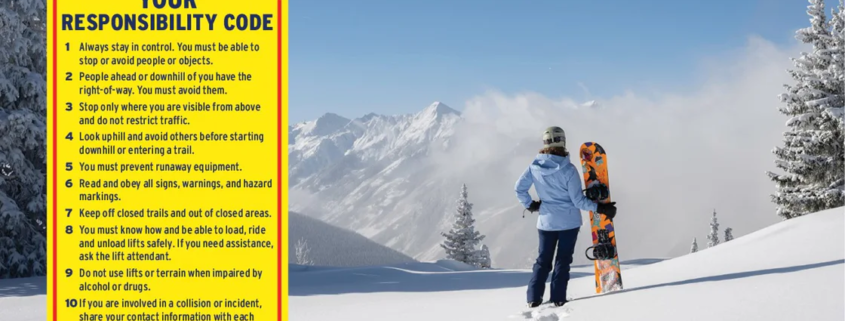
You may already be familiar the ten points of Your Responsibility Code. You probably have seen it posted on slopes somewhere, instantly recognizable thanks to its bright yellow signage and reminders posted throughout US ski areas.
The Code has been in use since 1962, when it was developed by the National Ski Areas Association (NSAA). In the last 60 years, the Code has undergone revision to stay in step with modern language and skiing behavior.
The Code covers ten points:
1. Always stay in control. You must be able to stop or avoid people or objects.
2. People ahead or downhill of you have the right-of-way. You must avoid them.
3. Stop only where you are visible from above and do not restrict traffic.
4. Look uphill and avoid others before starting downhill or entering a trail.
5. You must prevent runaway equipment.
6. Read and obey all signs, warnings, and hazard markings.
7. Keep off closed trails and out of closed areas.
8. You must know how and be able to load, ride and unload lifts safely. If you need assistance, ask the lift attendant.
9. Do not use lifts or terrain when impaired by alcohol or drugs.
10. If you are involved in a collision or incident, share your contact information with each other and a ski area employee.
There are a couple of other safe practices I use, and you should, too.
Maybe these also will be included one day to an update to the Code –

Courtesy Colorado Ski Country
· Always lower the safety bar on a chairlift, for everybody’s safety.
· Be nice to lift attendants and to ski patrollers, who work long hours in the cold to help ensure that you are safe and enjoying yourself. Also to employees in ticket sales booths, restaurants and the front desk of your hotel or condo.
· Slow down around beginners and kids.
· Remember where you parked your car and also your skis.
· Share photos on social media only of skiers and riders practicing slope safety, to encourage others to enjoy the sport we love.
See you on the slopes – safely – during National Ski Safety Awareness Month and all the other months of ski/snowboard season.
[authors_page role=contributor]