

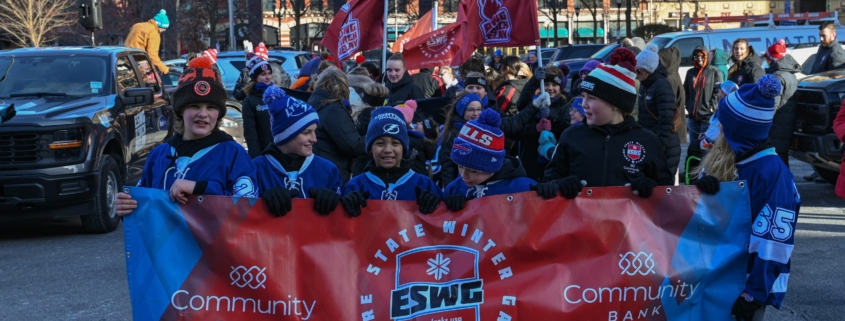
Empire State, the Other Winter Games
 Just as the XXV Winter Olympics in Milano Cortina Italy are set to begin February 6, some 2,500 athletes, coaches and officials will be wrapping up four days of competitions in Lake Placid and surrounding communities in the Empire State Winter Games, the largest and oldest continuous multi sports winter event in the US. This year there are 176 events in 16 disciplines on the schedule.
This is the 46th edition of the New York based winter games which began in 1982 and have been held every year since, except 2020 when they were curtailed due to COVID. This year there will be competition in 21 sports, including adaptive, using the modernized Olympic venues in Lake Placid and nearby community sites. Some of the sports will have age group competitions. (more than 150 seniors are expected to compete this year.)
There are 30 states that host Olympic style multi-sport events like the Empire State games. But most focus on warm weather competitions and the others with traditional winter sports limit those to figure skating and hockey. New York is the only one with a menu that includes bobsled, luge, skeleton, biathlon, cross country skiing and ski jumping.
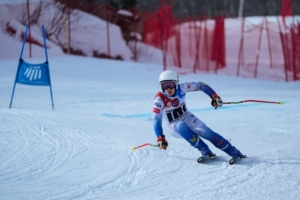 The New York games are not a seat of the pants operation. A 400-mile torch relay starting in Buffalo kicks off the event in Lake Placid with the lighting of the flame at the opening ceremonies. All participants receive branded outfits before the opening, and there are medal presentations after each event.
The original Empire State Games were first held in the summer of 1978. The Winter Games were added four years later. Most of the participants are from New York State but that is not a requirement. Since the games began, more than 35 of the athletes have gone on to become Olympians, 12 of whom have won Olympic medals, including Nordic Combined gold medal winner Billy Demong and two-time alpine medalist Andrew Weibrecht.
Before his first Olympic medal in the Super G in 2010, Weibrecht was a three-time Empire State Games participant, competing as a teenager in the alpine events in 2003, 04 and 06. “It was my first multi-sport competition” he recalls. “It was a lot of fun meeting athletes from all the other sports.”
Turns out it is also a shared experience in the Weibrecht family. As an athlete, Andrew competed against brothers John and Ethan in alpine events. His wife Denja, daughter of former Olympic ski Jumper Jay Rand, also competed in the games and last year, the oldest of their three children Ada, then 9, participated in ski jumping.
Today, Weibrecht, as a manager at the family-owned Mirror Lake Inn in his hometown of Lake Placid, sees The Empire State Winter Games from a different perspective. ” It is a great winter event. With all the athletes and their families, it brings a special energy to town between the Martin Luther King holiday and President’s Week.”
The games almost became just a sports footnote a dozen years ago. Funded for many years through New York’ s Parks and Recreation Agency, the financial crunch of 2008-9 forced the state to withdraw funding for the event. While the summer games were cancelled, officials from the Lake Placid Visitors and Tourism Bureau – now ROOST -spearheaded a campaign to raise private funds to underwrite the winter games. It worked, and the games have been underwritten by corporate sponsors since 2010.
The Empire State Winter Games this time will kick off Thursday Feb 5 and wrap up four days later Sunday Feb 8. In addition to the traditional events program shared by the Winter Olympics, there will be competition in ski orienteering, winter triathlon, snowshoe sprints and relays, and most popular for adaptive athletes: sled hockey.
You won’t see the Empire State Winter Games on network television in prime time. But some of that same competitive spirit and enthusiasm that we’ll be watching in Italy will once again be on display in Lake Placid just days before.
First You Make It, Then You Save it
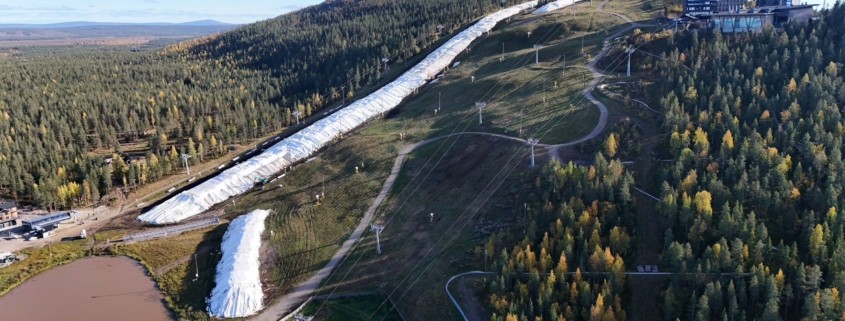
Credit: Levi Ski Resort
If you’re an alpine skier, you are familiar with snowmaking and know it is vital for resorts and surrounding communities in order to sell tickets and meals and beverages, fill beds, provide jobs, generate taxes and so much more.
Snowmaking is less of a given at cross country areas in the U.S. and Canada, although it present at roughly 70 sites, with the number increasing each year. The most extensive XC systems are generally at venues hosting World Cup and Olympic races, such as Soldier Hollow, UT; Canmore, AB; Mt. Van Hoevenberg, NY; Whistler Olympic Park, BC.
But there are other Nordic operations which have made major investments in snowmaking, including Ariens Nordic, MadNorSki and the Birkebeiner trails in Wisconsin; Forbush Corner, MI; Tahoe Donner, CA; several private schools and colleges with XC teams in New England; and clubs like Caledonia Nordic inBC; Bridger Ski Foundation, MT; and Nakkertok Nordic, QC.
Curiously, few XC operations owned by alpine ski areas have added substantial snowmaking.
Evolution of XC Snowfarming
Once upon a time, “snow farming” in the cross country ski world meant doing what you could to keep whatever falls from the sky. Back in the early 1970s, when I got in the business of designing and maintaining trails, that often meant simple, logical, ongoing, but time-consuming measures. These generally included routing trails to optimize snowfall; removing protruding rocks; trimming overhanging conifers; cleaning up debris after a storm, etc.
A few sophisticated venues would improve surfaces with grass or wood chips; snowfencing to take advantage of wind-created drifts for later re-distribution; mitigation and re-routing for wet areas where melt and ice were concerns, using culverts, adding fill when possible; bridges with railing and kickboards to prevent “bleeding” off edges and allow melt to drain off; removing encroaching brush, etc.
Not elaborate measures, but manpower-intensive. And of course, we would shovel snow onto the trails. So we learned the value of packing and “age-hardening” through machine-grooming snow from the moment it fell.
In the West, the drought winter of 1976/77 and another miserable season in 1980/81 made us more conscious of weather vulnerability. By then, Eastern and Midwestern operations in the U.S. and Canada were well aware that once-predictable winters would be interspersed with periods of melt.
XC Snowmaking
Over the years, XC snow-saving technology has evolved to include man-made snow. The earliest snowmaking I can recall was Weston Ski Track in the mid-1970s (they are still going strong), on a golf course near Boston.
There were some additional areas, but Nordic snowmaking has become relatively frequent only in the past dozen years or so. Olympic sites seem to be the primary exception, with Canmore Nordic Centre probably the earliest, around 1988, and Soldier Hollow in 2002.
Several of these sites include professionally designed trails with snowmaking. Trail planner John Morton of Morton Trails in Vermont has often combined the two. Some of Morty’s projects are Ariens Nordic; Rikert Ski Touring Center, VT (Middlebury College); Oak Hill, NH (Dartmouth College); Dublin School, NH; and Kents Hill School, ME.
Snowmaking companies increasingly see XC as a significant if smaller-than-alpine market.
The Next Step: Keeping What You Get
The basic principle is that when you have enough snow (preferably man-made stuff because of its density/longevity), your priority is to coddle it. Rain, sunshine, warm temperatures, and especially wind can wreak havoc on piles of snow that could otherwise prolong the ski season.
Roughly 20 years ago, XC operators in Europe – especially those involved with early season high-level races – started using wood chips and sawdust to preserve snow throughout the summer. This often meant that you could open some trails when your neighbors were still sighing about the weather.
Craftsbury Nordic in Vermont, Canmore Nordic Centre in Alberta, and Whistler Olympic Park, BC, have used wood products to protect piled man-made snow between closing in the spring and opening in the fall.
The three goals of starting operations on an early, predicted date are hosting events, providing on-snow training opportunities for individuals and teams, plus drawing recreational skiers. This timing can be vital to both ski operations and their local economies.
Most Federation International du Ski (FIS) and International Biathlon Union (IBU) XC race venues already use woodchips and/or sawdust. Chips a couple of feet deep insulate very well (summer loss is as little as 12%), but they have a number of drawbacks – growing cost, longevity, disposal, dust and debris rising to the surface, separation from snow in the fall, acidifying soil, leaching runoff, etc.
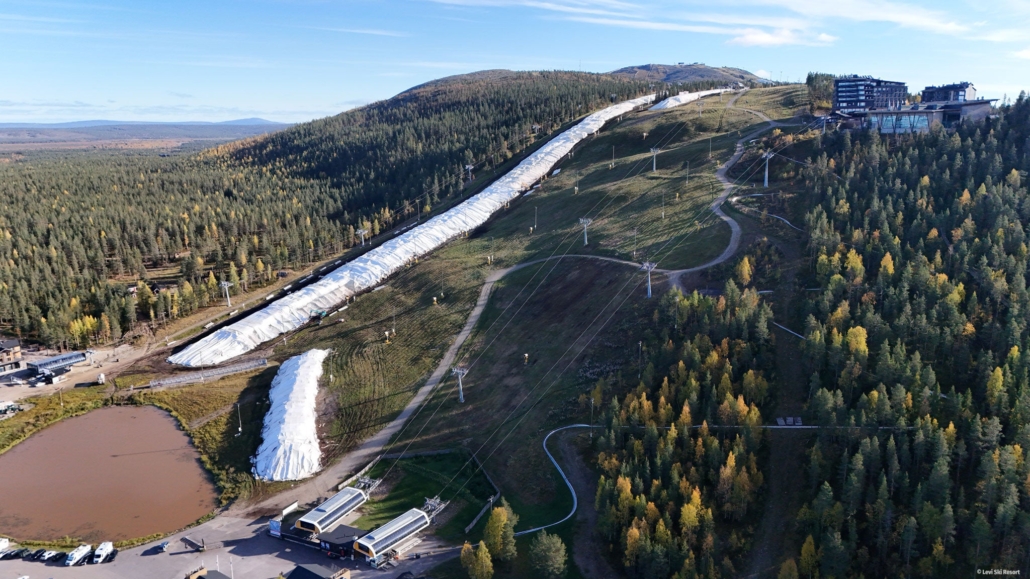
A Finnish company, Snow Secure, has developed white extruded polystyrene blankets that are now being used in Europe for both alpine and XC and has been honored for its resilience and sustainability. (Full disclosure: Snow Secure is one of my clients and we are introducing it to XC areas in both the U.S. and Canada, with Soldier Hollow, UT, our first customer.) Currently, they are working with four alpine resorts in North America, including Sun Peaks, BC and Bogus Basin, ID.
Shapes for snow piles are tailored to the site. Ideally, the snow piles are made when temperatures are coldest in winter, providing dramatic savings in water and energy usage as opposed to snowmaking in the fall; packed into layers; and covered with foam mats. At XC World Cup venue Ruka in Finland, there are three piles configured like bread loafs, each about the size of a football field – around 220’ x 110’ x 25’ high and pretty formidable looking. That’s about 14,000 cubic meters of snow when produced in the winter.
It generally becomes a lot more dense while stored, say 10,000 cubic meters by the time it’s uncovered in autumn. When spread out in the fall, this can translate into roughly 3 kilometers of trails covered by snow 1’ deep by 20’ wide. These synthetics provide effective insulation in temperatures as warm as 100 °F, even when venues such as Ruka have perpetual summer daylight.
Their stored snow is good quality for spreading, grooming, and skiing, although the system is not quite as efficient as wood chips for preserving snow. The materials are durable and long-lived (10+ years). Installation and uncovering the snow is swift and simple, then it’s spread. Instead of eventually heading to a landfill, like wood products, the materials can eventually be collected, then can be routed to recycling or energy recovery.
The Future of Snow Storage
Complexities include cost, finding a convenient summer location for the piled snow, and winter storage of the insulating materials. But the word is getting out that there’s an option to losing vital parts of early season operations. I predict that in the next few years, we’ll see at least a half-dozen more North American XC areas – more and sooner for alpine resorts – that adopt snow storage as a case of “Can’t live without it.”
Three Days to Change Your Life
All the Grandkids
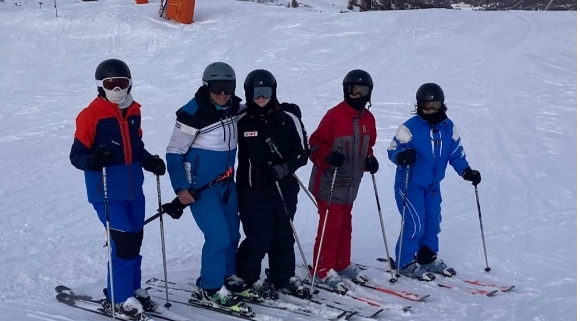
We live in crazy times. This year’s family ski trip in December would be different. I would take three of my teenage grandchildren skiing, “sans parents.” I had taken one of these kids skiing before and she was a competent skier. The other two were starting their lives as skiers. We planned to visit Serre Chavelier in France, a large ski resort spread along a valley connecting four towns. The area has 250 kms. of trails, 80+ pistes, mostly red, and 60+ modern lifts. We choose to stay in the small village of Chantemerle in the middle of the area.
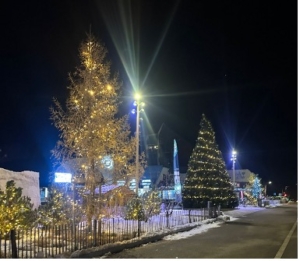
The hamlet of Chantemerle is compact, maybe a quarter of a mile from end to end. Our apartment, the ski rental store, the gondola going up to the skiing and central commercial area were all within a five-minute walk. We started our adventure at the ESF, (Ecole de Ski Francais). I wasn’t sure how fast these kids would progress, so for starters, I booked three days of private lessons; two hours in the morning and an hour after lunch. We met our ski instructor and I handed over the kids, confirming where I would collect them at the end of the lessons, and off I went with my other grandchild taking advantage of some new snow on the red runs. We all met up for lunch at one of the restaurants near the gondola and then back to ski school.
Christmas Market Chantemerle
The next day we were joined by my son and two more grandchildren; our group got bigger, but our ski school program remained intact. The two beginners were in ski school and the rest of us were skiing the resort. On the afternoon of the third day, I met the kids and the ski instructor, thinking that maybe I should add another day or two of lessons, but to my amazement the ski instructor thanked me for the three days of private lessons and told me the kids were making nice parallel turns and she told me to enjoy our remaining stay in the resort. That was it! Our whole group took another run to initiate our new skiers into the family ski team. Up we went on the lift but I wasn’t sure how we would get down. To my great surprise these beginners skied down really nicely, making the turns and keeping in control on blue and red runs.
Three days, that’s all it took. What would have taken two or three weeks fifty years ago, is now accomplished in nine hours of ski lessons; hardly any snowplows, no stem Christies, no heel pushes, just skiing naturally and turning the skis. For these kids, this was any easy introduction to the world of skiing. Skiing will be an integral part of the rest of their lives. Three days can really change your life in unexpected ways.
[authors_page role=contributor]