


Snow In Literature: An Old Man’s Winter Night
By Robert Frost
All out of doors looked darkly in at him
Through the thin frost, almost in separate stars,
That gathers on the pane in empty rooms.
What kept his eyes from giving back the gaze
Was the lamp tilted near them in his hand.
What kept him from remembering what it was
That brought him to that creaking room was age.
He stood with barrels round him—at a loss.
And having scared the cellar under him
In clomping there, he scared it once again
In clomping off;—and scared the outer night,
Which has its sounds, familiar, like the roar
Of trees and crack of branches, common things,
But nothing so like beating on a box.
A light he was to no one but himself
Where now he sat, concerned with he knew what,
A quiet light, and then not even that.
He consigned to the moon,—such as she was,
So late-arising,—to the broken moon
As better than the sun in any case
For such a charge, his snow upon the roof,
His icicles along the wall to keep;
And slept. The log that shifted with a jolt
Once in the stove, disturbed him and he shifted,
And eased his heavy breathing, but still slept.
One aged man—one man—can’t fill a house,
A farm, a countryside, or if he can,
It’s thus he does it of a winter night.
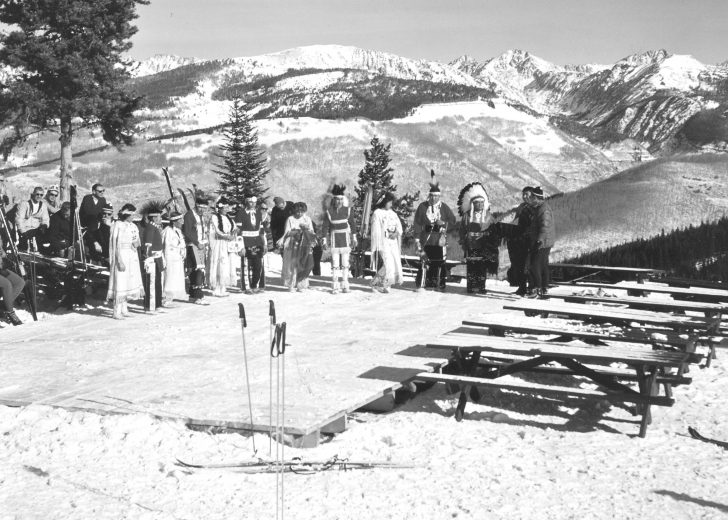
Mystery Glimpse: Divine Intervention
Special Times On The Mountain Top

Here’s another challenging picture from the Colorado Snowsports Museum. Something is going on, obviously, on this mountain. What’s happening? Who arranged it and for what purpose? When? Take your best guess down in the Comments box below.
Last Week

This magnificent photo was taken in 1952 at the Alta ski area. It is part of the Alf Engen Ski Museum’s Ray Atkeson collection. Ray Atkeson (1907-1990) was a photographer best known for his landscape pictures of the American West. Many of Atkeson’s alpine photos were taken before chairlifts were even invented, which meant carrying heavy camera equipment through deep snow and mountain terrain.

Ray Atkeson, Alta. Credit: Alf Engen Ski Museum
Needless to say, Atkeson was an intrepid professional, committed to capturing the beauty and majesty of the world around him and sharing it with others. Best said by his wife Doris, Ray’s “greatest joy was sharing the beauty of these places with people who would never go there.”
For more on Atkeson, click here. Many thanks to the Alf Engen Ski Museum, Park City, UT., for contributing this photograph.
70s Ski Testing: Political Fall Out
Advertisers Or Readers?
Ski testing in the early 70s challenged SKI magazine’s leaders in ways they didn’t anticipate. While our readers loved the reviews and wanted more, we were careful about what we wrote.
A huge proportion of SKI Magazine’s income came from advertisers. Our publisher regularly reminded me that ad revenue dwarfed what came in from subscriptions and special events.
However, readers showed up in ski shops with ski reports in hand asking questions that the shop personnel couldn’t answer nor could the manufacturers’ reps. Skiers wrote to us asking for data on skis that weren’t reported.
Right away, the question “do we print a bad report?” came up. Space limitations limited how many skis we could cover and only printed “good” reports.
SKI was accused by some manufacturers of destroying a whole year’s worth of marketing with our reports. Several challenged our results and methodology, but, after seeing the details, were satisfied with its accuracy that reflected what they already knew or suspected.
We offered to bench test and ski prototype new products, and many took the magazine up on its offer. Again our data proved to be accurate.
Unfortunately, we became the whipping boys of the marketing people. Our response was to only sell skis that performed was met with cold stares.
Pressure mounted because several manufacturers threatened to reduce their spend with the magazine unless we gave their skis “good” reports. John Fry, Ski Magazine’s editor in chief at the time, refused in a battle that was well above my pay grade.
In the end, SKIpp debunked three “sacred truths” of ski design at the time:
- Myth – ski core determines performance. The truth – the core is nothing more than a form around which the materials that affect the performance are mounted;
- Myth – Side cut determines how well a ski carves. The truth – side cut has little to do with how well a ski carves but does affect the rate of turn (remember, this was long before the shaped skis of today); and
- Myth – Material A is better than Material B. The truth – it is how the materials properties are combined into the ski’s flex pattern, damping and resistance to torsion that determines how well a ski performs not the materials themselves.
Forty-four years later, after running one of the most innovative ski testing programs in the industry, my 73 year-old legs still have some calibration left and if you gave me a row of unmarked skis covered, I’ll bet I can name the brand after two runs.
Now, I rent skis because I don’t want to schlepp them on airplanes, and, because most ski shops have a selection of high performance skis, you can swap out on a daily basis. This way I can play ski tester every time I ski. So, some things never change.
[authors_page role=contributor]