

I Thought Skiing in the US was Becoming Increasingly Risky, Then I Went to France!
Photo by Boris Misevic on Unsplash
Last season I was fortunate to be skiing in the French Alps. One day I was skiing a crowded feeder trail to a lift and was about 200 yards from the maze. As I was making my way down, using the eyes in the back of my head I saw a snowboarder on an intercept course with me. Within seconds he was threatening my space. As he closed on me, I instinctively resorted to my defensive tackle days and gave him a straight arm to avoid an impact. He fell. I stopped and asked if he was OK. He said yes and apologized for nearly hitting me. I saw this scenario repeated over the week I was there. In fact, one afternoon while having lunch I couldn’t help but notice that about every 20 minutes or so, the ski patrol was bringing another person down in a sled escorted by a snowmobile. The rate of injured skiers seemed as steep as some of the trails there.
Of course, not everyone in France skied like a nut (in fact, French skiers in general were quite courteous). But every day, on every run there were skiers heading straight down the trail at excessive speeds, making no turns and never, ever saying ‘on your left” or “on your right”. They just flew by you in a flash. Our guide told us, for reasons he didn’t understand, teaching that particular safety rule had fallen out of vogue. It shows.
Seniorsskiing.com is a proud supporter of Snow Angels, an organization that promotes skier safety and Ski Guardians, a company producing a safety device consisting of banners on your poles that help you claim the space immediately around you as you ski down the mountain. Of course, they have their work cut out for them here in the US but if they saw what I saw in France they would cover their eyes and cringe.
There is no doubt advancements in equipment have made skiing safer. Skis are now designed to be more stable, enabling skiers to maintain control and allowing them to carve turns more efficiently and reach higher speeds. When combined with crowded slopes, this can be a recipe for disaster. Even skilled skiers may have difficulty reacting in time to avoid a collision in such conditions. Design innovations in ski bindings, which release more effectively during falls, help prevent leg injuries, particularly ACL tears (There was a time when a boot-top break was the #1 ski injury.) Helmets are now considered essential gear, significantly reducing the severity of head injuries. Despite these improvements, accidents still occur at an alarming rate, leading some to question whether other factors are offsetting these advancements.
Given the popularity of the corporate resort passes one undeniable change in the ski industry is the increasing number of people hitting the slopes at the same time. Resorts are experiencing higher visitor numbers, leading to more crowded conditions. This congestion can result in a higher risk of collisions, especially when skiers of varying skill levels share the same slopes. Beginners may struggle to control their speed and direction, while more experienced skiers may weave through crowds at high speeds, increasing the likelihood of accidents.
Climate change has also played a role in ski safety, altering snow conditions in ways that make skiing riskier. Warmer temperatures and erratic weather patterns have led to a more unpredictable snowpack, increasing the chances of avalanches and unstable skiing surfaces. Ice patches, slushy snow, and thinly covered areas with hidden rocks or tree stumps all pose hazards to skiers, making falls and injuries more likely. Moreover, inconsistent snowfall patterns mean that ski resorts rely more heavily on artificial snowmaking. While artificial snow can provide coverage, it often creates a harder, icier surface than natural snow, increasing the likelihood of high-speed falls and injuries. Skiers who are accustomed to powdery snow may struggle to adjust to these conditions, further contributing to the risk factor.
Data on skiing injuries provides mixed insights into whether skiing has become less safe over time. While overall injury rates have remained relatively stable, the nature of injuries has changed. Fatal accidents, often linked to high-speed impacts or avalanches, continue to occur, though at a low frequency relative to the total number of skiers. Head injuries have decreased due to increased helmet use, but severe leg injuries, including fractures and ligament tears, remain a concern.
Some studies indicate that collision-related accidents have become more common due to crowded slopes and high speeds. Additionally, backcountry accidents have seen a rise as more skiers venture off-piste without adequate preparation. Despite safety advancements, these emerging trends suggest that skiing’s risks are evolving rather than diminishing.
So, is skiing becoming less safe? Unfortunately, the answer is not straight forward. Here are some current statistics on ski safety in the United States:
- In the 2022–2023 season, there were 46 fatalities, 37 of which were skiers. The common cause? Excessive speed, loss of control, and collisions with stationary objects.
- Snowboarders are 33% less likely to be killed in a crash than skiers.
- Most fatalities occur on more difficult “intermediate” terrain.
- More men are victims of skiing accident deaths than women.
- Skiing and snowboarding have similar injury rates. There are about 1.2 injuries per 100,000 participants and around 2-3 injuries per 1,000 skier days.
- Fractures are the most common injury, followed by strains and sprains.
- Fatalities from chairlift and aerial ropeway mechanical malfunctions are rare.
Some studies show a significant rise in ski-related emergency room visits over recent years, indicating a potential trend towards more accidents. Approximately 200,000 skiing and snowboarding related injuries are treated in US emergency rooms annually. While most skiers with injuries are discharged the same day roughly 7,000 or 1% of those cases requiring hospitalization each year.
For skiers looking to stay safe, the key lies in awareness and responsibility. Choosing appropriate slopes, wearing protective gear, following resort safety guidelines, and avoiding reckless behavior can help mitigate risks. While skiing will always carry an inherent level of danger, mindful decision-making and respect for safety measures can help keep the sport as safe as possible.

How Okemo saved Thanksgiving

photo credit: Harriet Wallis
Publishers Note:
It is with great sadness that we learned of the recent passing of one of our most popular contributors, Harriet Wallis. This is one of her many wonderful articles we are republishing this season.
“Quick. Look over there. Do you see what I see?”
The fog was as heavy as a wet blanket. I’d already been driving for 3 hours and most of it was in the pea soup as I headed north up the Connecticut River Valley. High beams were too much. Low beams weren’t enough. Just stay on the road.
Destination: Killington, Vermont.
We left home in Connecticut in the middle of the night with the intention of being first on Killington’s slopes. It was the late 1970s, and Killington was the only New England ski area that was open – on just a few trails on the top of the mountain. We’d have to ride several chairlifts to get to those trails. We built in extra time for that, but we hadn’t expected heavy fog and slow travel.
It was the first Thanksgiving that I was a divorced mom. The three of us – Craig, 12; Alison, 10; and I – agreed that it wouldn’t be any fun sitting around a turkey by ourselves, so we decided to start a new Thanksgiving tradition. Let’s go skiing!
That’s where we were heading. It was vaguely becoming daylight as I left the fog-bound interstate and headed north on 2-lane roads toward Killington. Fog was thinning a bit, but I still had a white-knuckle clench on the wheel. I was beginning to wonder if we’d get to Killington in time to make the long drive worth it.
Waves of fog continued. Horses looked over pasture fences and exhaled plumes of frosty breath. Little farm houses appeared ghostly and then quickly dissolved away. The images were magical, but we wanted to get to the slopes.
Just beyond Ludlow, the wispy curtains of fog opened for a moment and we saw snow guns blasting snow at Okemo.
“Quick. Look over there. They’re making snow!”
It was still another hour to Killington, but I needed a break. I drove to Okemo and we took a look. Snow guns were pounding the beginner slope – and skiing was free for anyone who dared to ski it.
Skip Killington. We’re here. Let’s ski Okemo’s beginner slope. The price was right and the drive was over. The snow guns turned us into frosted doughnuts on every run. We crinkled from our wool hats to our ski boots, and we had to chip the ice off each other after every run. But we’d started our new ski on Thanksgiving tradition.
What’s New in New Hampshire for the 2025/26 Season
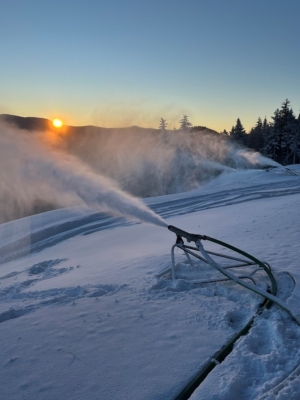
Sunrise 2024 at Bretton Woods Credit: Ski NH
New Hampshire’s ski areas were hard at work this summer adding new lifts and upgrading technology and snowmaking, to create an even better than before experience for skiers and snowboarders.
Here’s what’s new this season from our friends at Ski New Hampshire, the statewide association representing more than 30 alpine and cross-country resorts. Alphabetically, of course, since that’s the only fair way.
Bretton Woods will debut the new Bethlehem Express Quad II (BEQII), a four-person Leitner-Poma detachable quad. Its installation also includes a redesigned base area layout to ease congestion and improve safety.
The resort also is unveiling a new black diamond glade on Mount Rosebrook. This never-before-skied, steeper section features tree runs and cliff elements between the Upper Swoop and Upper Express trails, giving advanced skiers and riders exciting new terrain to explore.
Cannon Mountain retires its iconic tram, with plans in motion for a next-generation replacement – but that will be next season, 2026/27, not this one, and invested more than $200,000 in new pipelines and tower guns.
This season, guests will notice new roofing on the Notchview and Brookside lodges, fresh paint on the Peabody, Notchview and Brookside buildings and Peabody lift terminal, as well as new lighting, flooring, stair grips, and fans in the Peabody Lodge. There’s also new digital signage in Peabody.
Cranmore Mountain Resort is introducing Arctic Light Tubing, New Hampshire’s first glow-in-the-dark nighttime tubing adventure with lights and music. This experience will be available every Friday, Saturday, and Wednesday night throughout the season.
Dartmouth Skiway’s Master Plan has an ambitious goal of becoming the nation’s most sustainable ski area, featuring all-electric automated snowmaking, expanded glades, and a new Learning Center.
Great Glen Trails has widened several trails, which will reduce tree debris, leaves, branches, and blowdowns on the trail and result in improved skiing conditions.
King Pine has transformed its Evergreen Room into a multi-use event space featuring a custom bar, handcrafted post-and-beam ceiling, updated dance floor, and upgraded A/V systems. This follows recent improvements including the addition of a rooftop deck, which provided expanded base lodge outdoor seating, and a ‘magic carpet’ uphilllift at the Tubing Park.
Loon Mountain Resort will begin work this winter on New England’s first pulse gondola to connect the hotel to the base. There’s also new conveyor belts, or “magic carpets’ at Sasparilla Learning Center for safe, easy uphill transport for children and beginners. The resort also doubled its snowmaking capacity on North Peak. Loon has also added another Ford Lightning vehicle to their lineup, bringing them to five EVs in total – the most of any ski resort in the East.
Pats Peak will introduce the Hurricane Quad, a SkyTrac fixed-grip lift with a loading conveyor and enhanced loading zone for improved efficiency and guest experience;
Waterville Valley Resort will unveil a new MND Ropeways T-Bar, expanding uphill capacity and access to terrain for training programs, athletes, and recreational skiers and riders. And, they
upgraded night skiing operations with energy-efficient LED lighting,
Whaleback Mountain is adding a new surface lift serving Lower Spout, the racing trail, as well as Canyon, Scrimshaw, and new connector trails.
Snowmaking and Sustainability
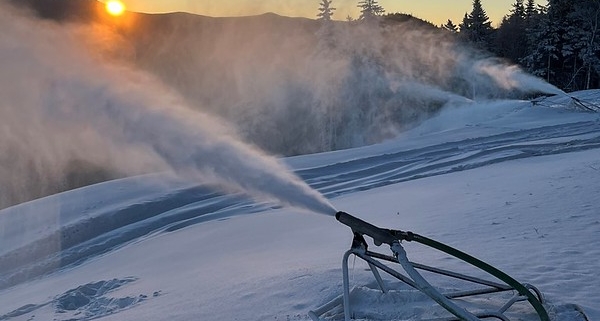
Snowmaking is energy-intensive, but advances in technology are making it more efficient than ever. Today’s systems allow areas to produce more snow with less energy while using smart monitoring tools to optimize when and where snow is made. This summer, several New Hampshire resorts made major snowmaking investments.
Gunstock Mountain Resort installed 24 new HKD Impulse tower guns and Klik hydrants to boost efficiency. Snowmaking upgrades also were made at Ragged Mountain Resort and Tenney Mountain.
Nordic areas also continue to benefit from expanded snowmaking capacity. Jackson XC and Great Glen Trails both added new snow guns at their cross-country centers this summer.
Energy efficiency efforts extend beyond snowmaking.
Cranmore Mountain Resort and Loon Mountain Resort have each added the PistenBully 600 E+ to its fleet—the cleanest and quietest snow groomer in its class. With its Tier 4 engine, the E+ reduces fuel consumption, noise, and CO₂ emissions by up to 20% while allowing staff to cover more terrain, faster.
Ski New Hampshire is the statewide association representing 30+ alpine and cross-country resorts in New Hampshire. For more information on ski areas, trail conditions, vacation planning, and updated events at Ski New Hampshire resorts, visit SkiNH.com.
For statewide travel info, go to VisitNH.gov.
See you on the snow!
[authors_page role=contributor]