


Pay Me to Ski Here

Photo by Claudio Schwarz on Unsplash
Sadly, conditions are far from knee-deep in several top resorts in the West and in Europe, where it’s limited terrain on man-made snow. That includes Cortina, site of 2026 Winter Olympics skiing competitions.
The lack of natural snow is bad enough that the parent company of the Ikon Pass is offering passholders a $20 “mountain credit” for each day the pass is used, through Feb. 25, at areas most affected, according to the ABC News affiliatte TV station in Denver.
But don’t too excited –
The money back offer from Alterra is good for only three days of skiing or riding at specific resorts, for a grand total of $60.
That’s enough for a white tablecloth lunch for two, a day’s rental, a tune and waxing, or $60 off new helmet, goggles, jacket or pants at a retail shop.
So it barely puts a dent in the price of your pass, airline ticket or accommodations.
Also, the up to $60 credit is only at specific Ikon Pass resorts and participating restaurants and retail shops, including Deer Valley, Steamboat, Palisades Tahoe, Mammoth, Stratton and Sugarbush.
So, this brings up an interesting issue:
Resorts charge a premium for accommodations during peak periods, especially the Xmas-New Year’s week, and several limit access for some passholders, whether that’s Ikon, Epic or Mountain Collective season pass – regardless whether conditions are great or pathetic. And some privately-owned areas, such as Powder, limit peak weekends to passholders only, no walk-ups.
So why can’t they give us a discount when conditions suck? Or a free hot chocolate when the weather is suitable only for polar bears. Or add another day or two to the allowable days on a pass, to compensate for two days of skiing the only three open trails, all greens from the base, as I experienced in mid-December at two adjacent resorts – one Ikon, one Epic – which I might identify over an apres beverage somewhere.
Hoping for a lively discussion here, with lots of comments.
Drop the Still
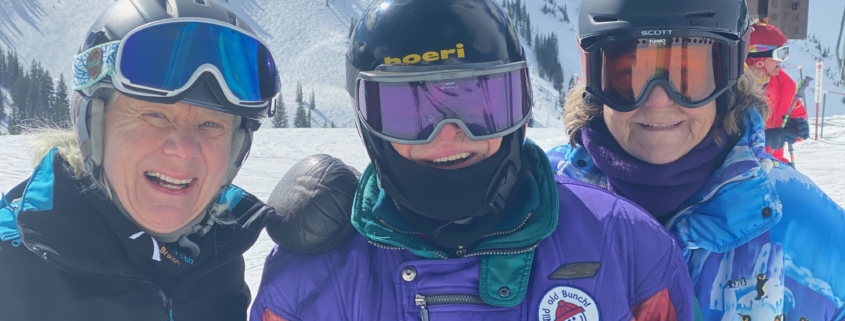
Alta 2022, Cherri, George, & Marianne
There are certain words that are at best—annoying. “Still” is one of them. Not kind to say to a mother, “So your daughter is still single?”. To the very pregnant woman, “You still haven’t had that baby?” Or to the frugal guy, “I can’t believe you are still wearing that parka!” OUCH was my reaction to a recent email from a young guy, who I thought viewed me as an inveterate skier. He asked, “Still getting out there?”. By return mail, he now knows he is in semantic trouble. I am on a personal mission to educate people, one at a time, to just drop the “still”. Never let the ask, “Do you still ski?” come from respectful lips.
This campaign is not about my daughter, expectancy or my wardrobe. It is all about my/ our age and ageism. It seems there is a commonly-held belief that skiers reach an age and, presto—they no longer ski. So not true. I recall the winter I joined the Seventy Plus Ski Club where all the members have at least celebrated that milestone. I did two outings with the club including a week in Utah skiing six mountains with 140 hearty skiers and boarders. I was on the younger end of the spectrum but, thankfully, held my own. It was a 103 year old man who stole my heart and gave me hope and incentive to hang in there for many years to come. At Alta, where he was treated as a celebrity, we skied a great run. When he glanced to the left and spotted a strip of powder, he was off! His 72-year old son was quick to reprimand him and I was fast to make a note to remember to leave my kids at home.
At my home Vermont mountain, Sugarbush, there is designated front row parking for 80+ year olds. Bravo to the resort for the recognition and provision to make it a bit easier. Don’t use the “‘still” word with all the racers on the course or in the woods who are well over seventy—they have earned and deserve better. The fact that most resorts have upped their ages for reduced price or free skiing is evidence of skiers/boarders staying with their sports for longer and longer. Win Smith, the former resort owner, then in his 60”s, instituted “The Boomer Pass” allowing weekday skiing at a great price.
Maybe you have to ski in the boots to recognize we are ageless if we love the sport and stay fit. While we may appreciate some considerations, it is best realizing we are tough and determined. We feel fortified when we are perceived as just another constantly-working-on -our-technique person out for fun, companions and exercise. Maybe it is our task to educate people who don’t get it by calling them out on the use of “still” with “Why do you ask me that?” The defensive responses are usually worth the effort! Teach on!
Snow Going: Safety Tips for Winter Driving
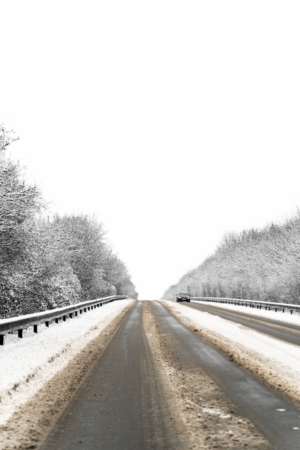
Photo by Krzysztof Hepner on Unsplash
If you were driving in the massive winter storms which ravaged much of US in January, you already know about the stress and dangers of driving in snow, ice, black ice and low visibility or blizzard and white-out conditions. If not, these rules of the road in winter will help prevent spin-outs and accidents driving on snow, ice and other foul weather conditions, including white-outs.
More or Less
More – Winter driving requires more space between you and the vehicle ahead, more attention to changeable road conditions, more attention to the speedometer, and more time to get to your destination safely.
Less – Winter driving also requires less speed on icy or slick roadways, less dependence on such safety features as lane departure warnings, even cruise control.
Kitty litter is less expensive and more available than packaged rock salt to help get you out of a wheel-spinning nightmare.
It’s Essential
Do not drive unless absolutely necessary.
Leave roads clear for snowplows and emergency responders to do their jobs, including saving the lives of those injured in storm-related driving accidents.
If road conditions are not in good shape, consider postponing non-essential travel until roads are cleared.
If you must drive, be prepared in case you become delayed while traveling, especially if it’s a long trip. That means making sure your gas tank is full or your EV or fully charged – also your phone – along with snacks, water, a blanket, emergency flares and a working flashlight.
Consider leaving early or later to avoid being on the road during the worst of the storm.
Even if you have GPS, familiarize yourself with directions and maps before you go, and let others know your route and anticipated arrival time.
Winter driving is stressful, so take breaks. Stop to stretch, get something to eat, check your phone, and change drivers if you feel drowsy.
Smart Stuff
Don’t think you or your vehicle can outsmart the basic laws of physics.
The bigger your vehicle and the faster you are traveling, the more distance you will need to stop.
Expect to need as much as ten times more distance to stop in bad weather, even with such high-tech safety features as automatic braking (ABS).
If your vehicle is not equipped with adaptive cruise control, which brakes automatically when you get too close to the vehicle ahead, don’t use cruise control at all. You’ll have better control manually.
Easy Does It
Everything takes longer on icy and snowy roads, so accelerate and brake gently to maintain traction and prevent skidding out of control.
Today’s ABS brakes require that you jam on the brake pedal as hard and fast as you can, and keep your foot down firmly, to activate the system.
The grinding noise tells you tells you the ABS is working. Let it keep grinding – do not let go thinking you have broken something.
Release the brake when you need to steer, since the vehicle can do only one thing at a time. You are not good at multi-tasking, and neither is your vehicle.
Watch the Thermometer
Temperatures right around freezing are especially dangerous, because wet snow and ice are more slippery than the frozen solid variety.
Most dangerous of all is so-called black ice, which is a thin veneer of ice on an otherwise dry road. It is not visible, which makes it so dangerous – no different than hitting a patch of ice on the slopes.
The safest snow to drive on is the kind that crunches under the wheels. That tells you the snow is firm enough to provide traction in starts and stops.
Avoid Changing Lanes
You are more likely to lose control trying to drive over that build-up of snow or slush between lanes than if you stay where you are, says the AAA.
Tires, Windshields and Frozen Locks
Make sure tires are properly inflated, and never mix radial tires with other types of tires.
Rotate tires according to manufacturer’s instructions.
You’ll be using a lot of cleaner to keep the windshield clear of road salt and grime.
Never use plain water, unless you want a coat of ice that’s all but impossible to defrost.
Also, never use water on a frozen lock. Instead, use a quick blast with a hair dryer, a quick squirt of 10 W 40, or a commercial lock de-icer.
Steering Out of a Skid
Forget that confusing old rule about “steer into the skid”. It’s much easier than that – just look where you want to go and steer to get there.
Smoothly and slowly, please, since quick and jerky steering can worsen the skid.
Both ABS and traction control require a firm grip on the steering wheel, advises Edmunds.com. Not white knuckle, just firm.
It’s important to remember not to brake and steer at the same time, because you are asking the car to do too many things at once.
Brake first, and when you feel ABS kick in, then steer – gently.
Traction control holds back spinning wheels and allows the engine’s power to switch to the wheels that have a better grip.
ABS reduces what automotive engineers call “pedal travel” and provides a more constant braking feel, so ABS requires firm, constant pressure – no pumping as on conventional brakes.
In fact, you need to jam on the brakes as fast as you can and as hard as you can – and keep your foot there – to engage ABS.
Don’t be scared off by the grinding noise – that means ABS is working.
Drive safe this winter – and see you on the slopes.
[authors_page role=contributor]